
The World Bank continues to rate Vietnam as the fastest-growing economy in the East Asia-Pacific (EAP) region, thanks to high-tech manufacturing and exports, public investment, and foreign direct investment (FDI). However, inflationary pressures, import concerns, and risks from the AI supply chain remain key issues to consider.
Benefit from the wave of AI investment.
On October 6th, the World Bank released an updated report on the East Asia and Pacific region's economy, raising its forecast for Vietnam's economic growth in 2026 by 1.1 percentage points to 7.4% – the highest in the region.
According to the World Bank, Vietnam's economy will grow by 8.02% in 2025 and accelerate further to 8.3% in the first half of 2026, leading the EAP region. Manufacturing, exports, and public investment are the main drivers of this growth.
In the first eight months of 2026, merchandise exports increased by 22% year-on-year, with electronics and machinery continuing to play a core role. In August alone, merchandise exports increased by 26% year-on-year.
The World Bank also noted that investment in the electronics and machinery sectors remained positive, while FDI inflows in the first half of 2026 reached their highest level in the past five years.
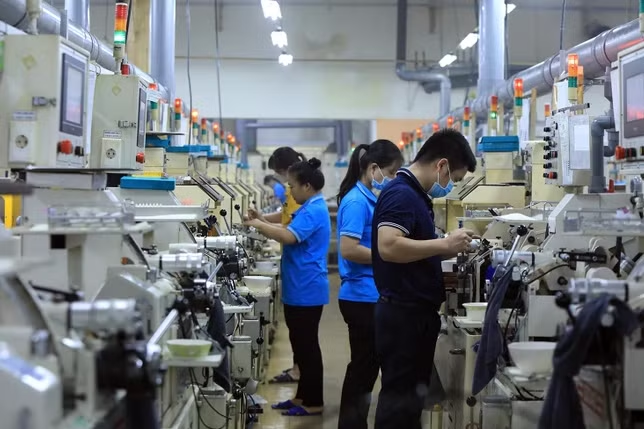
Notably, Vietnam is increasingly integrating into the technology supply chain, with artificial intelligence (AI)-related products contributing significantly to export growth. This is also why Vietnam has the largest upward revision to its 2026 export forecast in the EAP region.
According to the World Bank, the global surge in AI investment is creating more room for economies to participate in the technology supply chain. China, Indonesia, Malaysia, the Philippines , Thailand, and Vietnam exported a combined total of approximately $1.4 trillion worth of AI-related goods in the 12 months ending April 2026.
In this supply chain, Vietnam holds a notable position in the equipment assembly stage. Computers, servers, and routers account for approximately 60% of Vietnam's AI-related exports, with a significant portion destined for end-user demand in the United States.
Besides exports and manufacturing, public investment continues to be a crucial driver. The World Bank stated that the public investment plan for the 2026-2030 period continues its upward trend, focusing on key infrastructure such as energy, transport, and logistics, aiming to raise total investment to 40% of GDP.
However, the World Bank forecasts Vietnam's growth to slow slightly to 7.3% in the next two years (2027 and 2028). Even so, the 1.1 percentage point upward revision to the 2026 forecast makes Vietnam the country with the strongest growth forecast upgrade in the region.
Inflation and imports are key areas to consider.
Despite improved growth prospects, World Bank experts also warned of several pressures on the Vietnamese economy, primarily inflation.
According to the report, inflation rose from 2.53% in January 2026 to 4.89% in August, mainly due to increased fuel, housing, and utility costs. The World Bank forecasts average inflation for the whole of 2026 at 4.2%.
Meanwhile, imports are growing faster than exports. According to the World Bank, this development partly reflects businesses accumulating electronic inventories, along with rising chip and fuel prices.
Notably, Vietnam's oil import bill has increased sharply. Along with the rising import bill, interventions to stabilize domestic gasoline prices have contributed to a decrease in foreign exchange reserves. The World Bank projects that Vietnam's foreign exchange reserves in 2026 will be equivalent to less than two months of imports.
From a long-term perspective, the World Bank notes that Vietnam's increasing reliance on AI supply chains also creates a new type of risk.
Franziska Ohnsorge, the World Bank's Chief Economist for Asia, believes that whether Vietnam's double-digit growth target marks the beginning of a new phase of development or is merely a short-term goal will depend heavily on fluctuations in the external environment.
According to Franziska Ohnsorge, Vietnam is one of the most open economies in the world , and is heavily reliant on participation in AI-driven value chains and development. Therefore, if the global growth trend driven by the AI wave continues, Vietnam will be in a favorable position. Conversely, the economy could be vulnerable if global economic activity slows down.
Overall, the World Bank assesses that Vietnam is clearly benefiting from its position in high-tech value chains and the wave of AI-related investment. Along with public investment and structural reforms, these factors are laying the foundation for a significantly improved growth outlook in 2026.
However, inflationary pressures, rapidly increasing imports, declining foreign exchange reserves, and the risk of a reversal in global AI demand are factors that Vietnam needs to monitor in the coming period.
Source: https://baotayninh.vn/ngan-hang-the-gioi-kinh-te-viet-nam-tang-toc-nho-xuat-khau-cong-nghe-cao-va-ai-158023.html