

With over 3,000 km of coastline and numerous major cities located along coastal economic corridors, many localities have formed important centers for tourism, trade, industry, and services. The new legal framework creates opportunities for effectively exploiting coastal space, improving urban quality, and mobilizing resources for development.
Placing coastal cities within a regional connectivity network.
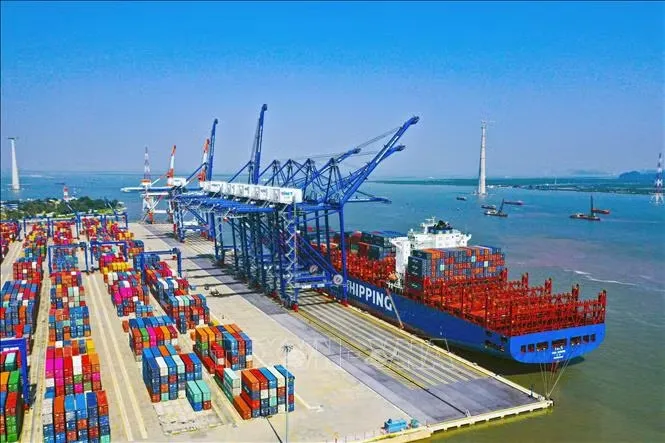
For a seaport to function effectively, it needs a comprehensive logistics system, including roads, railways, distribution centers, and accompanying production areas. Photo: VNA.
Resolution 20-NQ/TW on building and developing Vietnam into a strong maritime nation identifies the sea as a strategic development space and a driving force for growth, while also requiring the development of the marine economy based on science and technology, innovation, digital transformation , and environmental protection. Simultaneously, the recently passed Law on Urban Development by the National Assembly further refines the legal framework for planning, investment, and development of urban systems towards a synchronized, modern, green, and climate-resilient approach.
These guidelines lay the foundation for coastal cities to be viewed not only as population centers or tourist destinations, but as a link in the national maritime economic structure and urban system. According to experts, the advantages of coastal cities lie not only in their proximity to the sea, but more importantly, in their ability to connect the sea with the inland areas.
For a seaport to function effectively, it needs a logistics system, including roads, railways, distribution centers, and accompanying production areas. Industrial zones require human resources, housing, and services. Tourism needs airports, transportation, public spaces, and high-quality service systems.
Dr. Nguyen Van Dinh, Chairman of the Vietnam Real Estate Brokers Association, believes that coastal urban development needs to be placed within a comprehensive, long-term, and inter-regional plan, avoiding rapid but localized development. The marine economy has a significant ripple effect on trade, logistics, transportation, tourism, and many other service sectors. Therefore, coastal cities must be planned in a way that allows these sectors to support each other.
In fact, this direction is becoming clearer in some localities. Da Nang, for example, has advantages in tourism, services, its airport, and seaport. The development of Lien Chieu port and its logistics system is expected to help the city expand its role from a tourism center to a regional trade and logistics hub.
In Khanh Hoa, the urban cluster of Nha Trang , Cam Lam, Cam Ranh, and the Van Phong area creates a multi-centered development structure, combining tourism, services, seaports, logistics, and industry.
Similarly, Quang Ninh is also strongly developing a multi-sectoral marine economic model. The Quang Yen coastal economic zone is oriented to become a multi-sectoral marine economic center, linked with industry, trade, tourism, services, and port systems, while also forming modern, smart cities...
From the perspective of a National Assembly representative, Associate Professor Dr. Tran Hoang Ngan believes that Vietnam has a great advantage in terms of its coastline and needs to exploit this advantage strategically, linking urban development with seaports, logistics, and economic centers. Focusing on the sea and strategically developing the marine economy is an opportunity to create strong momentum.
"The key point is that planning thinking needs to shift from individual cities to a network of coastal cities. One city can take on the role of tourism, another as a seaport and logistics hub, and yet another developing industry or services. When connected by appropriate infrastructure and mechanisms, the overall picture will create far greater value than separate development," Mr. Ngan analyzed.
Accordingly, a strong coastal city doesn't necessarily need to have the most projects, but rather needs to create the most economic linkages.
From scenic advantages to green economic drivers
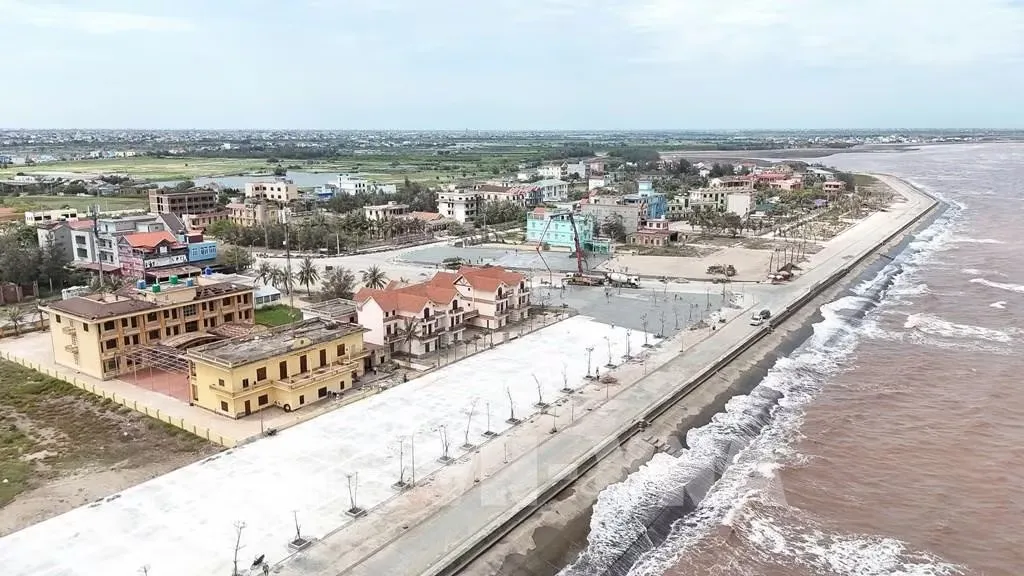
The coastal tourism area of Giao Ninh commune is preparing for comprehensive infrastructure investment. Photo: Cong Luat/TTXVN.
A major challenge for coastal cities is avoiding over-reliance on tourism and real estate development. The sea can generate greater value if it is simultaneously exploited for logistics, maritime services, high-tech industries, clean energy, the digital economy, and emerging economic sectors.
Resolution 20-NQ/TW sets the goal of developing the marine economy in a modern, green direction, based on science, technology, and innovation, while also requiring the sustainable use of resources, protection of the marine environment, and improvement of the quality of life for coastal communities. This is also a direct requirement for the urbanization process.
Coastal cities will need to invest more heavily in drainage systems, wastewater treatment, public transportation, green spaces, flood control infrastructure, and structures capable of adapting to extreme weather. If construction is expanded without upgrading infrastructure and the quality of urban services, the advantage of being a coastal city could become a burden for the city itself.
Government Resolution No. 01/NQ-CP on the main tasks and solutions for implementing the socio-economic development plan and state budget estimates for 2026 also sets out the task of researching an urban development program for the period 2026-2030; in which the orientation is to build a number of modern coastal cities based on ecological, green growth, and smart models, linked to sustainable tourism development and adaptation to climate change.
According to Associate Professor Tran Hoang Ngan, the development of the marine economy needs to be accompanied by appropriate planning and a thorough assessment of environmental impacts. This is a condition for localities to both exploit their advantages and ensure long-term development potential.
Meanwhile, Resolution 21-NQ/TW, issued by the Central Committee on July 28, 2026, outlines the viewpoints and orientations for amending the Land Law and related laws, adding requirements for improving the efficiency of land resource utilization and increasing the synchronization between land planning and urban and regional planning. This is of significant importance for coastal cities, where the demand for infrastructure development, housing, services, and economic spaces is ever-increasing.
New policies are creating a broader development framework for coastal cities. The next challenge lies in the ability to concretize the plan, select the right economic sectors with advantages, and create mechanisms for public and private resources to participate together.
If done well, coastal cities can become new growth poles, connecting the inland economy with the maritime space, and creating momentum for the entire region instead of just developing individual localities.
Thu Hang
(Reported by VNA)
Source: https://btgdv.cantho.gov.vn/vi/news/bien-gioi-bien-dao-viet-nam/lam-chu-khong-gian-de-tro-thanh-quoc-gia-bien-manh-bai-cuoi-do-thi-bien-don-co-hoi-thanh-cuc-tang-truong-moi-4689.html