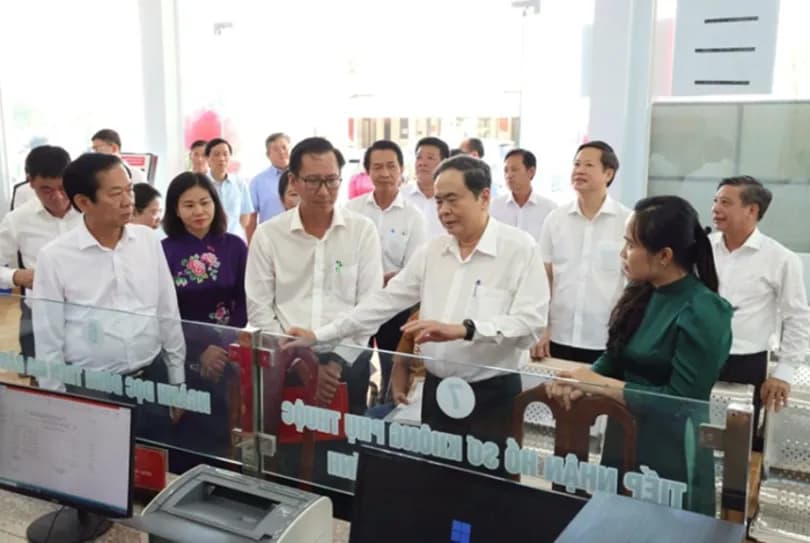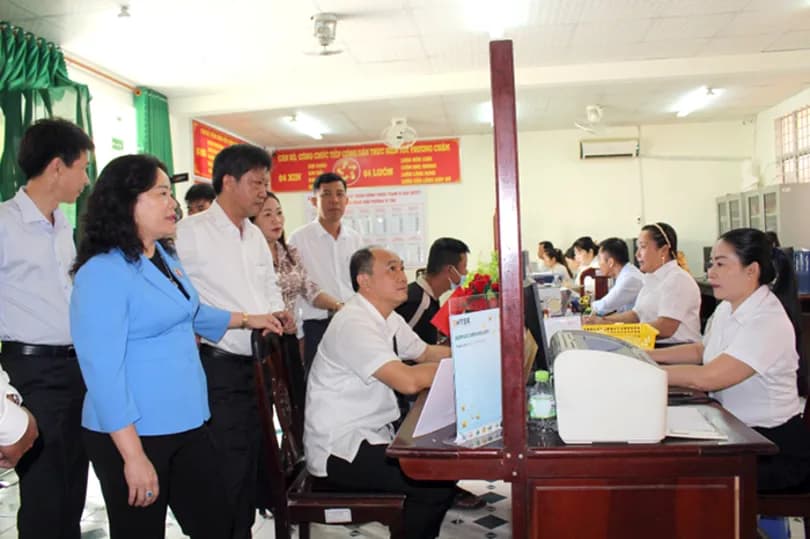

As the area expands, the workload increases, and demands from the people grow higher, the question is no longer how "streamlined" the system has become, but rather how a less cumbersome workforce can still handle the ever-growing workload. At the grassroots level, behind the seemingly "smooth operation" lies a pressure that is not easily visible.
One official - many "hats"
Concerns about the capacity of the grassroots administrative apparatus stem not only from local realities but have also been raised in the National Assembly. During the discussion on the implementation of a two-tiered local government system at the first session of the 16th National Assembly, delegate Tran Thi Hoa Ry (from Ca Mau province) argued that, alongside initial achievements, it is necessary to promptly identify and address bottlenecks to ensure the government truly operates effectively, is closer to the people, and serves them better. Notably, she pointed out a paradox: while the number of administrative units has been streamlined, the workload at the grassroots level remains very large; with only two specialized departments under the commune-level People's Committee, each department has to handle the equivalent tasks of approximately seven departments and agencies. Therefore, a commune-level official no longer "knows only one thing in depth," but must handle many areas, while the number of administrative files increases but staffing levels are not always adjusted accordingly.
Behind those figures lies an unavoidable question: has the apparatus been streamlined, but has the work truly been streamlined? If we simply eliminate one intermediate level and transfer the entire workload down to the commune level, organizational streamlining can easily become an increase in pressure at the level closest to the people. This is also a point highlighted by delegate Tran Thi Hoa Ry, who argued that eliminating intermediate levels requires simultaneous process redesign and resource reallocation, rather than simply "transferring work" to the grassroots.
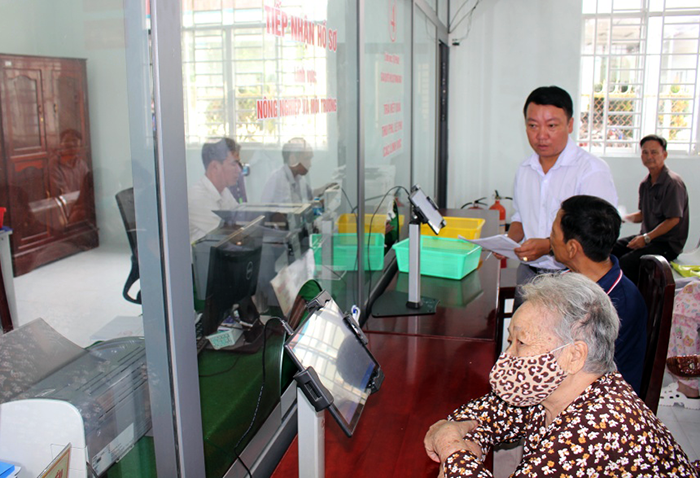
Commune-level officials and civil servants are facing increasing pressure as they have to handle a growing workload.
Just by following a civil servant through a typical workday, one can fully appreciate the pressure weighing on what is considered the closest "extended arm" of the government to the people.
Currently, Ms. NTKH, Deputy Head of the Culture and Social Affairs Department of a commune in Can Tho City, is in charge of a wide range of tasks, from internal affairs, culture, labor, employment, social welfare to information, propaganda, and many other duties. These tasks, previously assigned to multiple departments, are now consolidated under one authority, while the workload remains undiminished.
There are days when her desk is almost never empty. Documents from various fields constantly arrive, sometimes reaching around 50 documents requiring research, processing, or consultation. Each document has different content, requirements, and deadlines. Some require consultation, some need to review data, and some directly relate to the policies and regulations concerning citizens; all appearing within a short period of time. "There are days when I work from morning until evening and still don't finish. For matters requiring focused research, I have to work through the evenings. Many days I have to take files and documents home to continue working on them, because if I leave them until the next day, some tasks will miss their deadlines," Ms. NTKH said.
Overload is not only measured by the number of tasks, but also by the number of simultaneous tasks that require staff to complete within a limited timeframe. The organizational structure may be streamlined on a diagram, but if the workflow continues to converge on a single point of contact, the challenge is not just how to get staff to "get everything done," but also how to reorganize the work so that staff don't have to use their overtime to compensate for the increased workload.
A "mountain" of documents and endless reporting circles.
One of the less-seen pressures at the grassroots level is administrative work. THK, a specialist in the People's Council and People's Committee Office of a ward in Can Tho City, works in an office and almost daily deals with a "mountain" of documents. Some directives arrive in the morning and require processing by the afternoon; some tasks seem completed but then require updating data, supplementing reports, or compiling information according to a different form. "During six-month or year-end reviews, we sometimes have to prepare 2-3 reports a day. As soon as one report is finished, another is due. Sometimes we're compiling data for one task in the morning, and in the afternoon we have to move on to another request. The work just keeps piling up; we haven't finished one task before we have to start another," THK said.
According to Mr. THK, it is noteworthy that there are cases where the same content is requested by different departments and agencies at the higher level, even though the basic information and data remain unchanged. Commune officials then have to review, compile, compare, and present the information according to different forms and requirements.
From the story of an office worker, the "mountain" of documents is no longer an abstract concept. It represents a constant stream of documents, consecutive deadlines, and endless reporting cycles that sometimes repeat the same data.
A streamlined system may have fewer points of contact, but if each task still involves too many layers of reporting, the pressure doesn't disappear; it simply shifts from the organizational levels down to the desks of grassroots officials.
The issue, therefore, is not simply about how many more reports staff can produce. The more important question is: among the reports being produced, what information is truly necessary for management, what can be integrated, and what can be leveraged from existing data?
Because every time an official has to reopen a file, re-enter data, or rewrite previously reported content, it's not just an additional administrative step. It's an additional portion of the system's time tied up in endless reporting cycles.
A great responsibility, but are the policies adequate?
Another issue of concern to many commune-level officials and civil servants is that the compensation and benefits are not truly commensurate with the workload and responsibilities they undertake. This issue is not only discussed at the grassroots level, but also raised by delegates in the National Assembly regarding concerns about allowances, benefits, and working conditions for those directly performing duties at the commune level.
For example, when speaking during a discussion on socio -economic development at the first session of the 16th National Assembly, National Assembly representative Ha Sy Huan (Thai Nguyen) stated his view: After the district level is completed, the team of officials and civil servants at the commune level will become the core force in implementing decentralization and delegation of power.
Accordingly, the commune level directly handles matters for the people, and every decision directly impacts the rights and interests of the people. "A head of the economic-infrastructure department, the head of the urban-infrastructure department, or the head of the culture-social affairs department has to advise on many matters and handle many tasks for 6-7 departments, sectors, and fields," Mr. Huan said.
According to Mr. Huan, this increases the pressure of legal responsibility, requiring civil servants and leaders to possess comprehensive professional competence.
However, delegates pointed out that the position allowance for commune-level officials and civil servants is still low, not commensurate with the nature of the work they are doing, and there is a considerable gap compared to the allowance for provincial-level management officials.
Specifically, Mr. Huan stated that heads of departments at the commune and ward levels receive an allowance of 0.25, and deputy heads receive 0.15; at the provincial level, heads of departments receive an allowance of 0.5, and deputy heads receive 0.3 times the basic salary.
Therefore, the delegates proposed that the Government conduct a comprehensive assessment of the salary and allowance policies for officials and civil servants at the commune and ward levels, and promptly implement synchronized solutions to ensure that the workforce can work with peace of mind, contributing to improving the effectiveness and efficiency of local government operations.
In reality, commune-level officials and civil servants are at the end point of many policies and initiatives, and are also the first people people turn to when they need to resolve a specific issue; meanwhile, many issues regarding staffing, job positions, allowances, and policies for grassroots personnel are still being studied and adjusted.
A local official shared: "We believe that once we've been assigned a task, we must do it. We can't let the people's work be delayed just because we're tired. But for someone to stay committed and work with a high sense of responsibility, in addition to discipline and accountability, we also need policies that make us feel that our efforts are recognized."
This is not just the sentiment of one individual. Because if the demands on officials and civil servants are increasingly high, but the incentive mechanisms, rewards, and working conditions do not keep pace, then in the long run, it will pose a challenge in attracting, retaining, and developing capable people at the grassroots level.
Therefore, the question to be asked is not "do officials want to work?", but rather: are the policies strong enough to motivate capable individuals to work with peace of mind, commit to their jobs, and be willing to take on challenging tasks at the grassroots level?
Text and photos: TRUONG SON
Lesson 3: To have a strong foundation, you must "support" it.
Source: https://baocantho.com.vn/bai-2-bo-may-bien-che-tinh-gon-nhung-cong-viec-chua-tinh-gon-cap-xa-dang-chiu-ap-luc-lon-a217281.html