
From geographical areas, people, and working methods that were originally quite different, after the reorganization of administrative units, a new system was formed and gradually operated in a unified rhythm. Behind the changes in boundaries, headquarters, or names lies a complex "assembly" involving organization, personnel, coordination methods, and management thinking. In this process, each official must learn to overcome the "old versus new" mentality, prioritize the common good, and work together to find common ground to transform the individual pieces into a unified system that is close to the people, understands their needs, and serves them better and better.
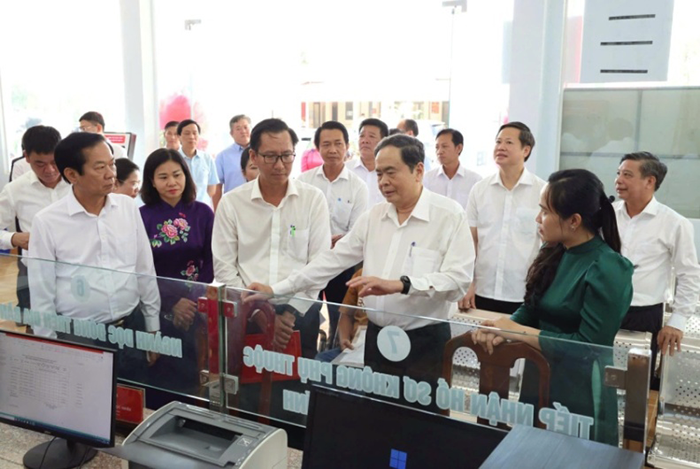
Mr. Tran Thanh Man, Member of the Politburo and Chairman of the National Assembly (front row, second from the right), along with leaders of Can Tho City, inspected the operation of the two-tiered local government system in several communes and wards in the city on June 30, 2025.
There are no job gaps.
The first day the new commune administration officially came into operation was also the day a "major problem" began to be solved. People who previously worked in different areas and agencies now stood together in one system. Files, documents, assets, and data were transferred. The methods that existed in the old units had to be gradually standardized. But there was one thing that could not be transferred, nor could it wait: the work of the people. This was the "test" for the new system: after the organizational change, could the government maintain continuity in serving the people?
In Hoa An commune, Can Tho city, established by merging Kinh Cung town and the former Hoa An commune, the reorganization of local units and organizations has entailed a large volume of work. One of the biggest challenges is ensuring that the new system does not create a sense of alienation for the people. The local government is only truly "new" in terms of organization; for the people, their concerns are very simple: where to go to get their issues resolved, who will guide them, how their documents will be processed, and whether their rights will be protected.
According to Mr. Ly Hung Em, Secretary of the Party Committee and Chairman of the People's Council of Hoa An commune, the biggest difficulty in the early days was not only reorganizing the structure and personnel, but also ensuring that the newly formed apparatus could quickly achieve unity in understanding and action. Each locality previously had different working methods, habits, and practical conditions; upon arriving at a new unit, if a unified working method wasn't established promptly, it could easily lead to a wait-and-see attitude or local parochialism. Therefore, the commune's Party Committee determined that stabilizing the morale of cadres was paramount, while simultaneously quickly identifying what needed to be done immediately and what could be done according to a roadmap; ensuring that the organizational restructuring process did not become a reason for delays in work progress. “Mergers may change geographical boundaries, organizational structures, and job positions, but what determines the success of a new system is its ability to create unity. When each official no longer thinks of themselves as belonging to their old area or unit, but instead recognizes that they are working for a new locality and are jointly responsible to the people, then the new pieces truly become a unified whole,” Mr. Ly Hung Em shared.
Following the directives of the Party Committee, Mr. Nguyen Vu Truong, a specialist in the Culture and Social Affairs Department of Hoa An commune, quickly adapted to the demands of the new environment. From the specific tasks assigned, he proactively reviewed and understood the procedures, coordinating with colleagues and relevant departments to ensure the smooth continuation of work. Mr. Truong recounted that in the final days before the merger, amidst the hustle and bustle of preparing for a new organizational structure, he received the application for social retirement benefits from Mr. Nguyen Van Bang, residing in Hamlet 2, Hoa An commune. The application was not yet complete when the merger date approached. The organizational structure changed, and the work transitioned, but Mr. Bang's application was not left behind.
After the merger, he continued to review and complete the necessary procedures so that his application would be processed according to regulations. By August 2025, Mr. Bang began receiving his social retirement allowance for the elderly. A seemingly ordinary application process, but for the people, it represents the difference between a "merger of administrative bodies" and a truly effective government that ensures people's work is not interrupted. "I submitted my application during the preparatory phase for the commune merger, thinking that the officials would have many other tasks to attend to, so the application would take a long time to process. Unexpectedly, the officials and civil servants of the new commune continued to monitor and not forget my application. I am very pleased with that sense of responsibility," Mr. Bang shared.
Similarly, in Vi Thanh ward, Can Tho city, the administrative apparatus was quickly streamlined, preventing any gaps in work. According to Mr. Tran Thanh Liem, City Party Committee member and Secretary of the Vi Thanh Ward Party Committee, the initial requirement was unity in leadership, smooth operation, and clear accountability in task implementation. The new apparatus has been tested through daily work and the progress of task resolution. As a result, since the merger, it is gratifying to see that 100% of administrative documents from citizens and businesses in the ward have been received and processed ahead of schedule or on time, contributing to ensuring smooth administrative operations and preventing backlogs and delays.
The numbers speak for themselves.
From diverse geographical areas, organizations, and personnel, Hoa An commune quickly established a unified operational rhythm, ensuring uninterrupted work and preventing delays in the legitimate rights of its people. In 2025, the first year of implementing the two-tiered local government model, under conditions of a newly reorganized apparatus, Hoa An commune achieved and exceeded 17 out of 17 socio- economic , national defense and security, and political system building targets. The commune's Party Committee was awarded a Certificate of Merit by the Standing Committee of the Can Tho City Party Committee for outstanding performance in 2025.
In the election of deputies to the 16th National Assembly and representatives to the People's Councils at all levels for the 2026-2031 term, 100% of voters in the commune participated; electing all 3 National Assembly deputies, 3 City People's Council deputies, and 22 Commune People's Council deputies according to the allocated structure and number. According to the announcement of the Can Tho City Election Committee, Hoa An commune achieved 103 points, ranking 4th out of 103 communes and wards; 3 collectives and 7 individuals from the commune received Certificates of Commendation from the Chairman of the City People's Committee for outstanding achievements in the election work.
And the ultimate measure of this progress is that people's work is handled smoothly, their rights are protected, and their trust in the government is gradually strengthened. Like many other citizens, Mr. Nguyen Van An in Hoa Son hamlet, Hoa An commune, inevitably had concerns when the policy of reorganizing and streamlining the administrative apparatus was implemented. "The policy of streamlining the apparatus and reducing the workforce is necessary. But at first, I was worried because after the merger, I didn't know if all the paperwork would have to be redone, and whether the government could manage such a large area," Mr. An shared.
A year after those concerns arose, Mr. An found the answer not through meetings or reports, but through his own direct experiences.
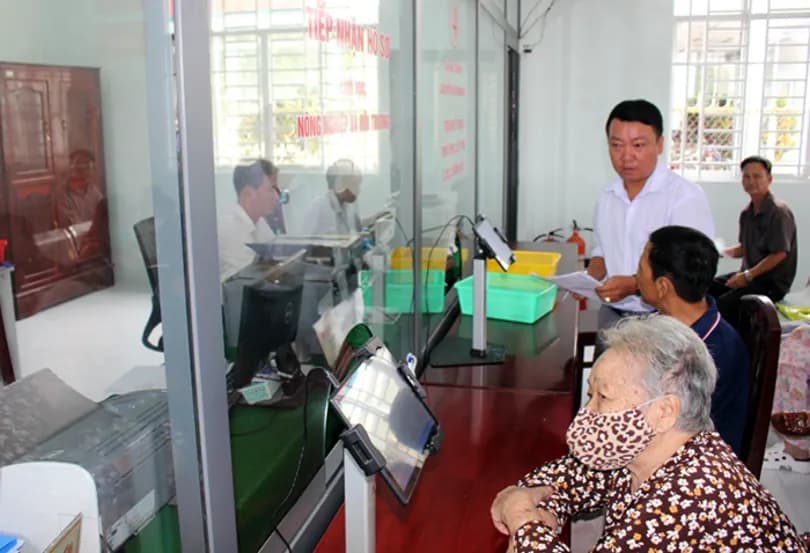
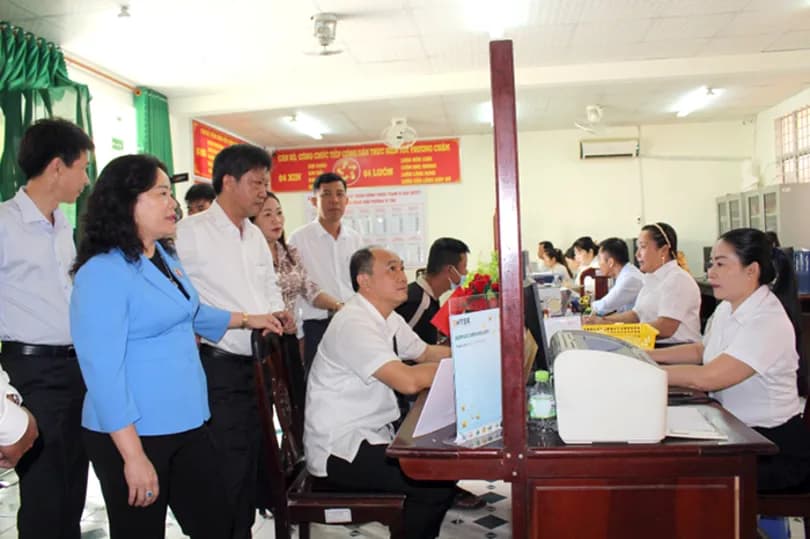
Not long ago, when Mr. An visited the Hoa An Commune Public Administrative Service Center to register his grandson's birth, he was surprised by how quickly everything went. The workspace was spacious, the reception process was clearly explained; his family's application was received and processed by the staff in about 15 minutes. Not only did they process the application on the spot, but the staff also guided him on how to complete the procedure online through the National Public Service Portal, so that he could do it from home in the future.
Mr. An's experiences weren't limited to the public administration sector. During the Lunar New Year of the Horse 2026, he noticed another change: the Kinh Cung Bridge – considered the "gateway" to the Kinh Cung market area (Hoa An commune) – was equipped with a lighting system, brightly illuminating the area at night. "Previously, crossing the bridge at night was quite dark. Now, with the lighting, it looks beautiful and is convenient for people to travel. This is a practical undertaking. From being worried, we've seen many things done quickly and practically. We, the people, have more confidence in the new organization and operation," Mr. An confided.
Not only in Hoa An commune, but also in other communes and wards in Can Tho City, the city has rapidly transitioned from a "reorganization" state to an "operational" state. By leveraging strengths and effectively exploiting the potential of each locality, Can Tho City's economy has maintained positive growth momentum in the first nine months of 2026, with many sectors recording double-digit growth. Industry continues to be a crucial driver of growth, with the industrial production index (IIP) for the first nine months estimated to increase by 11% year-on-year; merchandise exports and foreign exchange revenue reached US$4,592.5 million, an increase of 11.7%; total retail sales and consumer service revenue for the first nine months reached approximately VND 198,018 billion, an increase of 21.1%; tourism continues to thrive, welcoming approximately 11.71 million visitors, an increase of 25%, with revenue reaching approximately VND 10,280 billion, an increase of 28%. These results contributed to bringing the estimated state budget revenue for the first nine months to 21,681 billion VND, equivalent to 80.66% of the projected target.
At the working session with communes and wards to review the work of the first nine months of 2026, the leaders of Can Tho City acknowledged and highly appreciated the efforts of the localities, as most of the tasks set out were achieved and exceeded the plan. In particular, the work of budget revenue collection and enterprise development were outstanding highlights, showing the initial effectiveness of leveraging the role, strengths, and development potential of each commune and ward within the new organizational model.
From a broader perspective, we can see that in the third quarter of 2026, the national economy grew by 9.95% year-on-year, the highest rate since the beginning of the year, bringing the nine-month growth to 9.01%. This impressive result cannot, of course, be reduced solely to the reorganization of local government, because economic growth is a combination of many factors, from production, investment, consumption, exports to business activities. But from another perspective, it shows something noteworthy: even during a large-scale reorganization of the administrative apparatus, the rhythm of the economy and social life was maintained, and many sectors even continued to experience positive growth.
Behind those national-level figures are thousands upon thousands of tasks being handled daily at the grassroots level. Each task successfully completed is a link in the chain that keeps socio-economic activity uninterrupted, and the new system is gradually proving its adaptability through its practical effectiveness.
Text and photos: TRUONG SON
Article 2: Streamlined organizational structure and staffing, but the workload remains "streamlined" - commune-level authorities are under immense pressure.
Source: https://baocantho.com.vn/bai-1-tu-nhung-manh-ghep-den-mot-bo-may-thong-nhat-a217280.html