
From January 2026, Irish beef will be allowed to be imported into Vietnam, opening another chapter in agricultural and food cooperation between the two countries, coinciding with the 30th anniversary of the establishment of diplomatic relations between Vietnam and Ireland.
Speaking at an event introducing Irish beef in Vietnam, Ronan Cunniffe, Deputy Ambassador of Ireland to Vietnam, stated that the presence of an Irish product in Vietnam is the result of cooperation between government agencies, businesses, and partners from both countries. But beyond the commercial aspect, food can also become a way for two cultures to learn about each other.
According to Lorna Allen, Southeast Asia Director of Bord Bia (Ireland Food Commission), the story of food lies not only in the final product but also begins where it is grown and produced. Through this, consumers can learn more about the land and culture behind an ingredient.
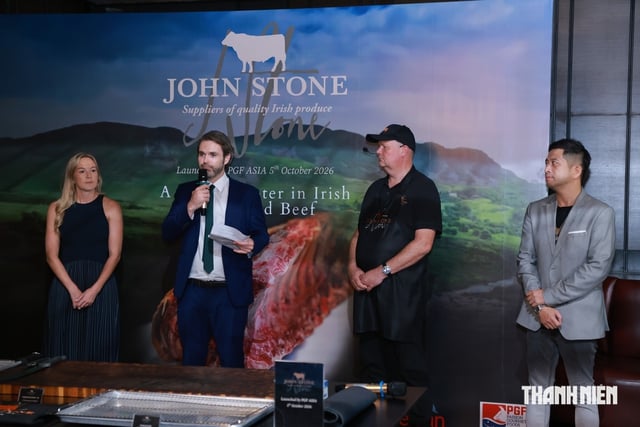
Mr. Ronan Cunniffe (second from left), Deputy Ambassador of Ireland to Vietnam, shared his thoughts on the friendly cooperation between the two countries.
PHOTO: LE THUY
From the grasslands to the Vietnamese dinner table
That story becomes more concrete when Irish ingredients are placed alongside familiar components of Vietnamese cuisine .
At the event, Irish grass-fed beef was combined with dry-curing techniques, then prepared using methods that incorporated Vietnamese ingredients and spices. Pickled eggplant, mắc khén (a type of spice), herbs, along with various salts and sauces bearing the mark of the local cuisine, appeared alongside the beef.
Some dishes combine beef with shrimp crackers and yuzu-flavored tapioca pearls; others use pickled eggplant as a side dish. Vietnamese spices like mắc khén (a type of spice) and herbs are also incorporated into the chẩm chéo sauce. What's noteworthy isn't the number of ingredients combined, but how a product bearing the hallmark of one region is received and interpreted in another.
Irish grass-fed beef still holds the story of the pastures, the farmers, and the production methods behind it. But when paired with eggplant, mắc khén (a type of spice), or other Vietnamese herbs, the ingredient is placed in a new context, with a different way of being enjoyed.
When flavor becomes a cultural story.
From a single ingredient, the story expands to how cultures receive each other. A product may carry the identity of its birthplace, but when it arrives in another land, it doesn't necessarily retain the same way it was originally enjoyed.
Cuisine thus becomes a rather natural space for fusion. Different ingredients are placed side by side, cooking techniques are combined, and from that, new ways of enjoying food are formed.
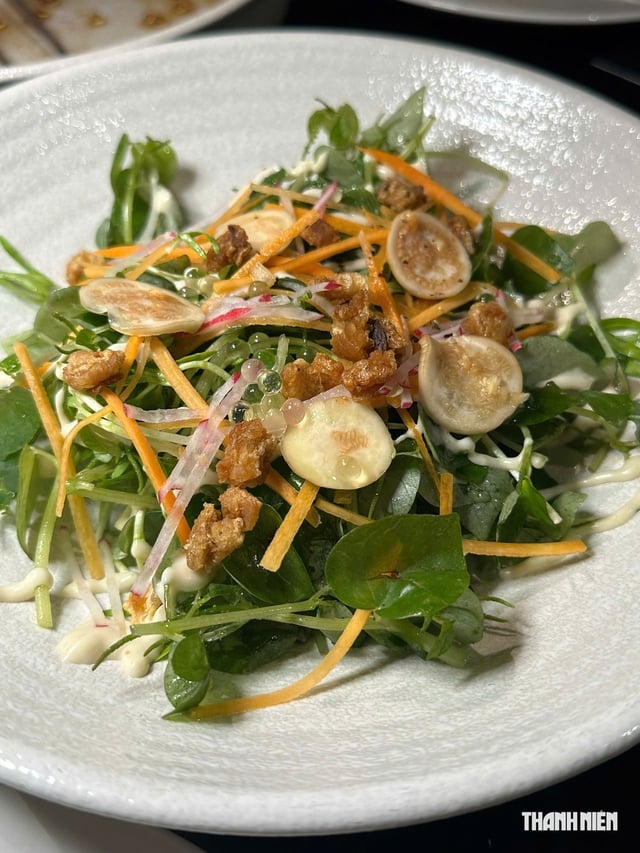
Irish beef is not presented in its original European style, but rather placed in a "dialogue" with Vietnamese ingredients and flavors, such as a salad with cheese, or Irish beef paired with Vietnamese pickled eggplant.
PHOTO: LE THUY
Irish beef, from the green pastures to the Vietnamese dinner table, is a prime example. The value of the story lies not only in the introduction of a new product to the market, but also in its ability to spark curiosity and dialogue between different tastes, ingredients, and ways of enjoying it.
That's also how cultural exchange can begin with very ordinary things: not by erasing each other's identities, but by placing differences side by side, so that each culture can be seen more clearly through how the other culture receives and retells them.
Tiffany Tran
Thanhnien.vn
Source: https://thanhnien.vn/khi-nguyen-lieu-ireland-gap-gia-vi-viet-185261006113743851.htm