
Adapting to the new operating model
From July 1st, 2025, implementing a two-tiered local government model, the highland communes of the former Thuan Chau district will be merged into three communes: Co Ma, Long He, and Muong Bam, with over 97% of the population being ethnic minorities. The percentage of poor and near-poor households according to the multidimensional poverty approach is high. Specifically, Co Ma commune still has 28.34% poor households; Long He 18.62%; and Muong Bam 21.09%.
Immediately after commencing operations, the Party committees and authorities of the three communes quickly adapted to the new model, maintaining effective state management in all areas, ensuring uninterrupted service to the people and the implementation of political tasks in the locality. At the same time, they consolidated and stabilized the socio-political organizations at the commune level to continue playing a core role in disseminating information and mobilizing members and the people to comply with the Party's guidelines and the State's policies and laws .

In addition, the Party committees and local authorities of the communes continued to assign cadres to the villages to assess the actual situation and review the potential and advantages of each area. Based on the results of this review, combined with inheriting the regional planning and economic development orientation of the former Thuan Chau district, the communes have re-planned sustainable production areas, linked with environmental protection… On that basis, they have set specific directions in leading and guiding the people to develop the local economy.
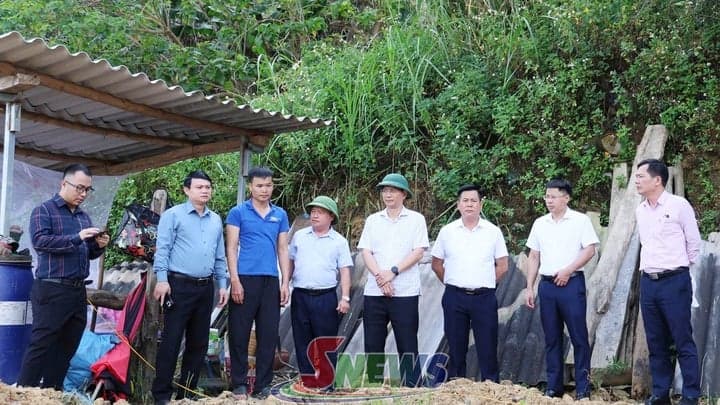
Welcoming us at the office, Comrade Nguyen Ngoc Tan, Permanent Deputy Secretary of the Co Ma Commune Party Committee, shared: Operating under the two-tiered government model after the merger requires the Commune Party Committee to change its mindset and approach immediately. We don't lead in a general way, but assign targets and clearly define responsibilities for each official and each village Party branch; at the same time, we promote the application of digital technology to handle work more quickly and efficiently. Although this is a mountainous area with many difficulties, officials must stay close to the people and listen to them so that the government can truly operate effectively and gain the people's trust and affection.
Positive changes in the mindset and working methods of officials in the highlands have breathed new life into the villages. The two-tiered government apparatus has not only become more streamlined and effective, but most importantly, it has narrowed the gap between the government and the people, laying the foundation for localities to tackle the most difficult problem: economic development and improving the lives of the people.
Working alongside the people to develop the economy.
Based on the results of the field review, the Party Committees and authorities of the three communes: Co Ma, Long He, and Muong Bam, have focused on leading the people in developing crops and livestock suitable to the soil and climate conditions; gradually building a model of linkage from production to processing and consumption of products, contributing to ensuring the output of local agricultural products, increasing income, and improving living standards.
In Muong Bam commune, after more than a year of operating under the two-tiered local government model, the Party Committee and People's Committee of the commune have assigned officials to work with the village management boards to propagate and mobilize the people to continue promoting the transformation of crop and livestock structures towards commodity production. Comrade Ta Dang Hai, Chairman of the People's Committee of Muong Bam commune, shared: "The good news is that, initially, the people have shown initiative in applying advanced techniques to production. To date, the commune has converted more than 356 hectares of land previously used for short-term food crops to fruit trees and coffee; nearly 30 hectares are planted with cardamom and macadamia trees. The people also cultivate nearly 208 hectares of grass for feed for nearly 4,300 buffaloes and cows kept in pens."
With a shared determination to achieve breakthroughs, the Party Committee and government of Long He commune have proactively collaborated with the people in addressing the challenge of economic development. Members of the commune's Party Committee are assigned to oversee each village, grasping the actual situation, especially the potential and advantages, and then advising the Party Committee and People's Committee on accurately orienting crop and livestock models that bring high economic efficiency to the people.
Sharing about the local progress, Comrade Ly A Chu, Chairman of the People's Committee of Long He commune, confided: "Right from the transition to the new model, we were concerned about how to improve the lives of the people. The commune focused on reviewing and selecting the right strong crops, while also promoting the change in livestock farming practices. Instead of free-range grazing, we encouraged people to plant grass to raise livestock in enclosures and participate in supply chains, notably the two cooperatives raising specialty black chickens, which are developing very promisingly."

Building upon previous achievements, the people of Long He commune have successfully converted 626 hectares of low-yield food crop land to high-value fruit trees such as hawthorn, mango, and longan. Visiting E Tong village, one can clearly feel the progress of collective economic models. Ms. Lo Thi Buoi, Director of the EFARM Ecological Agricultural Cooperative, shared: With the encouragement of the Party Committee and the People's Committee of the commune, the cooperative focuses on improving the quality of 3 hectares of clean vegetables and fruits, achieving a production of about 50 tons per year. In addition, members maintain the raising of nearly 1,000 native black chickens, selling 1-2 tons of commercial chickens each year, bringing in an average income of 60 million VND per person per year. Proactively expanding and accessing markets, ensuring stable output, has created more jobs and increased income for local laborers.
The shift in people's production mindset, coupled with the support of the political system, is the foundation for Long He to confidently move towards its goal: reducing the multidimensional poverty rate to below 35% and officially escaping the status of an extremely disadvantaged commune, becoming a relatively developed commune in the region by 2030.

Alongside Long He and Muong Bam, the highland commune of Co Ma has also recorded positive changes in the restructuring of crop cultivation on hillside land. Thanks to the close leadership and guidance of the commune's Party committee and government, the people have proactively introduced hawthorn, ginger, and fruit trees as key agricultural products. To date, the entire commune has 282 hectares of fruit trees, producing 1,500 tons per year, 85 hectares of coffee trees (15 hectares already yielding harvests), and nearly 160 hectares of ginger with a yield of over 3,187 tons of tubers.
Positive changes
With the close leadership and guidance of the local Party committee and government, along with a change in mindset and approach, and the collective determination of the people in the three communes of Co Ma, Long He, and Muong Bam to overcome poverty, a significant impetus has been created in the transformation of crop structure on sloping land and the development of commercial livestock farming. The clearest evidence is the economic efficiency with over 5,000 hectares of hawthorn and fruit trees; over 800 hectares of tea; nearly 1,000 hectares of coffee; and 352 hectares of various medicinal plants.
The livestock sector has also seen breakthroughs with the increasing number of farms applying scientific and technical advancements. The entire region currently maintains over 10,000 head of cattle and nearly 60,000 poultry, contributing to stable income and improved living standards for the local people.

Along with focusing on economic development, infrastructure in the three highland communes is also receiving attention and investment from the Party and the State, basically meeting the production and living needs of the people. To date, all three communes have paved roads leading to their centers; the percentage of villages with concrete roads is as follows: Muong Bam (approximately 80%), Co Ma (over 50%), and Long He (47.83%). The irrigation system is solidified, ensuring water supply for agricultural production. Nearly 100% of households have access to the national power grid and clean drinking water. Over 94% of schools and classrooms are built with solid or semi-solid structures...
The socio-cultural sector in the highland communes has also seen positive changes. The quality of universal education at all levels, literacy programs, and efforts to prevent relapse into illiteracy continue to be firmly maintained; 99.5% of children of preschool age attend kindergarten; and over 94% of people aged 15 and above are literate in the common language. The system of grassroots health stations has been strengthened, effectively meeting the requirements for primary healthcare for the people...

The working trip to Co Ma, Long He, and Muong Bam left a deep impression on the innovative and decisive spirit of the local Party committees and authorities, along with the strong will and aspiration of the highland people to overcome poverty. The resolutions of the Party Congresses at all levels for the 2025-2030 term are being implemented and realized in every home and on every hillside, creating momentum and a solid foundation for the highland communes to make breakthroughs, transform strongly, and build increasingly prosperous and happy homelands.
Source: https://baosonla.vn/phong-su/doi-moi-phuong-thuc-lanh-dao-tao-suc-bat-vung-cao-IPBorRrDR.html