

A star hundreds or thousands of light-years away from us clearly cannot be weighed. Even with a solitary star, determining its mass directly is extremely difficult. So how do astronomers "weigh" it?
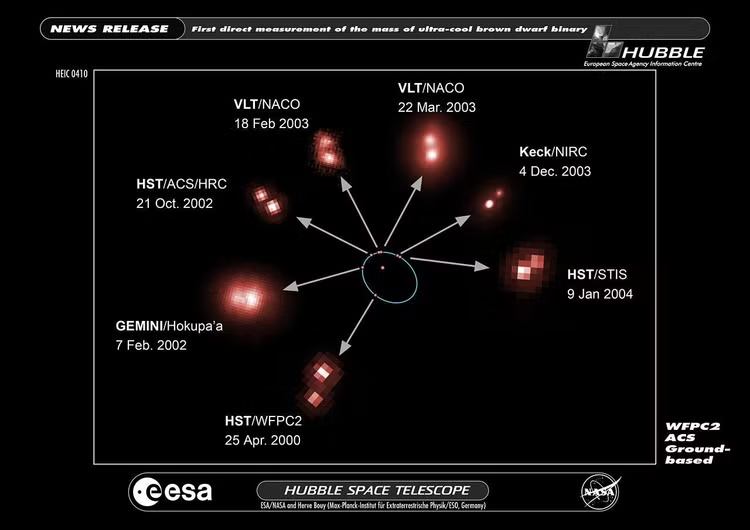
Photo: esahubble
The secret lies in gravity and motion.
The most favorable scenario is when the star has a "partner"—that is, a binary star system. The two stars don't actually stay stationary around each other, but rather orbit around a common center of mass. Like two people sitting on a seesaw, the heavier the star, the closer it is to the center of mass. Observing their orbits therefore allows astronomers to deduce their masses.
What they need to pay particular attention to is the orbital size and rotation period. According to Newton's version of Kepler's law, if the average distance between two stars and the time it takes them to complete one orbit can be known, the total mass of the system can be calculated. In other words, instead of placing the star on a scale, astronomers observe how the "cosmic scale" created by gravity itself works.
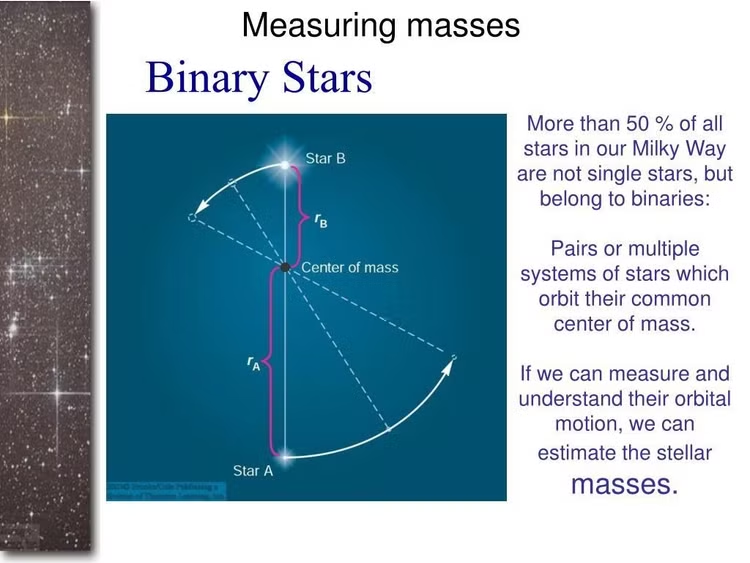
Photo: slideserve
But not all binary star systems are clearly visible through telescopes. Some pairs are too far apart or too close together. In those cases, spectroscopy becomes a particularly useful tool. The movement of the star toward or away from Earth causes the spectral lines to shift due to the Doppler effect. By measuring this periodic change, astronomers can determine the star's orbital velocity.
Another approach is to observe occultation in binary systems. When one star passes in front of the other, the system's brightness decreases. The cycles of these "darkening" events, along with spectral data, can provide further information about the mass and size of the two stars.
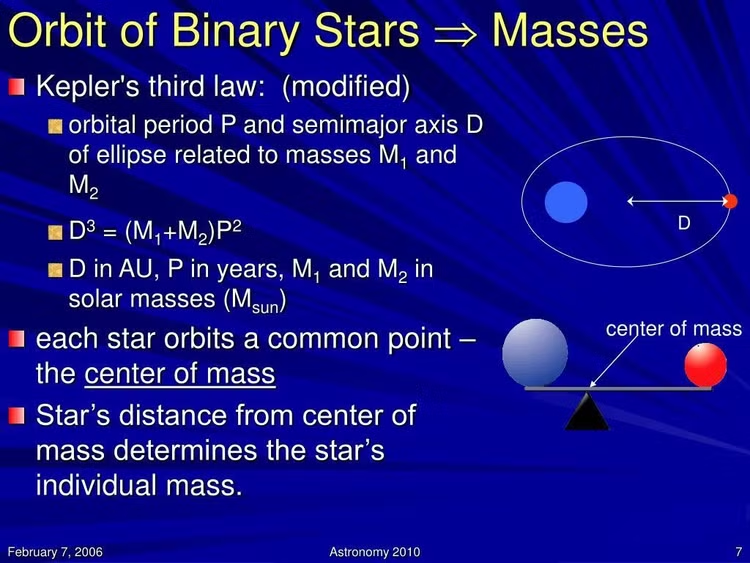
Photo: slideserve
Particularly interesting, this technique once helped astronomers measure the mass of an ultra-cold dwarf star in the 2MASSW J0746425+2000321 system. After years of tracking its orbit with Hubble and ground-based telescopes, they determined the main star had a mass of about 8.5% of the Sun, while its companion, a brown dwarf, had only about 6.6% of the Sun's mass.
Therefore, whenever astronomers see two stars orbiting each other, they are not just seeing a beautiful sight in the sky. They are seeing a giant natural scale – where gravity reveals the weight of worlds trillions of kilometers away from us.
Source: https://khoahocdoisong.vn/bi-mat-chiec-can-vu-tru-giup-do-khoi-luong-cac-ngoi-sao-post2149120595.html