On the morning of November 17th, in Hanoi, Deputy Minister of Agriculture and Environment Nguyen Hoang Hiep received and held a working meeting with Deputy Minister of Water Resources of China Liu Dongshun and his delegation. The meeting took place during the delegation's visit to Vietnam to attend the Second Mekong-Lancang Water Resources Cooperation Ministerial Meeting.

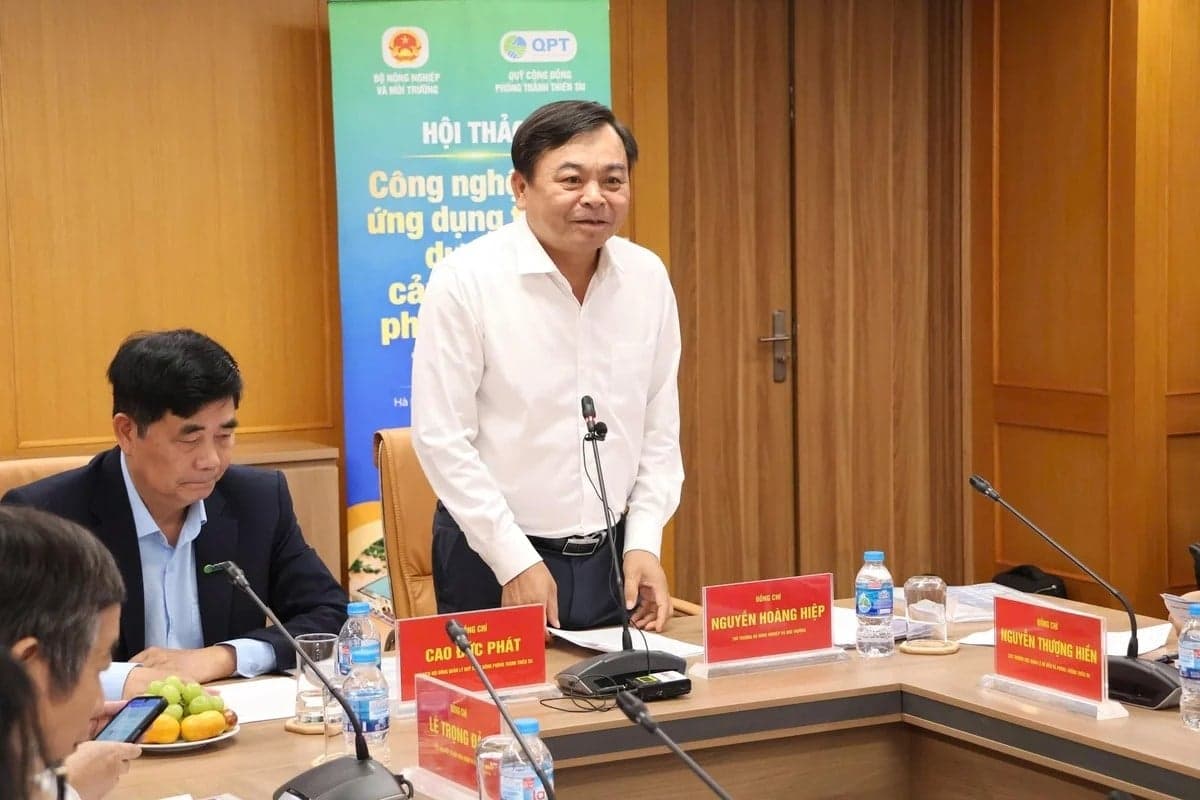
Deputy Minister of Agriculture and Environment Nguyen Hoang Hiep speaks at the working session. Photo: Mai Dan.
Deputy Minister Nguyen Hoang Hiep assessed that water resource management, irrigation, and disaster prevention are effective areas of cooperation between the two Ministries. The exchange of meteorological and hydrological information in the past has supported forecasting, water resource management, and disaster prevention.
According to the Deputy Minister, ensuring water security and sharing information are important areas of cooperation, both in bilateral relations and within the Mekong-Lancang Mechanism.
Acknowledging the cooperation of the Chinese Ministry of Water Resources in installing water level and rainfall monitoring stations and exchanging data, Deputy Minister Nguyen Hoang Hiep stated that the automatic information sharing mechanism, with a frequency of 4 times a day, is of practical significance for forecasting work, especially long-term forecasting.
Based on this, Vietnam aims to expand the number of stations, supplement data, and enhance real-time information sharing capabilities. Timely exchange of reservoir operation information also helps specialized agencies be more proactive in managing water resources and responding to floods, droughts, and saltwater intrusion.
China's Vice Minister of Water Resources, Liu Dongshun, agreed on the role of information exchange in disaster prevention and mitigation. He stated that, with many rivers crossing borders, maintaining information sharing between the two countries is essential. Information from both upstream and downstream will support proactive risk management and prevention efforts.

China's Vice Minister of Water Resources, Liu Dongshun, agrees on the role of information exchange in disaster prevention and mitigation. Photo: Mai Dan.
The two sides also discussed the effective implementation of the minutes of the online meeting on August 11, 2026 (which were signed on November 16, 2026, during the visit) on the mechanism for sharing meteorological and hydrological data in emergency situations between China and Vietnam.
Along with data, human resource training and the application of science and technology are areas that Deputy Minister Nguyen Hoang Hiep suggested focus on. He hoped that China would provide scholarships in the field of water resources and facilitate the exchange of lecturers and students between educational institutions in the two countries.
The Deputy Minister proposed coordinating research, training, and technology transfer, especially in artificial intelligence, automation, and digital transformation in irrigation. These are areas where Vietnam is interested in learning from experience to improve the management and operation of irrigation systems and the efficient use of water resources.
Acknowledging the above opinions, Deputy Minister Liu Dongshun welcomed the proposals on human resource training and advanced technology research; and also introduced China's experience in flood and drought prevention, water conservation, and protection of river and lake ecosystems.
Regarding future cooperation, he proposed that the two Ministries consider signing a Memorandum of Understanding on cooperation in the field of water resources. Specialized agencies, research institutes, universities, and businesses of both countries could expand technical exchanges on dam safety, estuary and delta management, application of digital mirroring technology, and the development of technical standards for the water sector.

The working session between the Vietnamese Ministry of Agriculture and Environment and the Chinese Ministry of Water Resources focused on exchanging cooperation in sharing hydrological data, training human resources, and applying irrigation technology. Photo: Mai Dan.
The Chinese side also proposed continued substantive cooperation within the Mekong-Lancang framework, and invited a delegation from the Ministry of Agriculture and Environment to exchange views and survey key irrigation projects.
In response to the invitation, Deputy Minister Nguyen Hoang Hiep expressed his desire to visit, exchange ideas, and directly learn about management experience and technology application in irrigation projects in China.