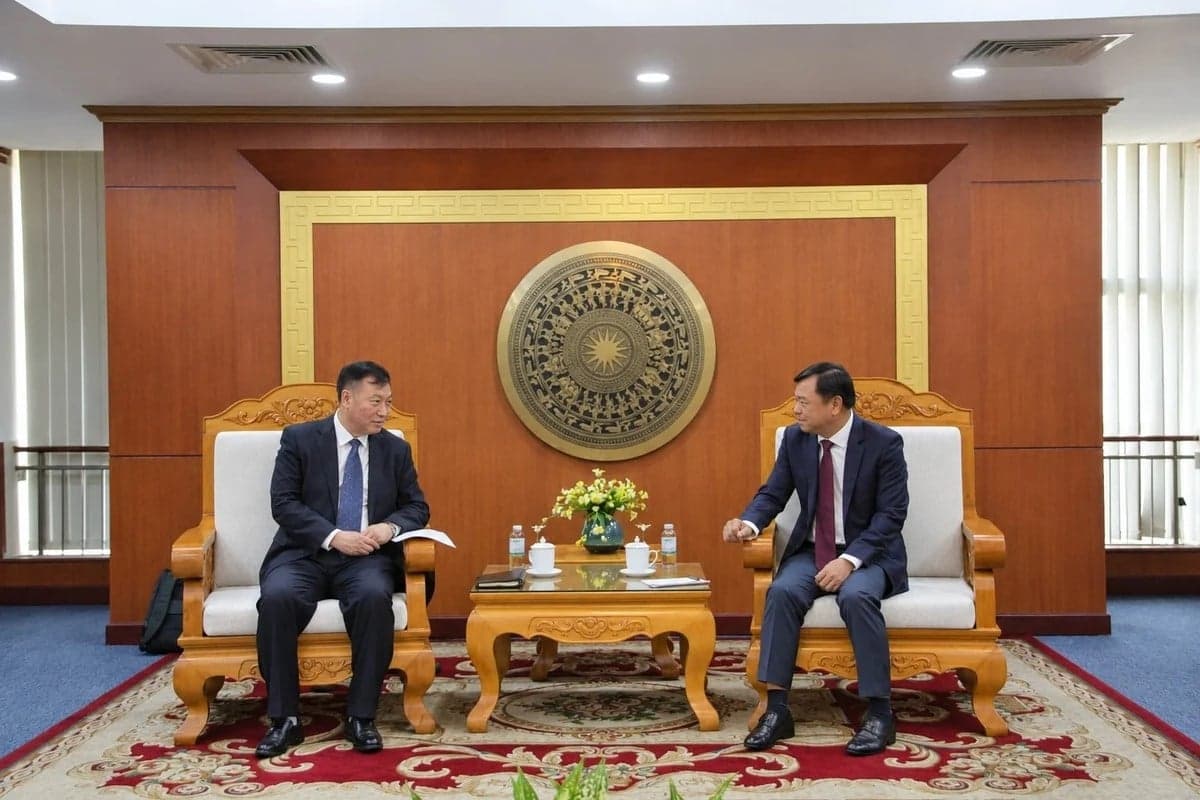

On the afternoon of November 13th, at the National Assembly building, under the chairmanship of Deputy Speaker Nguyen Hong Dien, the Standing Committee of the National Assembly discussed the explanation, acceptance, and revision of the draft Law on Marine and Island Resources and Environment (amended).
Reporting at the session, Deputy Minister of Agriculture and Environment Dang Ngoc Diep stated that the draft Law had been studied and incorporated by the Government based on 50 speeches by National Assembly deputies in committees, 14 speeches in the plenary session, and written comments from 10 National Assembly deputies, 5 National Assembly delegations, and the Committee on National Defense, Security and Foreign Affairs.
The revision process focuses on five major groups of issues, aiming to improve the mechanisms for managing, exploiting, and protecting marine resources and the environment, while simultaneously creating conditions to unlock resources for the development of the marine economy .

Deputy Prime Minister Ho Quoc Dung speaks at the session. Photo: National Assembly.
Improving the mechanisms for managing and exploiting marine space.
According to Deputy Minister Dang Ngoc Diep, one of the key focuses is clarifying the mechanism for integrated management and coordination of maritime space utilization. The draft Law defines responsibilities between the lead agency, coordinating agencies, and the decision-making authority; ensuring that it does not alter the management authority of the sectors and does not create additional administrative procedures or management decentralization.
The allocation of marine space is linked to planning, natural conditions, and the carrying capacity of the environment, while also establishing mechanisms for resolving conflicts between different marine use activities.
Regarding the mechanism for using sea areas, the draft Law reviews and comprehensively improves regulations on allocation, leasing, registration, auction, joint use, and multi-purpose use. Rights to transfer , contribute capital, and mortgage are defined according to the form of use, method of payment, and corresponding conditions.

Deputy Minister of Agriculture and Environment Dang Ngoc Diep presents the Report on receiving feedback, explaining and revising the draft Law on Marine and Island Resources and Environment (amended). Photo: National Assembly.
The draft also clarifies the basis for land acquisition, compensation, support, and protection of the legitimate rights and interests of organizations and individuals; and controls changes in ownership and control in sensitive areas or areas with foreign elements.
Another area of focus is promoting the blue economy linked to science and technology and digital transformation. Preferential policies and support measures are determined based on verifiable criteria, conditions, timeframes, and results, accompanied by mechanisms for monitoring and supervision.
The draft encourages the development of renewable energy, biotechnology, and environmental technology; while also improving the information system, shared database, and digital copies of national sea signs to serve management, forecasting, and warning purposes.
Regarding marine environmental protection, regulations controlling waste sources from land and maritime activities, waste collection and treatment, plastic waste reduction, and environmental incident response are being further refined. Marine ecosystem restoration is linked to assessing carrying capacity, prioritizing nature-based solutions, clearly defining implementation responsibilities, resources, and mechanisms for monitoring results.
The draft also emphasizes ensuring people's access to the sea and their legitimate livelihoods. The responsibilities of project owners and local authorities in assessing impacts, mitigating effects, supporting job retraining, and creating jobs are clarified.
For individuals engaged in aquaculture before March 30, 2021, but who have not yet been allocated a sea area, the draft regulations stipulate a review, on-site arrangement, relocation, or support for livelihood transition according to local plans, in line with actual conditions and the availability of sea space.
Deputy Minister Dang Ngoc Diep emphasized that throughout the revisions, the requirement is to ensure national defense, security, sovereignty, and national interests, in accordance with the legal regime of each maritime area and international treaties to which Vietnam is a signatory.
Clarify responsibilities for coordinating and controlling the carrying capacity of the marine environment.
On behalf of the reviewing agency, the Chairman of the Committee on Science, Technology and Environment, Nguyen Thanh Hai, assessed that the Government and the drafting agency had seriously studied, incorporated, and explained the opinions of the National Assembly Standing Committee, the reviewing agency, and National Assembly deputies.
However, upon review, the Standing Committee of the National Assembly's Committee on Science, Technology and Environment proposed further clarification on several important issues.

Chairman of the Committee on Science, Technology and Environment Nguyen Thanh Hai presents his opinion on the content that the drafting agency has incorporated, explained, and revised in the draft Law. Photo: National Assembly.
Regarding the focal agency assisting the Government in organizing and implementing the mechanism for coordinating activities using maritime space, the Committee believes this is a major task involving many ministries and agencies, and therefore should be assigned to a higher authority than the ministerial level.
Article 21, concerning the handling of conflicts and overlaps in the use of maritime space, does not clearly define the authority with the final say. Without specific regulations, determining responsibility will be difficult and the resolution process will be prolonged. Therefore, the reviewing agency proposes adding principles and authority for resolution, clearly defining the handling unit or reporting mechanism to the competent authority.
Regarding certificates of sea area use rights and ownership of assets attached to sea areas, the Committee assessed that the draft had for the first time included regulations related to this issue. However, it is necessary to add regulations on building an interconnected database to manage these certificates, similar to the way data is managed in the land sector.

Chairman of the Committee on Law and Justice Phan Chí Hiếu contributes his opinion. Photo: National Assembly.
Notably, the issue of marine environmental carrying capacity is identified as a complex matter requiring common methods and standards for consistent application. The reviewing agency proposed adding a method for assessing the cumulative impact of multiple activities in the same marine area, as well as evaluating the carrying capacity in controlling wastewater discharge from the mainland and islands into the sea.
For sea areas that have been declared to no longer have carrying capacity, strict management and control measures are needed, and no new permits should be issued. Without clear regulations, the restoration of the marine environment, as well as production, business, and tourism activities, could be affected.
Regarding the effective date, the Committee recommends that the Government carefully review the transitional provisions to avoid legal loopholes, the risk of profiteering, loss of state budget funds, or difficulties for businesses, including issues related to building setbacks.

Leaders of the Committee on Science, Technology and Environment and delegates and guests attending the session. Photo: National Assembly.
At the meeting, members of the National Assembly Standing Committee generally agreed with many contents of the draft, while also requesting that consistency and uniformity be ensured with related laws such as the Land Law (amended) and the Law amending and supplementing a number of articles of the Law on Environmental Protection.
Some opinions focused on the scope of the draft, the auction mechanism for the right to use sea areas in Article 27, and the need for further research on regulations concerning the carrying capacity of the marine environment.
It was unanimously agreed to submit the draft law to the National Assembly for consideration and approval.
Concluding the session, Vice Chairman of the National Assembly Nguyen Hong Dien highly appreciated the proactive and responsible approach of the Government and the agencies in charge of drafting and reviewing the draft in researching, incorporating, and explaining the opinions of National Assembly deputies in the working groups and the plenary session.

Deputy Speaker of the National Assembly Nguyen Hong Dien delivers the concluding remarks at the session. Photo: National Assembly.
The Standing Committee of the National Assembly basically agreed with many of the explanations, amendments, and revisions made by the Government, and requested the Government to direct the drafting agency to continue to coordinate closely with the Standing Committee of the Committee on Science, Technology and Environment and other relevant agencies to review and finalize each article and clause of the draft.
The revisions must fully incorporate the opinions of the Speaker of the National Assembly, the members of the Standing Committee of the National Assembly, the agency in charge of verification, and the valid opinions of National Assembly deputies. For contents that have not been incorporated, especially those with differing opinions, the Government needs to provide explanations and clarifications so that the National Assembly has a basis for consideration and decision.
Regarding the draft Law on Marine and Island Resources and Environment (amended), the Standing Committee of the National Assembly unanimously proposed that the Government continue to research, review, and refine five key areas, including: inter-sectoral coordination mechanisms and conflict resolution in the management and use of marine space; construction and management of artificial islands and structures at sea; certificates of land use rights related to marine areas; management of the carrying capacity of the marine environment; and building setbacks.

A view of the session. Photo: National Assembly.
Based on the results of the session, the Standing Committee of the National Assembly unanimously agreed to submit the draft Law to the National Assembly for consideration and approval after it has been revised and amended according to the conclusions of the session.
The Government is fully responsible for receiving feedback, revising, and perfecting the draft Law, both in terms of policy content and legislative technique, ensuring quality and timeliness for submission to the National Assembly for consideration and decision at the end of this session.