
The Politburo has just issued Conclusion No. 99-KL/TW dated September 28, 2026, on the exploitation, management, and protection of low-altitude space to serve national development in the new situation. Accordingly, by 2045, the low-altitude space economy is targeted to become an important economic and technical sector with high competitiveness in the region, contributing approximately 1.5% to the national GDP.
Notably, low-altitude airspace is simultaneously recognized as a "national resource, a new development space for the country, and a special sovereign space." This approach expands the task from managing flight operations to organizing the exploitation of a development resource, linked to protecting airspace sovereignty, data sovereignty, and cybersecurity.

UAV testing in Dien Bien .
To lay the foundation for this new economic sector, Vietnam aims to put into operation three national-level flight test sites, representing different geographical regions, and at least one national research and testing center for unmanned aerial vehicles (UAVs) by 2030.
From aircraft to the technology value chain
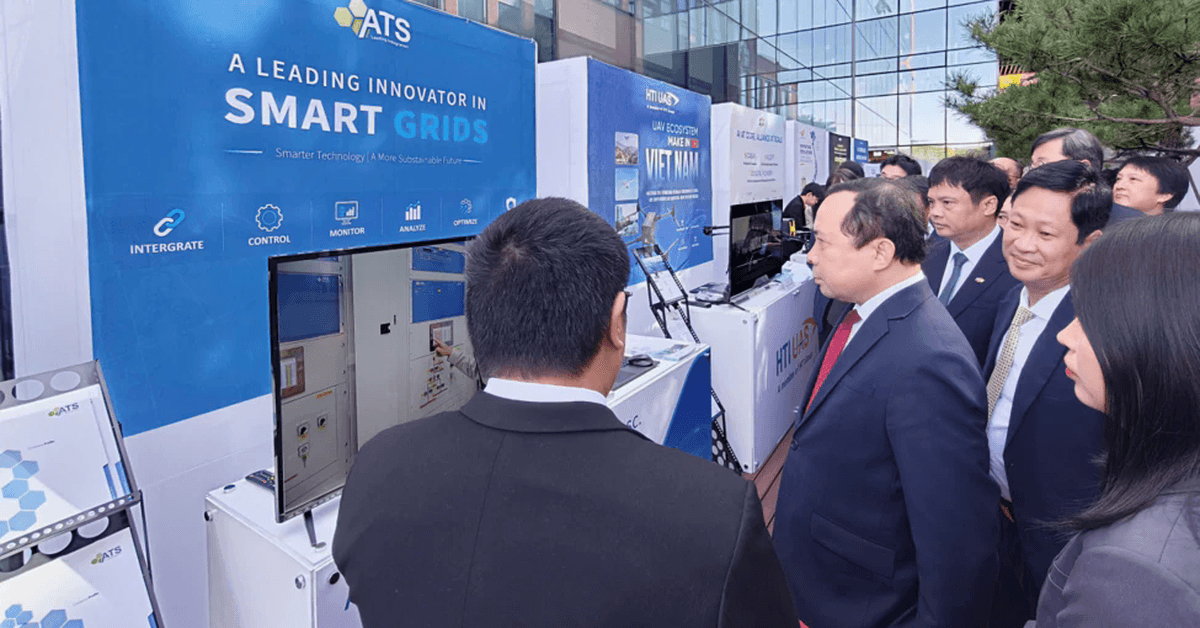
The low-altitude space economy encompasses more than just manufacturing and operating UAVs. These aircraft, combined with artificial intelligence, sensors, telecommunications, navigation technology, automation, and digital platforms, can form an ecosystem encompassing research, design, manufacturing, infrastructure, data, and specialized services.
Priority applications include logistics, agriculture , resource management, environmental protection, infrastructure monitoring, disaster prevention, search and rescue, medical emergency services, and smart cities.
In these areas, the value of technology is demonstrated through its ability to reduce transportation costs, increase production efficiency, shorten emergency response times, detect natural disaster risks early, or improve infrastructure management. The demand for these services creates a market for technology companies and operators.
Therefore, the development orientation links the expansion of applications with the building of domestic industrial capacity. The localization rate of key UAV models serving production is targeted to reach over 30-40% by 2030 and over 85% by 2045.
These indicators highlight the need for a step-by-step approach to mastering technology, developing domestic supply chains, and enhancing self-reliance in infrastructure and strategic data. The application market and production capacity need to develop together so that technology has an output, while domestic demand becomes the basis for long-term investment by businesses.
Place orders to form a market.
In conclusion, the State plays a guiding and leading role in the initial market through ordering, piloting, and applying in the public sector. This is an important aspect for a field where products, services, and business models are still in their formative stages.
The state focuses on creating the legal framework, governance system, standards, regulations, and essential infrastructure. Businesses play a central role in research, development, production, and commercialization, with the participation of research institutes and universities.
According to this approach, investment in technology must be linked to specific usage needs. Pilot programs need to verify both operational feasibility and socio-economic effectiveness, creating a basis for service development and market expansion.
At the local level, the exploitation, management, and protection of low-altitude space are required to be integrated into socio-economic development plans and programs. Local authorities should proactively select tasks that align with the issues that need to be addressed.
A mountainous province might prioritize transportation, healthcare , agriculture, and search and rescue. An industrial locality might focus on logistics, infrastructure monitoring, and industrial parks; a large city might choose applications in urban management and traffic.

UAV testing in Dien Bien.
Based on actual needs, localities determine the technology, users, service models, and investment resources. Effectiveness should be measured by the results of problem solving, the ability to maintain the service, and the value delivered, thereby limiting investment based on trends or building infrastructure that does not meet the needs of exploitation.
Market expansion goes hand in hand with management capabilities.
Exploring a new development space necessitates simultaneous management of vehicles, flight operations, and data. This concludes the need for a unified, modern national governance model based on digital platforms and risk management.
Activities are managed by region, hierarchical level, type, and risk level. The management process covers everything from registration, identification, licensing, operation, supervision, to inspection and handling of violations.
For new technologies, products, services, and business models, controlled testing mechanisms allow for verification within a defined scope and timeframe. Each test must have evaluation criteria, monitoring mechanisms, and conditions for termination or extension.
This mechanism facilitates the practical application of technology while identifying risks before wider deployment. The overarching requirement is to ensure national sovereignty, defense, security, safety, and the legitimate rights and interests of the people.
The target of contributing approximately 1.5% to GDP by 2045 requires translating technological capabilities into production and business capacity. Three pilot zones, a national research center, and commissioned programs are foundational steps; the ultimate outcome depends on the formation of businesses, products, and services that have a market, operate safely, and create lasting value.
Source: https://mst.gov.vn/viet-nam-dat-muc-tieu-kinh-te-tam-thap-dong-gop-15-gdp-197261002161928618.htm