
Video shows a man flying a kite in Tangshan city, Hebei province ( China ) in March 2026 - Source: NEW YORK POST
A video showing a young person clinging to a kite string and being pulled high into the air, suspended in mid-air in Cho Moi commune (An Giang province), has left many wondering: how could a lightweight kite made of fabric and frame lift an entire person off the ground?
If the wind increases by 20%, the force can increase by approximately 44%.
According to NASA's Glenn Research Center, when a kite flies, the airflow creates an aerodynamic force acting on it. This force is typically broken down into lift and drag, and then transmitted to the kite keeper via the string.
NASA describes the lift force of a kite using the following formula:
L = 1/2 × ρ × V² × S × C_L
In this formula, ρ is the air density, V is the relative speed between the air and the kite, S is the kite's surface area, and C_L depends on the kite's shape and wind angle.
In the formula above, the velocity V is squared. This causes the force to increase faster than the wind speed. If other factors remain almost constant, a 20% increase in wind speed, for example from 10 to 12 m/s, could result in a 44% increase in aerodynamic force. If the wind speed increases from 10 to 15 m/s, the theoretical force would increase by approximately 2.25 times.
Therefore, a brief surge of wind can cause the person holding or clinging to the rope to suddenly experience much greater force than they did just seconds before.
However, the lift force of the kite is not entirely transmitted vertically down to the person. The string is usually at an angle, so the tension in the string is both horizontal and upward.
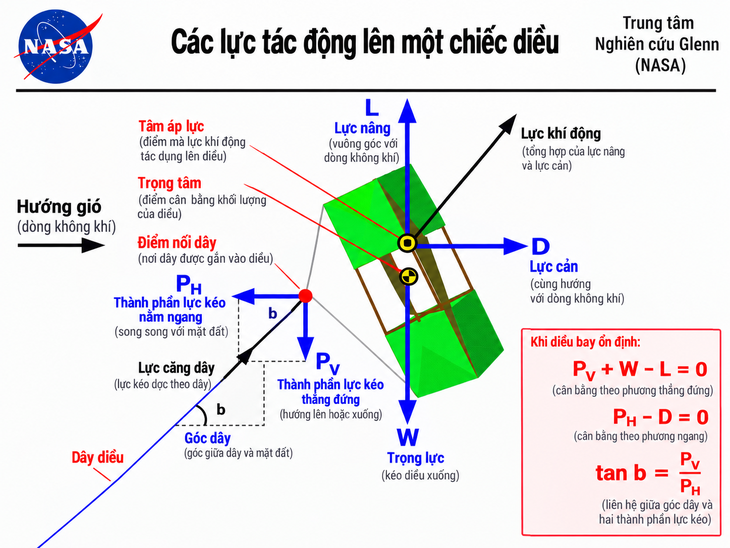
Simulating NASA's calculation formula - Photo: NASA
To put it simply:
Upward force = tension in the string × sin(angle of the string)
Meanwhile, the weight of the body pulls the person down to the ground.
A person weighing 70kg has a weight of approximately 687 N. If the rope makes a 60-degree angle with the ground, in an ideal model, the tension needed would be about 793 N just to balance the upward force on the person's weight. For the person to actually accelerate upwards, the force would need to be greater than this.
If the angle of the rope is lower, the tension required is even greater. With the rope angled at 45 degrees, a 70kg person needs approximately 971 N to balance their weight vertically.
This shows that whether or not a person is lifted depends on both the force of the kite and the angle of the string at that moment.
NASA also notes that the speed V in the formula is the relative speed between the air and the kite. It doesn't necessarily match the exact wind speed a person feels when standing on the ground.
When the kite is almost stationary in the air, the two values can be quite close. But if it's hurtling through a stream of wind or constantly changing direction, the relative speed between the kite and the air can increase, resulting in greater aerodynamic force.
This principle is utilized in sports like kitesurfing, where the pilot moves the kite back and forth in the wind to generate strong thrust.
Large kites have been known to generate string tension of up to 15,000 N.
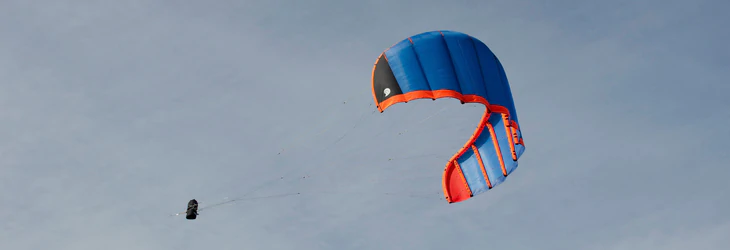
Kites in a 2019 study by Johannes Oehler and Roland Schmehl's team - Photo: WES
The ability of kites to generate significant force has been directly measured in numerous studies.
In 2019, Johannes Oehler and Roland Schmehl from Delft University of Technology, Netherlands , published their research on soft kites used to harness wind energy from the air in the journal Wind Energy Science .
A prototype with an area of 40 m² achieved a string tension of 15,000 N during a test flight in 2018.
To put the force into perspective, 15,000 N is roughly equivalent to the weight of an object with a mass of over 1.5 tons.
Of course, this is a specialized kite, and this figure cannot be applied to the kite that appeared in the video at Cho Moi. Nevertheless, it shows that a large kite can generate a force on the string far exceeding the weight of a person.
A study published in the journal Remote Sensing in 2022 also directly measured a commercial kite with an area of 12 m² and a string length of 24 m. The results showed that the string tension varied with wind speed, wind direction, and the kite's position in the flight area.
Therefore, with the same kite and the same person holding the string, the pulling force can change significantly simply because the kite changes position or a new gust of wind comes along.
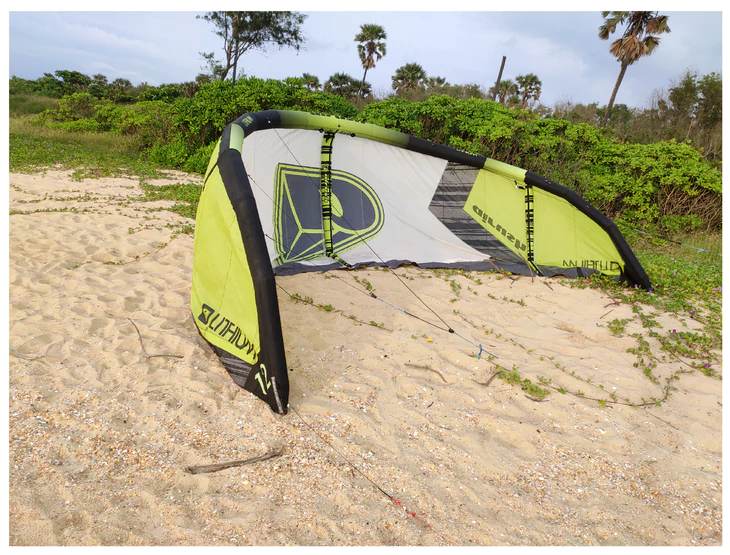
The kite was used in the 2022 study - Photo: MDPI
According to the National Museum of Australia, on November 12, 1894, inventor Lawrence Hargrave attached four box kites, fitted a chair to the system, and then lifted himself to a height of approximately 4.8 meters at Stanwell Park, south of Sydney.
This experiment was conducted while Hargrave was researching the principles of manned flight.
Modern kite-tossing sports also record many cases of players being lifted off the ground unintentionally.
A study of 127 kite-pulled tricycle riders in 17 countries, published in the Journal of Orthopaedic Surgery and Research , noted a common accident mechanism: riders being lifted off their tricycles by the force of the kite.
Sudden gusts of wind are cited by the authors as one of the possible causes of this situation.
Another study of 33 kitesurfing and kitesurfing accidents in Norway noted that wind gusts were a contributing factor in 8 of them. In one instance, a kite surfer was pulled up approximately 7 meters vertically and 15 meters horizontally after a gust of wind.
Source: https://tuoitre.vn/vi-sao-mot-chiec-dieu-co-the-nhac-bong-nguoi-len-khoi-mat-dat-100261006163620735.htm