
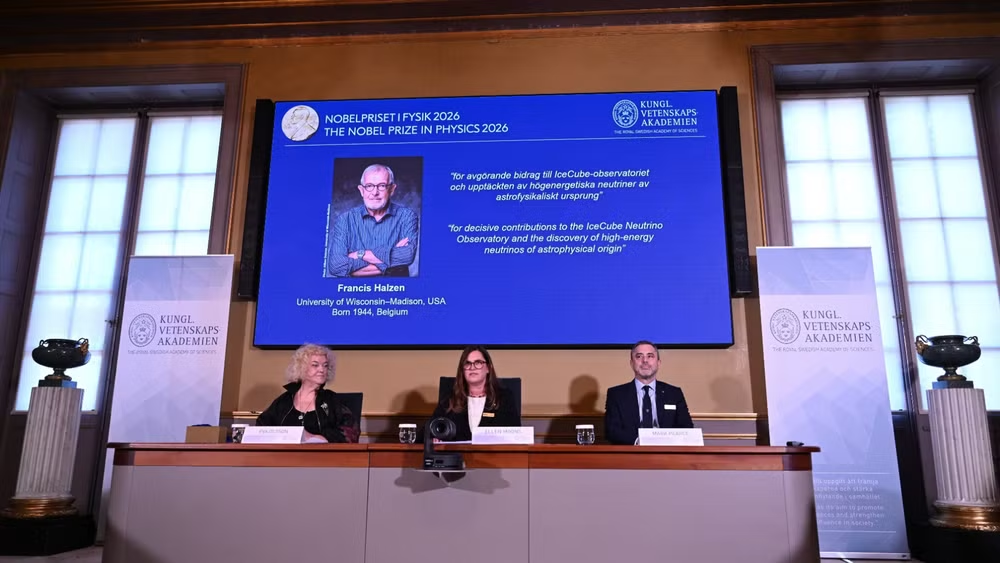
The research of scientist Francis Halzen focuses on detecting neutrinos—tiny subatomic particles considered "cosmic messengers" that help decipher the evolution of the universe.
Neutrinos are tiny subatomic particles that are ubiquitous and constantly traverse the Earth and the human body at near-light speeds. Despite their immense presence, they interact almost non-existent with matter and are not deflected by magnetic fields or lose energy along the way. This characteristic makes neutrinos the perfect "messengers," carrying information from the most violent cosmic events far away back to Earth – something other types of waves or particles cannot do.
In 1988, Professor Halzen first proposed the idea of using the monolithic ice sheet in Antarctica to "capture" neutrinos. When a high-energy neutrino rarely collides with an atomic nucleus in the ice, it produces an extremely faint flash of light. The pristine, geologically stable, and earthquake-free Antarctic ice sheet is the ideal environment for sensors to detect this phenomenon without interference.
This seemingly impossible idea has become a reality with the IceCube Observatory – a 1km³ ice block in Antarctica with a network of light sensors, completed in 2011. Thanks to IceCube, Professor Halzen and his colleagues were the first to detect high-energy neutrinos originating outside the solar system, opening up a completely new method of observing the universe (neutrino astronomy). Professor Francis Halzen's work not only solved a decades-long technical problem but also provided humanity with an invaluable tool to continue exploring previously unknown cosmic phenomena.
This is the second Nobel Prize to be announced in this year's Nobel season, following the Nobel Prize in Physiology or Medicine. The next prizes to be announced include the Nobel Prize in Chemistry (October 7th) and the Nobel Prize in Literature (October 8th). The winner of the Nobel Peace Prize will be announced on October 9th in Oslo, Norway . The Nobel Prize in Economics will conclude the 2026 Nobel season on October 12th.
Each Nobel Prize comes with a cash prize of 12 million Swedish krona (approximately $1.2 million), an 18-carat gold medal, and a certificate of award. If a prize is awarded to two or three people, the prize money is divided among them.
Source: https://nhandan.vn/giai-nobel-vat-ly-2026-vinh-danh-cong-trinh-nghien-cuu-ve-hat-neutrino-nang-luong-cao-co-nguon-goc-tu-vu-tru-post993325.html