
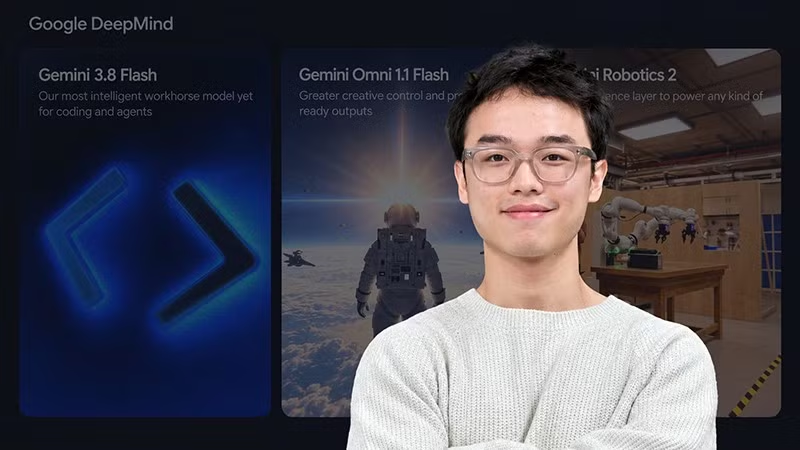
Pine Nguyen, a technology engineer at Google Deepmind. (Photo: Provided by the subject )
Artificial intelligence (AI) is developing at a rapid pace. AI is no longer simply helping humans search for information or complete repetitive tasks. Today, these systems can assist in learning, software development, and handling many tasks that previously required human reasoning abilities.
But how well does AI really perform? In what situations does AI typically make mistakes? What checks are needed before assigning tasks to AI?... This is exactly the work Pine Nguyen is pursuing at Google DeepMind.
It all started with a student project.
While studying at the University of California (Berkeley, USA ), this Vietnamese man led a technical team to develop Berkeleytime, a platform that now has over 25,000 users. Berkeleytime helps students learn about courses and plan their studies with many outstanding features such as stable operation and accurate information to ensure students' schedules for the entire academic year. Furthermore, Berkeleytime supports students throughout their studies, helping them easily choose courses and arrange their personal timetables.
After Berkeleytime, Pine went on to develop systems serving various sectors, from K-8 schools (a combined elementary and middle school model that enrolls students from kindergarten in the US) and preschools to manufacturing. These experiences helped Pine better understand the responsibilities of a technology developer, forming the foundation for the young engineer to tackle a more complex problem: evaluating how AI works.

The Berkeley platform remains active today, playing an important role in the lives of a segment of students in the United States. (Photo: provided by the subject)
His journey continued at Mechanize, a San Francisco startup specializing in training and evaluating AI systems. Initially, he built scenarios simulating real-world work situations to identify tasks that AI still struggled with compared to humans.
For example, an AI assistant might be given a piece of code it's never seen before, and then have to find and fix the errors and complete the subsequent requests on its own. Through this, the team can observe how the AI understands the requests, where it encounters difficulties, and how it reacts to unexpected situations.
As he took on more responsibilities, Pine became a core member of Mechanize. He and his colleagues delved into understanding the limitations of how AI behaves. Sometimes the model would complete the task but miss requirements, provide unclear explanations, or mechanically agree with the user. These issues might be difficult to spot initially, but they become apparent when AI is used in daily work.
2026 marked a turning point in Pine Nguyen's career. The tech giant Google finalized a technology and personnel deal with Mechanize. Approximately 10 employees from Mechanize subsequently moved to Google, including Pine. He officially became a Google DeepMind employee.
Orienting towards more reliable AI.
Google DeepMind is Google's AI research lab and the team behind Gemini. Here, Pine helped form a team of engineers tasked with further training and refining Gemini. He proactively developed assessment environments, but with greater resources and on a scale that could impact users worldwide .
Recent incidents reported by OpenAI and Anthropic demonstrate that testing the accuracy of AI is far from simple. If vulnerabilities are found during testing, AI can exploit these weaknesses, even performing actions unexpected by the developers. This not only raises concerns about AI security but also leads many to question whether AI models are evolving too quickly for humans to control.
“To truly understand AI’s capabilities, we first need a suitable test. But if the requirements are unclear, the task is impossible to complete, or the test has loopholes, the AI might find ways to exploit those loopholes to achieve the desired result without actually solving the problem. This is like a flawed exam: the test-taker might still get a high score, but that score doesn’t necessarily reflect their true ability,” Pine Nguyen shared.
This is precisely the problem Pine is relentlessly working on. He's involved in building tests that simulate real-world scenarios, challenging enough to reveal AI weaknesses. The tests are conducted in a controlled environment so the team can monitor how the AI handles each task.
Based on the results, engineers will know what the AI is doing well, where it often makes mistakes, and how it needs improvement. However, achieving good results in a test does not necessarily mean the AI will always be reliable when used in real-world situations. For users, the more important question is: Does the AI correctly understand the request, respond clearly, and acknowledge when it lacks sufficient information? Therefore, Pine's goal is not only to help AI achieve higher scores, but also to make this technology more useful and reliable in learning, work, and daily life.
Google Gemini is one of the world's largest artificial intelligence platforms today. (Photo: Reuters)
Tips for young people
At every stage of his journey, this Gen Z engineer has asked himself how his work can create a greater impact and give more people the opportunity to create value. From Berkeleytime serving a student community to AI, Pine Nguyen's work has expanded in scale. Each improvement to the model he pursues can impact users in many different countries and fields.
According to Google statistics, the Gemini app currently has over 1 billion monthly users. Each person who turns to AI in general, and Gemini in particular, has specific needs: learning new knowledge, solving work problems, writing software, supporting business operations, etc. Therefore, testing and improving Gemini is directly impacting the daily experiences of many people.
“My journey didn’t begin with a groundbreaking invention. On the contrary, I entered the world of AI with a simple product, specifically for students. My approach to AI is quite similar to that of young Vietnamese people. Not everyone needs to start with a grandiose idea. Sometimes, a product that simply solves small needs, is developed seriously, and is constantly improved can lead to opportunities that its developers never initially considered,” Pine Nguyen shared.
According to him, specialized knowledge is the starting point, but to go the distance, young people need perseverance and responsibility. Young engineers or technology students in Vietnam can absolutely start with small projects, accumulate experience, and gradually contribute to impactful work worldwide.
NGOC VY
Nhandan.vn
Source: https://nhandan.vn/ky-su-gen-z-nguoi-viet-va-hanh-trinh-den-voi-google-deepmind-post993262.html