Attending at the central headquarters were: Nguyen Thanh Nghi - Member of the Political Bureau, Secretary of the Central Committee of the Party, Head of the Central Policy and Strategy Committee; and Ho Quoc Dung - Member of the Central Committee of the Party, Deputy Prime Minister.
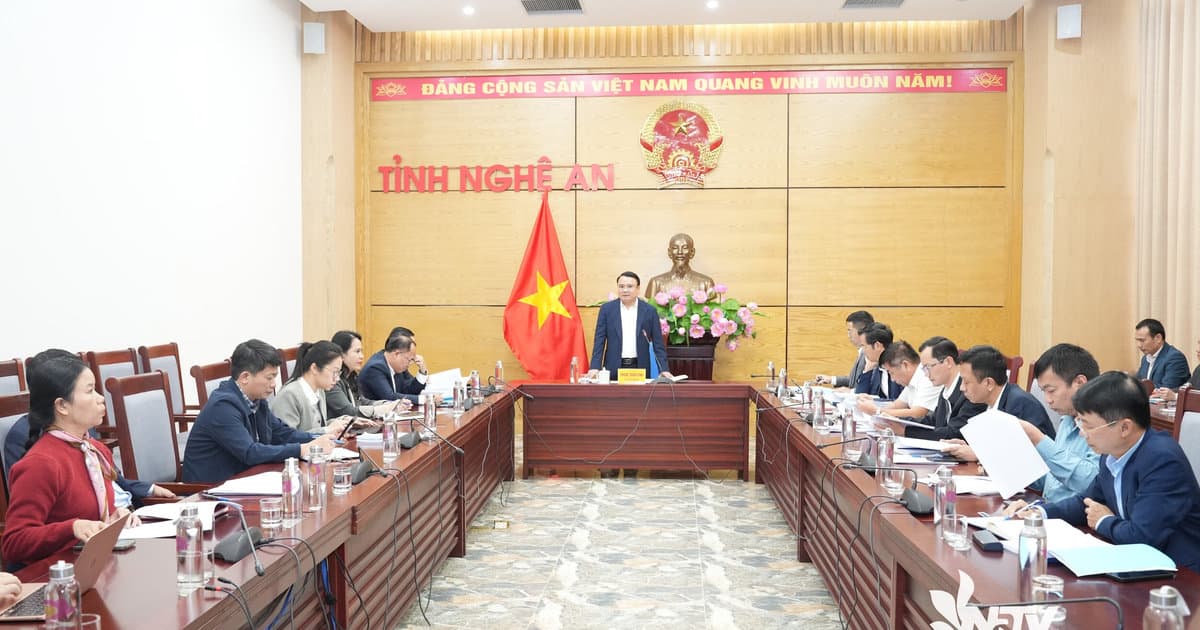
Comrade Nguyen Quy Linh - Member of the Provincial Party Committee, Director of the Department of Science and Technology - presided over the meeting at the Nghe An location.

The forum was organized to concretize the Party's guidelines and directions, especially Resolution No. 57-NQ/TW of the Politburo on breakthroughs in the development of science, technology, innovation, and national digital transformation .
This is an opportunity for central and local agencies, experts, scientists, and businesses to exchange ideas and clarify the requirements, roadmap, and solutions for implementing the National Digital Master Architecture Framework and the National Artificial Intelligence ( AI ) Development Strategy; and at the same time, identify difficulties and bottlenecks in institutions, data, technological infrastructure, human resources, and coordination mechanisms in order to promptly propose solutions to overcome them.
Speaking at the forum, Deputy Prime Minister Ho Quoc Dung emphasized the need to accelerate the construction and implementation of the digital architecture. According to the plan, ministries, sectors, and localities must complete the issuance of the digital architecture framework before January 29, 2027. This is an urgent task requiring decisive action from leaders and coordinated efforts among agencies and units.
Regarding the national AI strategy, the Deputy Prime Minister requested a shift from a mindset focused solely on research, development, and application of technology to a comprehensive transformation of national operations based on AI, considering it a core competency in governance, production, business, and public service delivery.
The strategy aims for Vietnam to be among the top 3 countries in Southeast Asia in AI research and development by 2030; for the AI economy to reach approximately 6% of GDP; and for labor productivity in AI-applied industries to increase by at least 10-15%. Notably, it strives for 100% of officials and civil servants to use AI-powered platforms weekly; for 60% of government agency decisions to be supported by data and AI; and for 100% of online public services to be integrated with AI.
To realize the above objectives, the Deputy Prime Minister requested ministries, sectors, and localities to focus on implementing six key tasks.
First and foremost, emphasize the responsibility of the leaders, who must directly supervise and be accountable for the progress and quality of building the digital architecture framework and the AI strategy implementation plan; assign tasks according to the "six clear principles," proactively address difficulties, and avoid delays.
In addition, it is necessary to review, inherit, and effectively utilize existing systems, avoiding scattered and duplicate investments; prioritizing the consolidation of infrastructure, platforms, and databases in localities after mergers, ensuring unified and smooth operation.
Another important task is to put data at the center, focusing on building, standardizing, and connecting databases according to the criteria of "accurate, complete, clean, active, unified, and shared," ensuring security and efficiency in data management and exploitation.
Simultaneously, priority should be given to deploying shared AI platforms within government agencies, focusing on AI assistants for public service, supporting the resolution of public services, institution building, and leadership and management. The application of AI must have mechanisms for risk control, monitoring, and accountability, ensuring that humans retain the final decision-making power.
Deputy Prime Minister Ho Quoc Dung also requested that the State play a leading role in developing the AI market, prioritizing the use of "Make in Vietnam" AI products; and proactively publicizing practical problems and needs to encourage technology companies to participate in research and product development.
In addition, strengthen inspection, supervision, and evaluation of implementation effectiveness; promptly finalize the KPI indicators, the national digital architecture management system, and criteria for evaluating the level of AI transformation. Focus on training digital skills and AI application skills for officials, civil servants, and public employees, especially at the grassroots level.
At the forum, delegates focused on discussing practical issues, sharing effective models, and identifying bottlenecks in the implementation of digital architecture and AI applications; thereby proposing feasible solutions that are appropriate to the conditions of each ministry, sector, and locality.
The synchronized implementation of the National Digital Master Architecture Framework and the National AI Development Strategy is crucial in creating a unified data platform, enhancing governance capacity, and promoting innovation in growth models.
The requirement for the coming period is to quickly translate strategic directions into specific programs, plans, and results; using the effectiveness of serving the people and businesses as a measure, contributing to the successful implementation of the national digital transformation goals in accordance with the spirit of Resolution No. 57-NQ/TW.