
Processing and manufacturing drive the growth "vehicle".
After three quarters, the industrial landscape of An Giang has become quite clear. The Industrial Production Index (IIP) in the third quarter of 2026 increased by 13.99% compared to the same period last year. This is the highest growth rate since the beginning of the year, bringing the cumulative growth for the first nine months to 13.74%, closely following the set plan. Notably, this growth came from a balanced distribution across many sectors, not just a few large enterprises. The processing and manufacturing industry increased by 14.84% and played a leading role. Mining increased by 14.36%. The electricity, gas and water supply, and waste treatment sectors both increased by over 6%.
Looking at the basket of key products, it's clear that the province's agricultural advantages are being transformed into industrial value. Frozen seafood production increased by 21.62%, and rice milling increased by 20.97%. These two items are directly linked to the raw material sources in the delta and coastal areas of the province. Labor-intensive sectors also recovered strongly: ready-made clothing increased by 17.96%, leather shoes by 11.76%. Stone quarrying increased by 14.88% and cement by 11.43%.
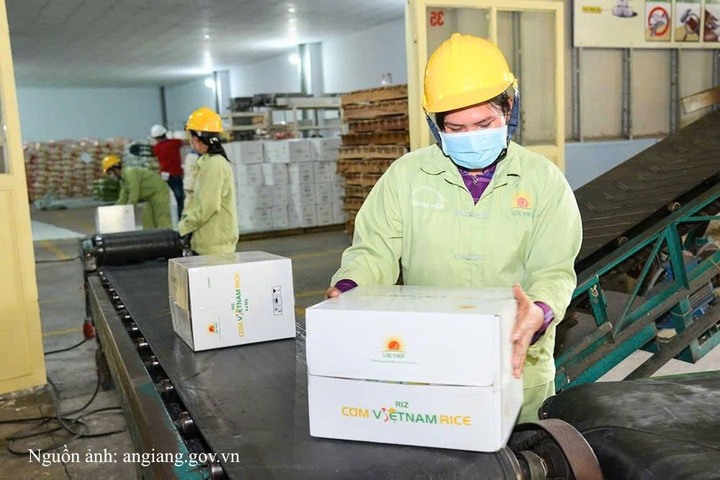
The processing and manufacturing industry grew by 14.84% in the first nine months of 2026, continuing to be the main driver of industrial growth in An Giang.
According to the An Giang Department of Industry and Trade, the driving force doesn't just come from orders. Most businesses have proactively innovated technology, improved processes, and expanded their consumer markets. They are also paying more attention to digital transformation , energy saving, and regional raw material linkages. This forms the foundation for the current growth rate to be more sustainable than cyclical recovery periods.
The trade and service sector accelerated even faster. Total retail sales of goods and consumer service revenue in the third quarter increased by 27.27% year-on-year. The cumulative increase for the first nine months was 25.27%, reaching 73.99% of the annual plan. Purchasing power increased in essential goods, food, and household items. Accommodation, food services, tourism, and transportation also showed a clear recovery, reflecting the attractiveness of Phu Quoc and the province's spiritual and border tourism cities.
In terms of exports, the value for the first nine months is estimated at US$1,837.3 million, an increase of 7.42% compared to the same period last year. Imports are estimated at US$872.5 million, a significant increase of 57.09%, despite a 12.4% decrease in the third quarter alone. However, export results only reached 68.74% of the annual plan. To reach the US$2,673 million target, approximately US$836 million is needed in the fourth quarter. This figure is nearly 27% higher than the US$658 million of the third quarter.
Removing the land acquisition bottleneck, paving the way for a new cycle.
While growth figures reflect the current "health" of the province, the policies issued over the past nine months indicate that An Giang is preparing for a longer-term future. The focus is on the Industrial Restructuring Plan for the period 2026-2030, with a vision to 2035, issued under Decision No. 1514/QD-UBND dated April 28, 2026. On August 10, 2026, the Provincial People's Committee issued Plan No. 443/KH-UBND to implement the plan. The plan clearly outlines key industry groups and assigns specific responsibilities to each department, sector, and locality. Units are required to report results periodically before December 1st of each year, thus preventing the plan from remaining merely on paper.
The biggest bottleneck for An Giang's industrial sector has long been the availability of clean land and industrial cluster infrastructure. According to the revised provincial development plan, An Giang has planned 44 industrial clusters with a total area of over 2,257 hectares. Besides the newly established My Phu and Hoa An clusters, investors have registered for three more clusters: Ha Giang (To Chau ward), Long Thanh (Long Thanh commune), and An Nong (Tinh Bien ward). To pave the way for investors, the Department of Industry and Trade has advised the Provincial People's Council to issue Resolution No. 12/2026/NQ-HĐND dated June 29, 2026, stipulating policies to support investment in the construction of technical infrastructure for industrial clusters, expected to be implemented in October. Simultaneously, the project for connecting the industrial clusters with a total budget of over 576 billion VND from medium-term public investment capital has completed its appraisal.
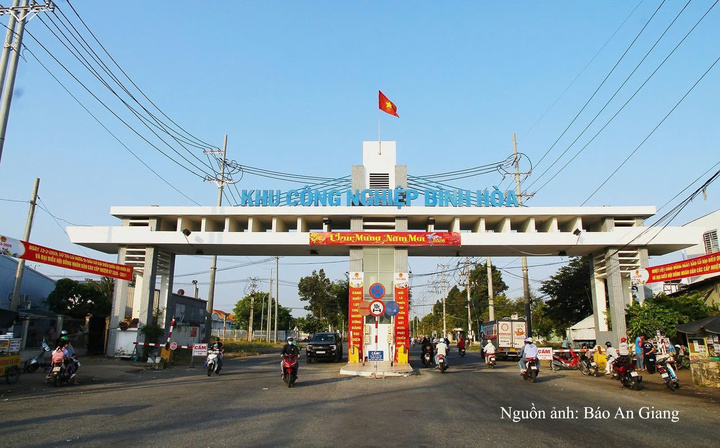
An Giang province has planned 44 industrial clusters with a total area of over 2,257 hectares, opening up opportunities to attract industrial investment in a new phase.
Initial results are evident. Accordingly, in the past nine months, the provincial authorities have granted investment approval for more than 14 industrial projects. These projects focus on processing agricultural and aquatic products, food, footwear, garments, building materials, and energy. Information on 19 industrial clusters has been compiled to facilitate investment promotion in Dong Nai City and Ho Chi Minh City. These two centers have abundant industrial capital but increasingly scarce land resources. The province is also developing a resolution to support secondary projects in industrial zones and clusters, which is expected to be submitted to the Provincial People's Council at the end-of-year session.
In the energy sector, time pressure is evident. The electricity sector is preparing to invest in five undergrounding, relocation, and power supply projects to serve APEC 2027, with a total investment of approximately VND 1,238 billion. The Department of Industry and Trade has advised the Provincial People's Committee to request the Government to resolve capital-related obstacles. The Department also regularly monitors the progress of land clearance for 110kV-220kV power projects in Phu Quoc. In the commercial sector, the Department of Industry and Trade, together with Central Retail, has surveyed supermarket and shopping mall infrastructure in Phu Quoc, Ha Tien, Giong Rieng, and Rach Gia . The province is currently seeking the opinion of the Ministry of National Defense regarding the proposed location for a supermarket in An Phu commune.
Nevertheless, the final sprint of the year is not easy. Input materials such as clinker, fly ash, slag, packaging, and raw seafood are sometimes scarce and expensive. Logistics costs, interest rates, and exchange rates continue to erode profit margins. In the third quarter, the petroleum market also experienced localized shortages due to slow deliveries by distributors. The Department of Industry and Trade has determined that in the fourth quarter, it is necessary to closely monitor key businesses and support their access to tax policies and loans. For each export sector, the province has specific solutions: linking raw material areas for rice, combating IUU fishing for seafood, and supplementing labor for garment and footwear industries. These are key conditions for An Giang to maintain its growth momentum and achieve its 2026 plan targets.
At the 2026 Planning and Investment Promotion Conference, An Giang province granted investment approval for 19 projects with a total capital of 66.9 trillion VND. This year, the province plans to commence construction on a series of energy projects such as the An Giang 1 Biomass Power Plant (50 MW), and solar power projects in Giang Thanh and An Cu. The target for industrial production value in 2026 is to exceed 134,382 billion VND.
Source: https://congthuong.vn/mo-duong-cho-cum-cong-nghiep-an-giang-giu-da-tang-truong-gan-14-475620.html