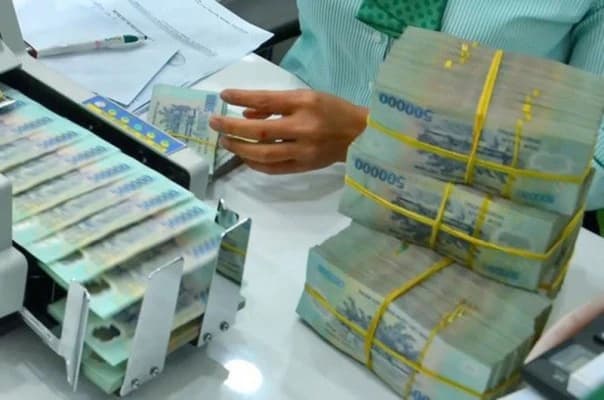

Rapid credit growth coupled with continued high demand for capital is putting pressure on deposit interest rates. Many banks are aggressively promoting deposit incentives, even issuing bonds with interest rates as high as 10.5% per year. According to experts, interest rates are unlikely to fall significantly from now until the end of the year, and there is limited room for a return to a period of cheap money.
Increased pressure to raise capital.
According to the State Bank of Vietnam, as of August 28, 2026, outstanding credit to the economy reached nearly 20.5 million billion VND, an increase of 10.24% compared to the end of 2025.
The persistently high demand for capital is forcing banks to intensify their fundraising efforts, thereby putting pressure on deposit interest rates and input capital costs. In reality, the currently listed interest rates are only for reference, as many banks implement additional interest rate programs through voucher giveaways, employee codes, or "golden hour" promotions.
At the beginning of October, the deposit market saw many new promotional programs, with interest rates exceeding 9% per year after additional incentives.
Cake by VPBank currently offers interest rates of 7.2%/year for 6-9 month terms and 7.4%/year for 10-24 month terms. During the program, which runs until October 31st, certain eligible customer groups will receive an additional 2.2 percentage points/year, bringing the interest rate for 10-13 month deposits up to 9.6%/year.
Techcombank also launched a program offering an additional interest rate of up to 1.8% per year for new deposits opened during the last week of September and the beginning of October.
Previously, a market survey at the end of September showed that NCB offered interest rates of around 9.35%/year for online deposits; GPBank at 9.1 - 9.3%/year for deposits from 100 million VND; Vikki Bank at approximately 9.2%/year for deposits from 200 million VND;SHB at 9.1%/year for deposits from 300 million VND; and MBV at approximately 9.04%/year. VPBank, OCB, BaoVietBank, and Sacombank also offered rates around 9%/year, depending on the program and conditions.
In addition to competition in the deposit market, the bank bond market has also become vibrant again as many banks increase issuance, pushing interest rates up to 9%-10.5% per year to supplement their capital.
Notably, PVcomBank issued bond issue code PCBL12604 worth VND 200 billion, with a 10-year term maturing in September 2036, and a fixed interest rate of up to 10.5% per annum, among the highest rates in the bank bond market in recent years.
In August, Sacombank issued bond tranches with fixed interest rates of up to 10% per year, with a 6-year maturity. SHB, TPBank, and Nam A Bank issued bonds with interest rates of 9.7% per year and 9.6% per year, respectively. Techcombank had bond tranches with interest rates of 8.6%-9% per year; VIB approximately 8.9%-9% per year; HDBank 8.7%-9.2% per year; and MB at 8.1%-9% per year. Among state-owned banks, BIDV issued bonds with interest rates of 8%-8.2% per year, while Vietcombank offered 7.87%-8% per year.
According to Dr. Can Van Luc, Chief Economist of BIDV, rapid credit growth forces banks to boost deposit mobilization, while people have many other investment options such as gold, stocks, real estate, and digital assets. Therefore, deposit interest rates must be attractive enough to keep money flowing in the system. Along with inflation expectations and high capital demand, these factors create additional pressure on deposit interest rates.

Mr. Nguyen Quang Huy, CEO of the Finance and Banking Department at Nguyen Trai University, also believes that the trend of increasing deposit interest rates reflects the capital needs of the economy and the pressure to balance funds at banks. When input costs increase, the slight rise in lending interest rates in some areas is an understandable development.
"It's more appropriate to say that interest rates are under upward pressure and showing differentiation, rather than viewing this as a simultaneous, rapid increase. To accurately assess the trend, it's necessary to simultaneously monitor deposit interest rates, lending interest rates, system liquidity, credit growth, exchange rates, and inflation," Mr. Huy analyzed.
Interest rates are unlikely to fall significantly between now and the end of the year.
Rising deposit interest rates increase banks' cost of capital, thereby putting pressure on them to adjust lending rates. Businesses therefore have to carefully calculate their cost of capital, cash flow, and investment efficiency, especially for long-term loans.
A representative of a food import-export company stated that the business currently has outstanding bank loans of 15 billion VND with an interest rate of 13% per year. Monthly revenue reaches 15-18 billion VND, with a profit margin equivalent to 10%-15% of revenue, or 1-2.7 billion VND per month.
"With the same loan amount, a trading company has to turn over capital 6-12 times a year, with only a 10% profit per turn. Therefore, we shouldn't worry about interest rates. The important thing is that we must identify market trends to avoid having our capital tied up," a business representative shared.
According to experts, interest rates are unlikely to fall significantly from now until the end of the year due to high demand for capital, while deposit growth has not fully met credit demand. Interest rates may decrease locally for certain customer groups or maturities, but generally will remain relatively high. The likelihood of a sharp, widespread increase is also low, and further reductions are quite limited.
Vietcombank Securities (VCBS) forecasts that deposit interest rates will continue to remain around their current high levels. The gap between lending and deposits remains large, forcing banks to strengthen their stable capital sources, especially medium-term capital. Competition for deposits is concentrated heavily in the 6-13 month term, while rising core inflation also limits room for further interest rate reductions.

Techcombank's analysis team also forecasts that deposit interest rates will mostly remain stable from now until the end of the year due to inflationary pressure and the need for capital to serve large-scale infrastructure and investment projects.
Conversely, accelerated public investment disbursement and the State Bank of Vietnam's liquidity support capabilities are expected to help limit interest rate hike pressure. According to Techcombank, if the State Bank of Vietnam resumes purchasing foreign currency to replenish reserves, the additional VND injected into the system could create room for interest rate reductions.
Mr. Nguyen Quang Huy believes that interest rate movements from now until early 2027 depend on many variables and are unlikely to decrease rapidly in a continuous trend. Interest rates are likely to remain stable and differentiated, depending on credit growth, capital mobilization, liquidity, exchange rates, and inflation.
"If macroeconomic balances are favorable, interest rate pressure may gradually decrease. Conversely, if capital demand increases faster than the ability to raise funds, pressure on interest rates may persist. Therefore, to sustainably reduce interest rates, it is necessary to create more sources of capital with reasonable costs," Mr. Huy analyzed.
To reduce the cost of capital, according to Mr. Nguyen Quang Huy, banks need to continue developing demand deposit accounts (CASA) instead of competing solely on interest rates. Expanding the payment ecosystem, digital banking, corporate cash flow management, and integrated financial products will help increase low-cost capital sources, creating more room to reduce lending interest rates.
In addition, banks need to reduce operating costs through digital transformation, automation, streamlining processes, and improving governance efficiency. This can help optimize resources and share some of the cost savings with customers.
Furthermore, leveraging the role of the stock market in increasing charter capital is also an important solution. A better equity capital base will help banks improve their financial capacity, reduce their dependence on increased capital mobilization, thereby contributing to controlling input costs and creating conditions for interest rate stability in the future.
Source: https://www.vietnamplus.vn/lai-suat-huy-dong-chiu-ap-luc-tang-kho-tro-lai-thoi-tien-re-post1139756.vnp