
Twelve provinces achieved growth rates of 10% or higher.
At a press conference announcing socio-economic statistics for the third quarter and the first nine months of 2026, organized by the General Statistics Office ( Ministry of Finance ) on the morning of October 3rd in Hanoi, Ms. Nguyen Thi Huong, Director of the General Statistics Office, stated that socio-economic results for the third quarter and the first nine months continued to be positive across many sectors and fields.
GDP in the third quarter of 2026 is estimated to increase by 9.95% compared to the same period last year, higher than the 8.15% increase in the first quarter and the 8.81% increase in the second quarter. For the first nine months of the year, GDP increased by 9.01%.
At the local level, 12 out of 34 provinces and cities achieved GRDP growth of 10% or more in the first nine months. Quang Ninh led with 12.5%, followed by Ha Tinh with 12.3%, Hai Phong with 12.08%, Bac Ninh with 11.8%, and Ninh Binh with 11.3%.
"Overall, high growth is concentrated mainly in localities with industrial foundations and large-scale processing and manufacturing production, while also being driven by investment, exports, and the development of the service sector, making a positive contribution to the overall economic growth of the country," the Director of the General Statistics Office emphasized.
In the first nine months, the agriculture, forestry, and fisheries sector grew by 4.02%; industry and construction by 11.2%; and services by 8.69%. Of these, industry and construction contributed 49.6% to the overall growth in the economy's added value, services contributed 45%, and agriculture, forestry, and fisheries contributed 5.35%.
Agricultural , forestry, and fisheries production maintained growth, with increased productivity and output of rice, fruit, livestock, and aquatic products, meeting both domestic and export demands.

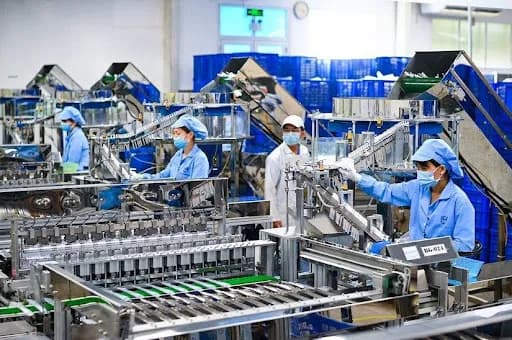
Industrial production continues to be a driving force for growth. The Industrial Production Index (IIP) in the third quarter is estimated to have increased by 14.8%; for the first nine months of the year, it increased by 12.3%, the highest nine-month growth rate since 2019. Manufacturing alone increased by 12.9%. This result was supported by several large-scale projects coming online, a recovery in export orders, and increased public investment.
In the service sector, trade, transportation, tourism , and services supporting daily life continued to grow. Domestic purchasing power improved, while tourism stimulus programs, events, and festivals contributed to boosting consumption and attracting visitors.
The number of registered businesses in the first nine months increased by 3.2% compared to the same period last year, and the number of businesses entering the market exceeded the number withdrawing. More than 223,900 businesses were newly established or resumed operations, averaging 24,900 businesses per month.
Conversely, nearly 89,800 businesses temporarily suspended operations, a decrease of 9.7%; 33,500 businesses ceased operations pending dissolution procedures, a decrease of 37%. Meanwhile, more than 48,700 businesses completed dissolution procedures, an increase of 118.8%.
Regarding international trade, the total value of goods exports and imports in the first nine months reached 888 billion USD, an increase of 30.4%. Of this, exports increased by 24.5%, and imports increased by 36.7%, resulting in a trade deficit of 19.4 billion USD.
State budget revenue in the first nine months increased by 12.1% compared to the same period last year, while budget expenditure increased by 14.5%. Regarding prices, the average CPI in the third quarter increased by 4.8% compared to the same period last year. Overall for the first nine months, the CPI increased by 4.52%, while core inflation increased by 4.26%.
"Under the leadership of the Party, the decisive direction and management of the Government and the Prime Minister , the involvement of ministries, sectors, and localities, and the efforts of the business community and the people, our economy achieved a growth rate of 9.95% in the third quarter of 2026. This is a positive growth rate, creating an important foundation to strive to achieve the socio-economic development goals for 2026," Ms. Huong emphasized.
Achieving double-digit growth is very challenging.
However, according to the head of the General Statistics Office, in the context of a global economy that continues to be complex and unpredictable with many uncertain factors, achieving double-digit growth is a huge challenge. Sectors and localities need to strengthen their efforts in updating and forecasting the situation, proactively and flexibly managing operations to suit the new circumstances; promptly addressing difficulties, and steadfastly implementing the growth target effectively while maintaining macroeconomic stability, controlling inflation, ensuring social security, and improving people's lives.
In addition, it is necessary to continue restructuring the agricultural sector towards improving quality, efficiency, applicability, and adaptability to climate change; promoting linkages in agricultural production, processing, and consumption, and developing sustainable value chains.
Industrial production needs to be promoted in a way that enhances competitiveness, proactively manages supply chain risks, diversifies supply sources, and controls logistics costs. At the same time, it is necessary to promptly remove obstacles related to procedures, land, and production and business conditions; and to accelerate the development of prioritized strategic technology products.
The General Statistics Office also proposed accelerating the disbursement of public investment capital in line with socio-economic efficiency; supporting the enhancement of export capacity, promoting sustainable exports, increasing added value, and diversifying markets.
Consumer stimulus programs, promotions, and demand matching initiatives should continue to be implemented, along with promoting tourism and service industries. At the same time, it is necessary to strengthen disease prevention and control; proactively respond to natural disasters, floods, droughts, and saltwater intrusion; ensure agricultural production safety and prevent forest fires to minimize economic losses.
Source: https://doanhnghiepvn.vn/kinh-te/9-thang-co-223-900-doanh-nghiep-lap-moi-va-quay-tro-lai-hoat-dong/20261003083414835