

Promoting unique values
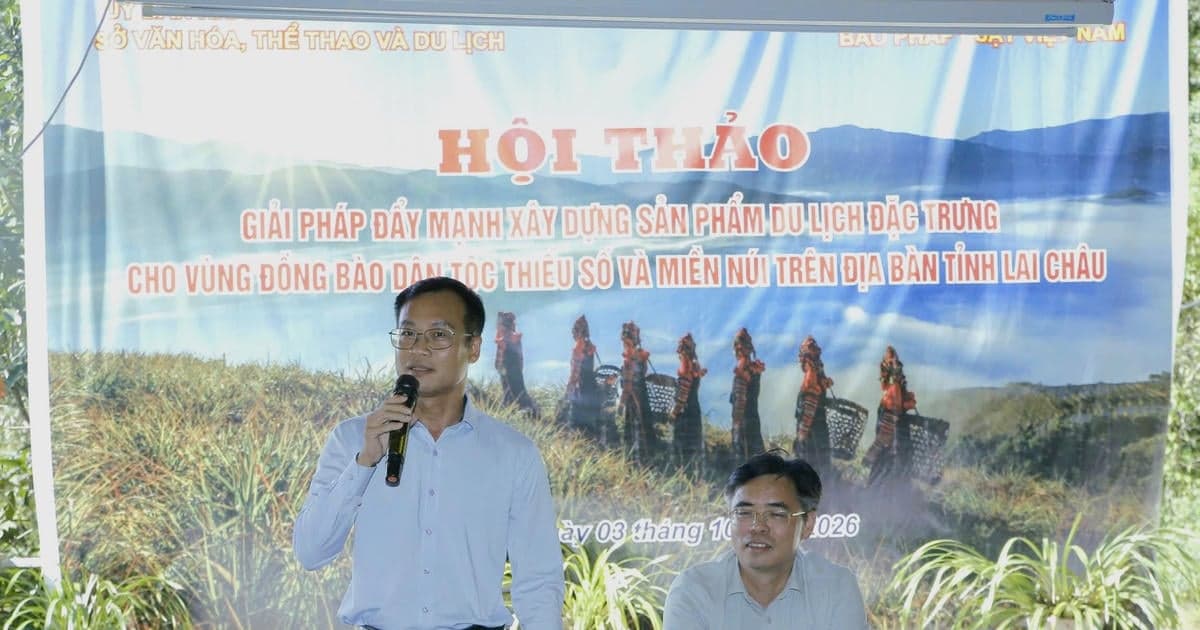
On the afternoon of October 3rd, within the framework of the "Footsteps on the Clouds Season 3 - Conquering the Ancient Stone Road of Pavi 2026" mountain climbing competition, at Sin Suoi Ho community tourism village, Sin Suoi Ho commune, the Lai Chau Department of Culture, Sports and Tourism, in coordination with the Vietnam Law Newspaper, organized a workshop on "Solutions to promote distinctive tourism products for ethnic minority and mountainous areas in Lai Chau province".

Mr. Tran Quang Khang, Deputy Director of the Department of Culture, Sports and Tourism of Lai Chau province, shared this at the workshop.
Mr. Tran Quang Khang, Deputy Director of the Department of Culture, Sports and Tourism of Lai Chau, said that Lai Chau is a land of mountain peaks, including 6 out of the 10 highest peaks in Vietnam such as Pu Si Lung, Pu Ta Leng, Bach Moc Luong Tu, Phan Lien San, Ta Lien Son, Po Ma Lung, Chung Nhi Vu, Nam Kang Ho Tao, and Ngu Chi Son. Each peak tells its own story.
Lai Chau boasts a diverse mountainous and forested ecosystem, home to 20 ethnic groups. Each community possesses its own unique culture, customs, and identity. Therefore, Lai Chau has rich potential for tourism development.
Located in the remote northwestern region, Lai Chau has chosen to develop tourism based on its unique features. Mr. Khang stated that Lai Chau has identified tourism development as leveraging the advantages of its indigenous highland culture and natural resources, closely linked to its forest ecosystem.
The province has identified two main product lines. Firstly, community-based tourism, which allows tourists to directly experience the lives of ethnic communities through activities such as homestays and visits to traditional villages.
Lai Chau's core orientation is to promote the unique characteristics of each ethnic group, avoiding duplication between destinations. Currently, Lai Chau has five typical community tourism villages that attract a large number of tourists to visit and experience: Sin Suoi Ho and Lao Chai of the Mong ethnic group; Vang Pheo of the Thai ethnic group; Tham village of the Lu ethnic group and Si Thau Chai of the Dao ethnic group.
The second key product is adventure sports tourism, through organizing adventure sports competitions. "Lai Chau has many high mountain peaks, the most beautiful and challenging trekking routes, and many peaks worth conquering," Mr. Khang said, inviting visitors.
Bringing the image and tourism products of the locality closer to tourists not only contributes to tourism development but also opens up opportunities to boost trade, create livelihoods, and improve the lives of the people.
Control development, preserve identity through planning.
With a focus on sustainable development, community-based tourism development in Lai Chau faces a major challenge in balancing tourism development and the preservation of cultural identity.

Journalist Tran Ngoc Ha, Deputy Editor-in-Chief of Vietnam Law Newspaper, moderated the workshop.
Mr. Tran Quang Khang shared that when tourists arrive in large numbers, their diverse needs make traditional cuisine susceptible to alteration. Clothing, customs, and architectural styles are at risk of commercialization, losing their original authenticity.
Taking Sin Suoi Ho village as an example, Mr. Khang said that this village is 100% inhabited by the Hmong people and still retains its original house architecture, customs, and traditional festivals.
Many years ago, Sin Suoi Ho was an extremely disadvantaged area, once plagued by opium cultivation and use. After years of developing community-based tourism and eco-tourism, the village has now become a civilized village with "5 no's" (no opium, no alcohol, no tobacco, no gambling, and no littering). In 2025, Sin Suoi Ho was awarded the title of "Best Community-Based Tourism Village in Vietnam" (part of the Vietnam Tourism Awards).
The development of community-based tourism has helped improve the village's infrastructure, raise people's living standards, and enrich its cuisine. However, along with the increasing number of tourists, the village also faces the risk of commercialization; the erosion, disruption, and loss of its unique identity.
Land allocated for housing and accommodation has increased, roads have been widened... Based on customer orders, the cuisine is also gradually changing. As a result, the unique characteristics of the village are at risk of declining.
Previously, the people of Sin Suoi Ho village did not sell their land to outside investors. However, the risk remains, as the land could become the subject of large-scale purchases. If another entity invests in guesthouses or hotels, the village will no longer be the community it is today…
Mr. Khang noted that this reality shows the importance of establishing a boundary between service development and the preservation of traditional spaces and cultural identity. Lai Chau's orientation is not to restrict tourism development, but there must be a clear boundary.


Delegates offer suggestions for developing tourism in Lai Chau.
One of the solutions Lai Chau is implementing is to conduct planning research aimed at maintaining building density and avoiding uncontrolled development that alters the existing spatial layout of the villages.
The detailed planning of Sin Suoi Ho village clearly defines the core area, specifying zones such as residential land and garden land. Once the detailed plan is issued and implemented, the construction of new buildings will have a basis for being restricted and controlled.
"The challenge is how to develop tourism while preserving the local cultural identity and unique values of each community. From architecture, culture, and cuisine to customs, everything needs to be preserved during the development process. This is the foundation for Lai Chau to not only build attractive tourism products but also create its own identity and move towards sustainable tourism development," Mr. Khang emphasized.
Also at the workshop, Mr. Khang provided additional information about major transportation projects that are currently underway or will be implemented connecting Sapa (Lao Cai) to Lai Chau, thereby helping the province develop tourism in the future.
Mr. Khang hopes that the delegates will work together to find solutions that both preserve the original cultural identity and promote effective communication to attract tourists to Lai Chau, breaking the long-standing situation of "high potential, low services, and lack of information."
To encourage tourists to "stay, experience, and spend"
At the workshop, chaired by journalist Tran Ngoc Ha, Deputy Editor-in-Chief of Vietnam Law Newspaper, delegates shared solutions for promoting Lai Chau as a tourist destination through various media channels.


Lai Châu has great potential for tourism development.
According to delegates, Lai Chau still has much potential for tourism, from scenic routes on high mountain peaks to destinations rich in cultural value and landscapes. One of the important factors for the development of tourism in Lai Chau is transportation infrastructure. When travel time is shortened, the number of visitors to the locality will have more opportunities to increase.
In addition, Lai Chau needs to focus more on product quality, training support staff and guides, and strengthening safety measures for tourists, especially for adventure and off-road tourism products.
The challenge for Lai Chau is not just about attracting tourists, but also about encouraging them to "stay, experience, and spend." To achieve this, the locality needs more products linked to its indigenous culture, from cuisine and handicrafts to local specialties and experiences in the villages. When tourists have things to experience, products to buy and take home, the value of tourism will truly spread to the local people.
As infrastructure, products, and service quality improve, Lai Chau's unique advantages will have more opportunities to be widely disseminated.
Source: https://baoxaydung.vn/lai-chau-quy-hoach-de-giu-ban-sac-phat-trien-du-lich-ben-vung-192261003211032138.htm