
Featuring five works created using traditional lacquer techniques without sanding, the exhibition marks a new direction of exploration after more than 15 years of the artist's dedication to lacquer painting.
Artist Hoang Huu Van shared with reporters from the Hanoi Press and Broadcasting Agency about his journey in practicing traditional lacquer techniques, which is opening up new creative avenues for him.
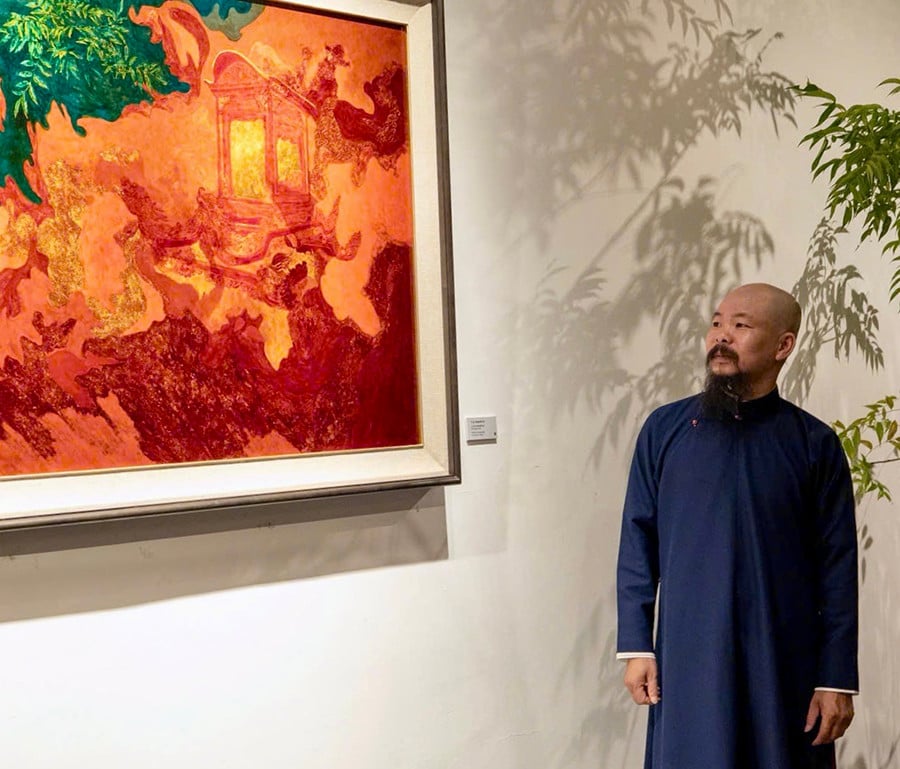
- After 15 years of working with traditional lacquer painting techniques (lacquer painting with sanding), what prompted you to switch to a technique that doesn't involve sanding?
- This was a deliberate choice of mine. During the creative process, having the opportunity to interact with and learn more about the history of traditional lacquer materials, I paid particular attention to the methods of working with traditional lacquer and the non-sanding technique. In fact, the non-sanding traditional lacquer was experimented with by some artists at the Indochina College of Fine Arts right from the early stages of introducing the material into visual art creation.
For me, traditional lacquer is a rustic, captivating, and thought-provoking medium. After 15 years of continuously working with traditional lacquer painting using the sanding technique, I began practicing traditional lacquer painting using the non-sanding technique.
And what surprised me most was that, when I no longer considered polishing as a mandatory condition of the creative process, I felt truly liberated. I was liberated in how I used materials, liberated in how I created surfaces, and liberated in how I could bring emotions more directly into my work.
Each work created using this method has led me to many interesting discoveries about the flexible expressive value of traditional lacquer painting, revealing the expansive depth as layers of paint overlap, penetrate, and blend to bring out vibrant colors.
The deeper I delved, the more I realized that, whether polished or not, the most important thing is to understand and express the essence, beauty, and unique feel of traditional lacquer.
- What requirements does traditional lacquer painting without sanding place on the artist?
- Not sanding doesn't mean simplifying the technique. Traditional lacquer is a very "fickle" material, but also very charming. It is greatly affected by temperature, humidity, and environmental conditions. The artist must understand the material and know how to "work" with the lacquer to create surface texture, color, depth, etc.
I spent months researching and practicing to find ways to control these factors, ensuring that the unpolished artwork would still be durable and achieve the desired aesthetic effect.
- In "Unpolished," you only present five works. Why did you choose such a modest number?
- These are five artworks created using traditional lacquer techniques without sanding. Through my artistic language and thinking, I want to tell the story of our national cultural heritage, in which traditional lacquer is a representative that embodies many distinctive values.
The five paintings, "Crossing Roads," "Under the Moonlight," "Red Brushstrokes," "The Beauty of the Countryside," and "Connecting Heritage," are arranged to form a journey, from choosing a new creative path and exploring the expressive potential of materials to returning to their roots, within a continuous flow of national heritage.
The works not only connect in terms of the flow of consciousness and ideas, but also represent a gradual refinement of technique, allowing traditional lacquer painting to express the artist's thoughts and emotions.
I also wanted to preserve my personal experience in the process of creating my first works using the non-abrasive technique. Therefore, I deliberately selected five works for the exhibition. Each work is a step in the exploration, a discovery of the expressive potential of traditional lacquer.
- Through the process of practicing traditional non-sanding lacquer techniques, what did you actually discover?
- I realized that it's not about choosing a particular technique that helps an artist best honor and enhance the value of traditional lacquer. The material itself is rich enough to express aesthetic thinking, with its vast expressive potential.
I've had the opportunity to conduct fieldwork at many temples and pagodas, learning about rural culture, traditions, and the history of traditional lacquerware. These experiences helped me understand more about the materials and methods our ancestors used.
However, today's visual artists need to find their own voice within that heritage foundation. This involves making choices within the overall context of traditional lacquer painting. By viewing the material from an artist's perspective, different from a craftsman's approach, I can discover suitable practices to reveal the material's inherent value.
- So, how will "No Grinding" open up the next stage of Hoang Huu Van's creative journey?
- I think after this exhibition, there will be a different Hoang Huu Van. I will continue to be committed to traditional painting techniques, but I won't limit myself to the unpolished technique. Subsequent works may combine both polished and unpolished techniques on the same surface, to continue telling stories about national cultural heritage and contemporary life rich in value and emotion.
Traditional lacquer is a material rich in heritage value, offering vast possibilities for creativity. I believe that, along with me, many artists are also exploring and discovering its hidden potential. This will open up new avenues of expression for traditional lacquer in contemporary Vietnamese art.
Thank you very much!
Source: https://hanoimoi.vn/hoa-si-hoang-huu-van-con-nhieu-nga-duong-sang-tao-with-traditional-paint-1759513.html