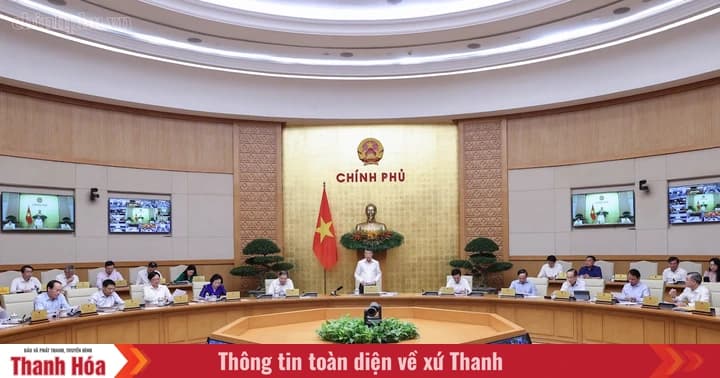


The Thanh Hoa Provincial Federation of Labor and Hoa Loi Group signed a cooperation agreement on October 1st.
For the resolution to be put into practice, it is important not only to organize study and dissemination but also to find specific implementation locations, concrete actions, and tangible results. The Resolution of the 20th Congress of the Thanh Hoa Provincial Party Committee identifies building a workforce with high professional and technical qualifications as a breakthrough in human resource development.
On September 9, 2026, the Provincial Party Committee issued Program No. 37-CTr/TU on building a workforce with high professional and technical qualifications to meet the development requirements of the province in the period 2026-2030, with a vision to 2045.
The Thanh Hoa Provincial Trade Union closely followed the Resolutions of the Vietnam Trade Union Congress, the Resolutions of the Vietnam Fatherland Front Congress of Thanh Hoa province, and the "Excellent Workers, High Productivity, Good Income" movement, transforming major goals into targets, tasks, and products at enterprises.
In that approach, Hoa Loi Group is a typical example with significant influence and widespread impact.
Having invested in Thanh Hoa since 2008, the Group's enterprises currently operate 23 factories in 20 communes and wards, creating jobs for approximately 120,000 workers. With this scale, the stability of employment, income, and labor relations at Hoa Loi's enterprises not only directly impacts the lives of hundreds of thousands of workers' families but also affects the production and business environment and the socio-economic development of the province.
More importantly, this is an area well-suited to test a new approach: trade unions don't stand outside the enterprise to advocate, but work with the enterprise to build a coordination mechanism, jointly identify what needs to be done, and share responsibility for the results.
Therefore, signing the Cooperation Agreement with Hoa Loi was not merely a formality or simply a way to address labor relations. It was about selecting a large-scale area to put the policy into practice, thereby evaluating, refining, and replicating effective models.
Don't wait for an incident to happen before taking action.
One of the notable changes in the Regulations is the shift in thinking from "handling issues as they arise" to "proactive prevention from an early stage, starting at the grassroots." Both sides agreed to maintain a mechanism for regular exchanges on production, employment, wages , income, and the thoughts and aspirations of workers; to improve the quality of worker conferences, dialogue, negotiation, and collective labor agreements; and to promptly address issues related to wages, bonuses, overtime, meal allowances, social insurance, working conditions, and safety. Cases exceeding their authority or with potential for complexity must be referred to the responsible focal point for coordinated resolution, limiting prolonged disputes.
This is also how trade unions fulfill their function of representing, caring for, and protecting workers in a more fundamental way. Protecting workers doesn't just begin when their rights have been affected or disputes have occurred. More sustainable protection means helping workers secure stable employment, acquire professional skills, work in safe conditions, have opportunities to increase their income, and have a mechanism for their voices to be heard, discussed, and resolved promptly. Conversely, a business with a stable, skilled, disciplined workforce that is listened to also has better conditions to improve productivity, quality, and competitiveness. This is where workers' rights and business development meet.
5 models for turning commitment into action
A notable aspect of the Regulations is that they go beyond general principles and focus on five specific models for the 2026-2030 period. The "Thanh Hoa Province Skilled Workers Competition" model aims to foster a movement of vocational training, skill development, skilled worker competitions, and the promotion of innovation and technical improvements. Importantly, the results of skilled work will not only be celebrated in a competition but will also be used by businesses as a reference in training, job placement, promotion, rewards, and career development.
The " Legal Advisory Team" model brings advisory services closer to workers, helping to receive suggestions early, classify them correctly, and process or forward them for processing promptly; thereby creating a "soft shield" to prevent risks and disputes at the grassroots level.
The "Workers' Cultural Space" model stems from the need for more comprehensive care. Workers need not only jobs and wages, but also an environment for learning, physical training, cultural exchange, access to legal advice, and enhancement of their spiritual lives, all conveniently located near their workplaces and residences.

Launching the Club of Trade Union Officials of FDI Enterprises in Thanh Hoa Province.
The "Trade Union Cadre as Party Branch Secretary" model aims to identify and nurture outstanding trade union cadres and members with competence and prestige; to promote the pioneering and exemplary role of the Party organization; and to link the activities of the Party organization with caring for workers, building stable labor relations, and working alongside businesses.
The "Model Trade Union - Exemplary Trade Union Member" model uses the effectiveness of representation, care, dialogue, initiatives, productivity, welfare, and contributions to the enterprise as a measure, shifting trade union activities from "being organized and active" to "having products, results, and impact."
These five models do not exist in isolation. Workers receive skills enhancement, legal advice, and cultural support; through movements to identify talented individuals, outstanding union members, and reputable officials; and from these factors, a core workforce is further built within the enterprise.
"Six clear points, one overarching principle" to go beyond just signing the agreement.
The core of this approach lies in its organizational method. Thanh Hoa province is adhering to the principle of "6 clear points, 1 consistent point" in its leadership and management: clear person, clear task, clear time, clear responsibility, clear authority, and clear output; each task has a single point of contact for continuous monitoring. The general spirit is that work must have a specific, verifiable output, not just general reports.
The Thanh Hoa Trade Union is incorporating this spirit into its task implementation. The plan for implementing Program No. 37-CTr/TU is divided into 31 tasks, each with a designated focal point, coordinating unit, deadline, and expected outcomes; the personnel directly responsible for implementation, the supervisors, and supporting documentation are all clearly defined to ensure accountability extends beyond the number of meetings or training sessions organized, focusing instead on the final results.
The regulations concerning Hoa Loi Group should also be viewed in that spirit. A worker's petition must specify who receives it, who processes it, the deadline, and the expected outcome. A training program must identify who is being trained, what skills are being taught, what the company needs, and how workers will improve after training. An initiative must be verified for its implementation. A skills competition must produce more skilled workers. A trade union model must create concrete benefits or positive changes.
In the province's leadership and management, the emphasized viewpoint is that dialogue should not be limited to merely "receiving" or "acknowledging" feedback; "tasks must be clearly assigned to specific individuals; tasks must have clear deadlines; and commitments must yield results."
That's also the spirit needed after a signing ceremony: sign to act, act to the end, and the final result must serve the workers and businesses.
From consensus to commitment to working together.
The practical significance of the above contents has received consensus from businesses. At the signing ceremony of the cooperation agreement on October 1, 2026, Mr. Lo Huai Sung, Deputy General Director of Hoa Loi Group, highly appreciated the role of the Trade Union in connecting workers and businesses, understanding their concerns, protecting their legitimate rights, and contributing to the stability of labor relations. The Group representative expects that the five models implemented in the 2026-2030 period will create substantive changes in skills, living standards, legal advice, as well as identify and nurture outstanding workers and union members.
More importantly, the Corporation has committed to strictly implementing the Coordination Regulations, creating conditions for the Trade Union to operate, coordinate in caring for employees, improve productivity, and build harmonious and stable labor relations, thereby contributing to the sustainable development of the enterprise in Thanh Hoa.
This commitment clarifies the meaning of "partnership." Trade unions do not replace businesses. Businesses, too, cannot remain indifferent to issues concerning workers. Each party has different functions and responsibilities, but they can meet at a common goal: workers progressing and their rights better protected; businesses having a stable workforce, higher productivity, and more sustainable development.
Based on a cooperation agreement with Hoa Loi Group, the Thanh Hoa Trade Union is aiming for a scalable approach: selecting the right enterprise, identifying the right problem, clearly defining responsibilities, organizing models that produce results, and following through to the final outcome.
If a policy on skills improvement is realized through a more skilled worker; a policy on welfare is concretized through better benefits; a demand for labor relations is transformed into a dialogue that resolves the issue; and a trade union movement generates increased productivity, income, and employee engagement within the enterprise, then that is the most practical way to put a resolution into practice.
And from then on, the message "Trade unions stand alongside businesses for the development of enterprises and the rights of workers" is no longer just a slogan, but is measured by concrete results in each enterprise, each production line, and in the lives of each worker.
Luong Trong Thanh
Member of the Provincial Party Committee, Chairman of the Thanh Hoa Provincial Federation of Labor.
Source: https://baothanhhoa.vn/cong-doan-thanh-hoa-dong-hanh-cung-doanh-nghiep-vi-quyen-loi-nguoi-lao-dong-303993.htm