

Recently, Ma Thi Phuong represented the voice of Vietnamese people with disabilities at the CASID 2026 International Research Conference held in Canada. Prior to that, in 2024, Phuong received a full Erasmus+ Mobility scholarship and had the opportunity to study at the University of Valladolid, Spain for six months. Also in that year, Phuong was selected to participate in the YSEALI Young Leaders Scholarship program at the University of Connecticut, USA.
Proactive adaptation
At the age of 15, shortly after passing her entrance exam for 10th grade, Ma Thi Phuong, a Tay ethnic minority girl, experienced a major health crisis. Her eyesight deteriorated and she eventually lost her sight completely. Phuong's life plunged into darkness. She was diagnosed with optic neuromyelitis, a chronic disease with no cure, which caused complete blindness in both eyes and risked paralysis. To prevent recurrence, she has to receive intravenous medication twice a year.
Phuong once went through a crisis and had to defer her studies for a year. During those days, what worried Phuong the most was not just losing her sight, but the fear that one day she would become a burden to her parents, family, and society.
During her most uncertain and confusing times, Phuong read many books and found inspiration to overcome adversity in "Adventures in the Dark" by Tom Sullivan - a blind American who lived an independent and successful life. Stories about Nick Vujicic, who was born without arms and legs, also helped her reflect on her own situation.
"There are people who can live a full life despite facing huge limitations, so why can't I? I asked myself that question and started thinking about the future in a different way," Phuong shared.
The first thing Phuong did was return to school after a year of leave of absence. Phuong became the first visually impaired student to be integrated into the curriculum at Luong Ngoc Quyen High School in Thai Nguyen . The first few days back in class were not easy at all.
After studying Braille for about two months, Phuong realized her writing speed couldn't keep up with the teacher's lectures. Furthermore, the teachers couldn't read Braille, making checking and correcting assignments difficult. Phuong changed her learning method. She switched to using a computer. She typed her assignments in Microsoft Word and sent the files to the teacher via email. For multiple-choice tests or questions with images, she asked friends or teachers to read the questions aloud, then thought about and chose the answers herself. The laptop became an important part of her learning.
Phuong joined technology groups for the visually impaired, asked experienced people for advice, explored software on her own, and tried different methods until she found one that suited her learning. This learning approach gradually formed a habit that later became part of Phuong's personality: not waiting for things to be designed for her, but finding ways to adapt and create suitable methods herself.
Conquer IELTS 7.5 through self-study.
In 2020, after graduating from high school, Phuong applied for the RMIT University's "Wings of Dreams" scholarship. She was rejected due to a lack of English proficiency. That failure made Phuong realize that foreign language skills would greatly influence her future choices. When she enrolled in the Social Work program at the University of Science - Thai Nguyen University, Phuong invested seriously in learning foreign languages to seek scholarship opportunities abroad and broaden her knowledge and understanding.
She started studying for the IELTS seriously in 2021. On her first attempt in 2023, Phuong achieved a 6.0. That milestone wasn't the end goal, but it was proof that she could go further on her own. Two years later, Phuong decided to retake the test. This time, she studied entirely on her own.
Without fixed classroom settings or a teacher sitting beside her to correct each piece of writing, Phuong leverages technological tools, turning artificial intelligence into a mentor. She uses ChatGPT, Gemini, Poe, and other tools to learn English, detect errors, and suggest vocabulary and grammar. OCR software converts PDF files or scanned images into text so she can read it using supporting software.
Phuong's learning method is quite unique: listen, memorize, correct yourself, and then redo it. For speaking skills, she prepares answers for predicted test questions in advance, then uses ChatGPT to suggest more natural ways of expressing herself or adding idioms to make her speech more lively and sound more like a native speaker. Thanks to this persistent effort, in December 2025, Phuong successfully achieved an IELTS score of 7.5.
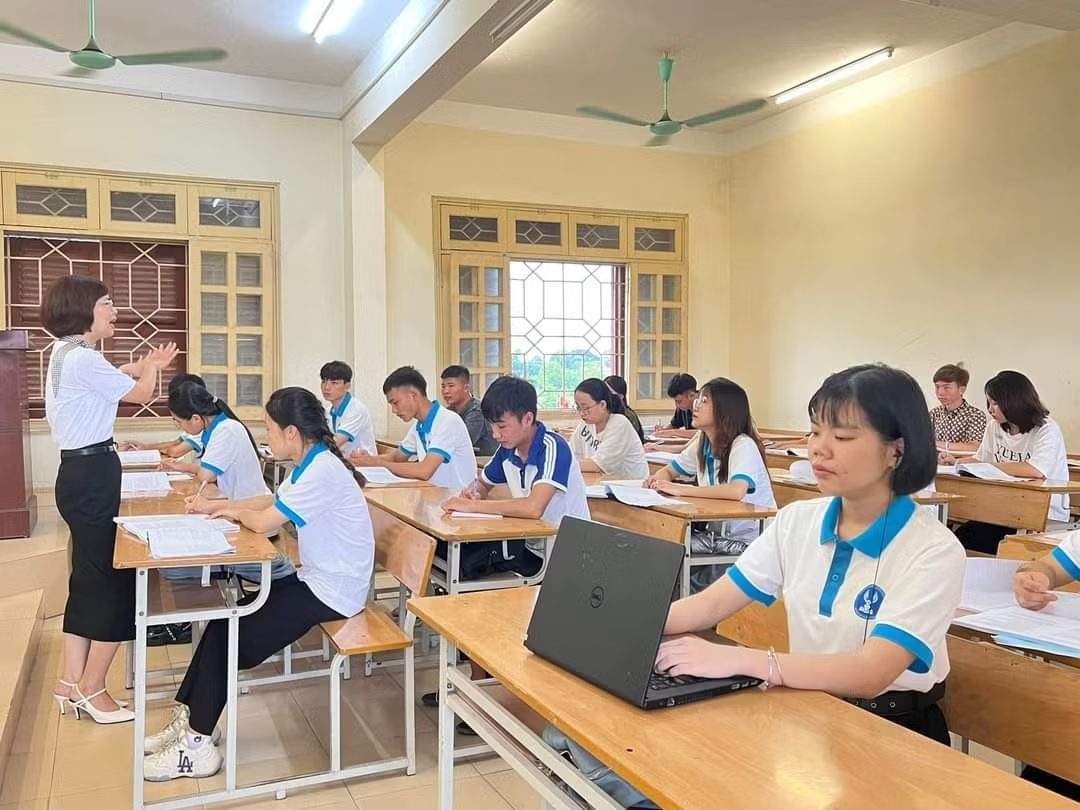
Ma Thi Phuong (far right) considers her computer a companion that helps her step out into the world and integrate into the community.
Recently, Phuong won a full scholarship for a Master's degree in Public Policy. While waiting to enroll, Phuong organized English classes for young people. She particularly dedicated her time to supporting students with disabilities in accessing foreign languages and preparing for the IELTS exam. Phuong shared that she herself used foreign languages to connect with the world. Now, she wants to pass that tool on to other young people, especially those in similar circumstances. Because she understands that sometimes a seemingly ordinary skill like the ability to use English, technology, communication, or network can become the key to unlocking a completely different door.
Ma Thi Phuong is one of 26 disabled youths nationwide selected and honored by the Central Committee of the Vietnam Youth Union in the "Shining Vietnamese Resilience" program in 2026. These are exemplary disabled youths, full of resilience, overcoming adversity, and making many contributions to the community.
Currently, Phuong is involved in the Hoa Thuy Tien project, providing English language and life skills support to visually impaired young people nationwide; and is also working with the Breaking Down Barriers project to enhance soft skills and expand employment opportunities for students with disabilities.
In the field of research, Phuong is a local research associate for the EDID project, in collaboration with Carleton University (Canada), studying gender-based violence against women with disabilities. She also participates in coordinating a project to enhance the socio-economic capacity of single women with disabilities for the CEPEW organization.
Phuong doesn't talk about resilience in the familiar way of inspirational stories. For her, people with disabilities shouldn't just be seen as those who "extraordinarily overcome difficulties." What she wants to change is how society perceives the abilities of people with disabilities.
“I have always held an unwavering belief: People with disabilities can make positive and sustainable contributions to society when we proactively develop our inner strengths and are given equal opportunities.” – Ma Thi Phuong, born in 2001
Instead of the story of "a poor disabled person who overcame adversity," Phuong wants more ordinary stories: a disabled person attending university, working, researching, starting a business, participating in international projects, paying taxes, supporting themselves, and contributing to the community. According to Phuong, that's what a truly inclusive society should be like. Phuong also wants the media to change the way they portray people with disabilities: not with self-deprecation, not with a sense of entitlement, not focusing solely on their shortcomings, but recognizing their abilities, value, and concrete contributions.
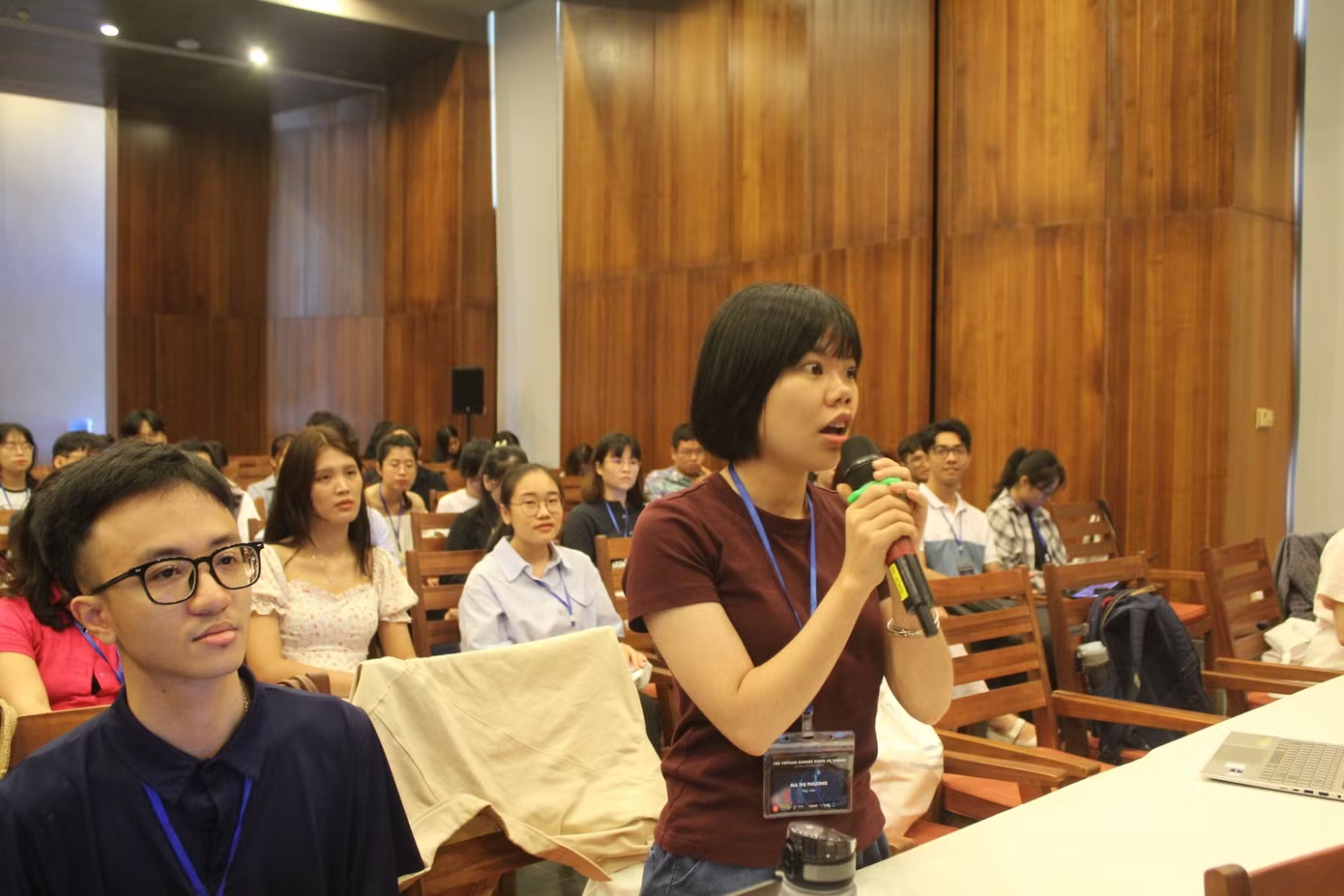
Student Ma Thi Phuong confidently participates in many forums and seminars both domestically and internationally.
Phuong hopes that in the future there will be more scholarships, support funds, and community initiatives led by people with disabilities. She hopes that international projects on education , livelihoods, and social research can reach local communities more easily.
One proposal that Phương is particularly interested in is building a network connecting universities, businesses, and social organizations, creating a cycle from skills training to job placement for people with disabilities. Because learning only truly opens up opportunities when that knowledge can be transformed into livelihoods and independence.
Source: https://tienphong.vn/co-gai-khiem-thi-buoc-ra-the-gioi-post1875050.tpo