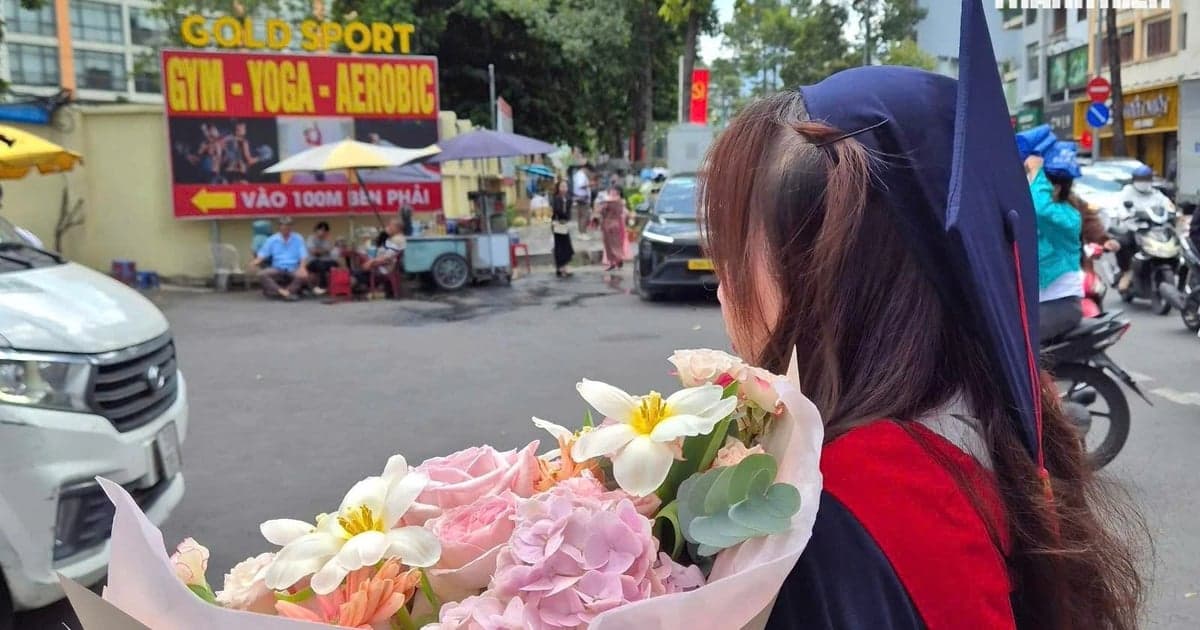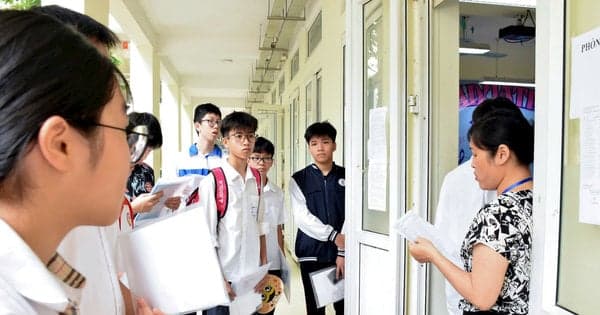


Many teachers have suggested revising textbooks to simplify, standardize, and increase consistency - Photo: DUYEN PHAN
On October 2nd, the Ministry of Education and Training announced the adjustment and updating of textbooks, finalizing them for use starting from the 2028-2029 school year.
According to experts and teachers, the reform of textbooks under the 2018 General Education Program is necessary. However, based on teaching experience, opinions suggest that textbooks need to be further streamlined, standardized, and made more consistent, while removing inappropriate materials to make teaching and learning more substantive.
On October 3rd, Tuoi Tre newspaper interviewed several teachers about the revision of textbooks, focusing particularly on the Literature subject.
Literature textbooks: Reduce theory and text to encourage in-depth reading for students.
According to Mr. Tran Le Duy, a lecturer in the Department of Literature at Ho Chi Minh City University of Education, the revision of the Literature curriculum and textbooks should aim for three requirements: simplification, standardization, and consistency.
Accordingly, it is necessary to reduce overly complex or ambiguous theoretical content in literature. Concepts such as point of view, symbolism, surrealism, etc., should not be presented in excessive detail; instead, the focus should be on helping students recognize and explain their effects in texts.
The teaching of different writing styles also needs to be streamlined. Writing types that fall outside the focus of the 2018 general education curriculum, such as literary analysis, analysis of life phenomena, and adaptation analysis, can be reviewed to avoid students having to learn too many different writing styles while their fundamental writing skills are not yet strengthened.
Regarding essays on "problems that need solving," Mr. Duy believes that the problem presented must genuinely need solving, such as difficulties, conflicts, or gaps that need to be overcome. Topics like the role of friendship, the significance of reading, or compassion, if only requiring students to present positive aspects, do not clearly reflect the characteristics of this type of essay.
Sample essays should also adhere to core principles such as clearly defining the thesis, using evidence, analyzing evidence, clarifying the relationship between content and form, and ensuring coherence.
Another problem is the text density in textbooks. Too much text forces teachers to rush through the program, students read quickly, and there's little opportunity for in-depth study. Meanwhile, reading comprehension ability doesn't depend on the quantity of text but on what students do with the texts they've read.
"I believe it's necessary to reduce the text density in some lessons. In some lessons, students are exposed to too much text in a short period of time. When the amount of text is too large, teachers are forced to speed up the pace of instruction, while students have difficulty reading in depth, analyzing evidence, discussing interpretations, and practicing transitioning to new texts."
"Developing reading skills doesn't depend on how many texts students have 'gone through,' but on what they actually do with those texts," Mr. Duy emphasized.
Should we introduce 'Bullying' and 'The Magpie' into the 11th grade curriculum?
A Literature teacher in Ho Chi Minh City has proposed removing the texts "Bullying" and "The Magpie" from the 6th grade curriculum and moving them to the 11th grade.
According to this teacher, in the poem "Bullying," some lines like "Just come and bully me. I'm used to being bullied" or " Why test the weak? Why not tease mustard?" may not be appropriate for sixth-grade students. The way the poem is presented doesn't really help students approach the issue of bullying in a way that helps them solve it, but rather creates a sense of challenge.
Meanwhile, Mai Van Phan's "The Magpie" is considered aesthetically valuable, but uses a highly symbolic style of poetry. The teacher believes this text is more suitable for 11th-grade students, as they have already learned more deeply about the characteristics and identification of symbolism in literature.
Furthermore, this teacher noted that among the three textbooks, "Connecting Knowledge with Life" contains many texts with educational and philosophical content, so further consideration should be given when selecting reading comprehension texts on this topic.
In addition, the selection of authors and works should also take into account cases where the author has made controversial statements in real life.
Avoid learning many different types of material but lacking depth.
Mr. Tran Le Duy also pointed out several existing problems in current Literature textbooks, such as combining too many genres in the same lesson unit; some knowledge and skills are repeated many times but the level of improvement is not clear.
Furthermore, the lesson sequence is not properly aligned with the actual testing and evaluation methods used in schools, resulting in many difficult texts, complex genres, or intricate theoretical concepts being concentrated within a single semester. The textbook's structure also fails to account for mid-term and final exams, forcing teachers to rearrange lessons or make significant adjustments to the book's structure.
"In short, I believe the goal of revising the Literature textbook should not just be to 'reduce content,' but more importantly, to reduce clutter and increase depth. A good textbook doesn't necessarily need a lot of terminology, types of exercises, or texts. What's important is that each piece of content included has a clear reason, directly serves reading and writing skills, is consistent throughout the entire grade level, and is appropriate to the students' actual comprehension abilities."
"Only then can the study of Literature shift from 'learning to grasp the content' to 'learning to truly be able to read, write, and think'," he expressed.
Source: https://tuoitre.vn/chinh-sua-sach-giao-khoa-giao-vien-de-xuat-dua-bat-nat-con-chao-mao-tu-lop-6-len-lop-11-100261003125428491.htm