

 |
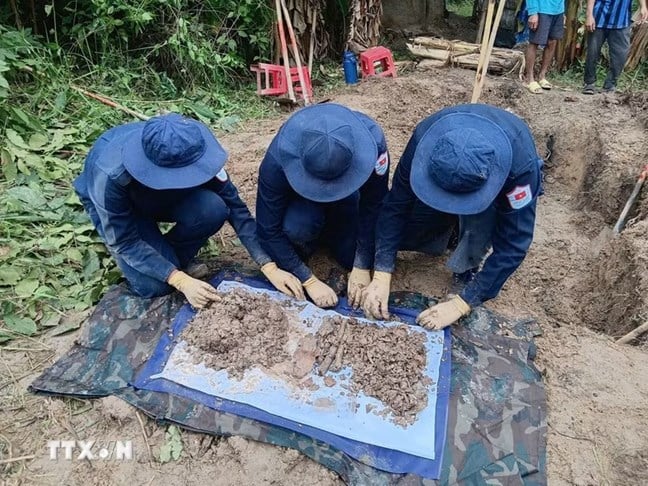
| Team K93 of An Giang province collects the remains of fallen soldiers in O Lam commune, An Giang province. (Photo: VNA) |
Based on information from residents in Son La, authorities found two remains of fallen soldiers after four days of searching; at Le Thi Rieng Park in Ho Chi Minh City, 701 remains were collected along with 304 sets of artifacts; and in Ca Mau, more than 3,000 unidentified graves were excavated and biological samples were taken.
These achievements are being followed up by the verification of records, information gathering, and DNA testing in the 500-day campaign to intensify the search, collection, and identification of the remains of fallen soldiers.
"As long as there is information, we must continue to verify it; as long as there is a basis, we must continue to search for it."
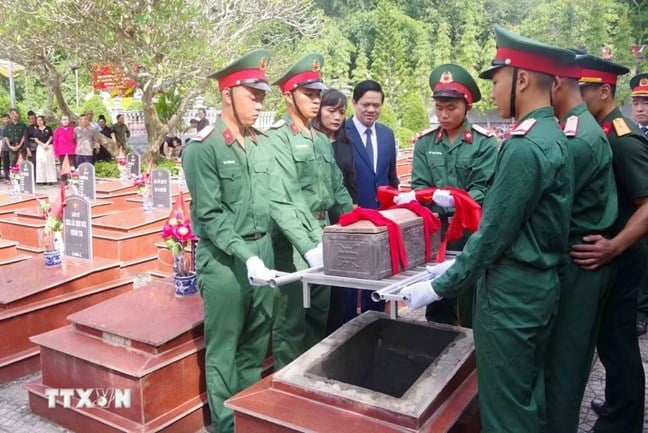 |
| Memorial service and burial of the remains of fallen soldiers at Yen Chau Commune Cemetery, Son La Province. (Photo: VNA) |
In late September 2026, based on information from residents of Cang Kieng village, Chieng Khoong commune, Son La province, authorities organized a search in the garden of a family believed to be the burial place of two martyrs who died in the resistance war against French colonialism.
Four days later, on September 27th, two sets of remains were found along with skulls, leg and arm bones, teeth, and several artifacts, including shrapnel. Biological samples were also collected for DNA testing.
On the morning of October 1st, two sets of remains were commemorated and buried at the Martyrs' Cemetery in Song Ma commune. According to Hoang Van Thuyen, Chairman of the People's Committee of Song Ma commune, the local authorities are continuing to coordinate with relevant agencies to collect biological samples in order to quickly identify the martyrs and provide them with accurate names and ages.
Initial information about the two fallen soldiers was provided by Mr. Luong Van Tui and Mr. Ha Van Pang, both from Cang Kieng village. Based on this lead, the authorities, in coordination with the local government, mobilized 30 officers, soldiers, and militia members to conduct a search in the identified area.
Also during the last days of September, at Le Thi Rieng Park in Ho Chi Minh City, search teams continued working amidst heavy rains . On October 1st, the team responsible for collecting the remains of fallen soldiers under the Ho Chi Minh City Command discovered 19 more sets of remains, bringing the total number of remains found and collected in this park to 701, including 668 individual remains and 33 sets of remains in 8 mass graves, along with 304 sets of artifacts. On that day alone, more than 500 cubic meters of soil were processed using machinery combined with manual excavation.
Heavy rains caused water to flood the excavation pits, making the soil muddy and hindering the search and recovery efforts. Officers and soldiers of Team K74 used high-capacity pumps to drain the water, covered the pits with tarpaulins, and continued digging manually in necessary locations. Lieutenant Colonel Le Ngoc Ha, Team Leader of Team K74, said: “Heavy rain is treated like light rain, and light rain is treated like no rain at all. When we discover remains, we put up tarpaulins, light up the pits, and work all day, all night, through the night to bring the remains up.”
Ho Chi Minh City also completed the collection of biological samples at all 18 martyrs' cemeteries, totaling 9,854 samples, of which 7,104 were eligible for DNA testing. In addition to the Le Thi Rieng Park area, authorities also searched for and recovered five more sets of remains in Thuong Tan commune.
According to Nguyen Manh Cuong, Vice Chairman of the People's Committee of Ho Chi Minh City and Head of the Steering Committee for the search, collection, and identification of the remains of fallen soldiers, the city continues to review and supplement records, lists, diagrams, and maps; exploit sources of records and documents; and meet with historical witnesses, veterans, and the people. Information must be verified, and the search must continue.
Expedite sample collection and DNA testing to identify fallen soldiers.
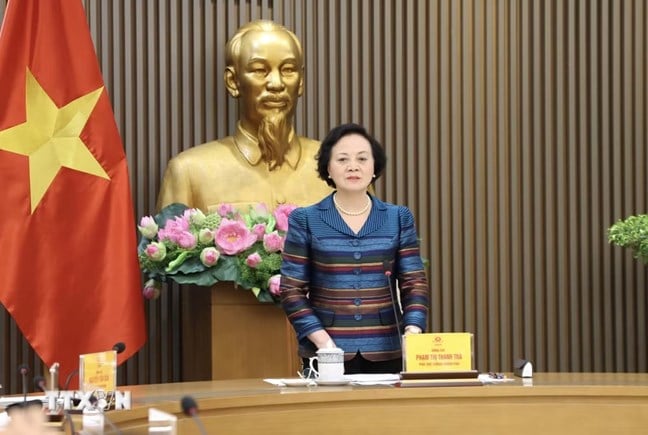 |
| Party Central Committee Secretary and Deputy Prime Minister Pham Thi Thanh Tra , Head of the National Steering Committee for the Search, Collection, and Identification of the Remains of Martyrs, delivers a speech. (Photo: VNA) |
The work of collecting biological samples is also being carried out in many places. In Ca Mau , as of September 26th, forces have excavated 3,184 out of a total of 3,464 unidentified graves at 11 martyrs' cemeteries, with a success rate of 73.8% in collecting biological samples.
At the provincial Martyrs' Cemetery, eight specialized teams are maintained to carry out excavations and sample collection. Excavated graves are inspected, information is recorded, and samples are collected according to procedure before being transferred to the testing facility. Ca Mau plans to transfer the collected samples to Hanoi for handover to DNA testing agencies on October 5th.
Lieutenant Colonel Vuong Dac Phong, of the Communications Company, Staff Department, Ca Mau Provincial Military Command, who is directly involved in this work, said that whenever they find relics, the officers on duty are deeply moved and carefully preserve the remains and artifacts, hoping to bring the martyrs back to their families as soon as possible.
Following the search process is the identification of the remains of fallen soldiers. During a meeting on September 14th between Deputy Prime Minister Pham Thi Thanh Tra, Head of the National Steering Committee for the Search, Collection, and Identification of the Remains of Fallen Soldiers, and the Standing Agency of the Steering Committee, the Ministry of Interior reported that the assigned units had completed the identification of 18,000 samples of fallen soldiers' remains within the framework of the Campaign. As of the reporting time, only 210 samples had been identified, and the identities of 10 cases had been confirmed.
Forensic facilities are receiving a large number of samples. The National Forensic Institute received 16,636 samples, the Military Forensic Institute 35,776 samples, and the Institute of Biology 37,610 samples. However, the major difficulties currently are sample quality and forensic capacity. Many remains have been buried for many years in hot and humid climates, causing DNA quality to deteriorate; meanwhile, many relatives of fallen soldiers are elderly, frail, or have passed away, making it difficult to obtain control samples.
Several new technologies are being tested to address this issue. NGS-SNP technology was tested with 58 samples at Tra Linh Martyrs' Cemetery, of which 54 samples met the data criteria for comparison. At Giong Rieng Martyrs' Cemetery, 965 graves were excavated, and samples suitable for analysis were obtained from 535 graves.
Since the beginning of the year, by combining mitochondrial DNA technology and high-resolution NGS-SNP technology, the DNA Forensic Center has had sufficient scientific and legal basis to announce the identities of 10 fallen soldiers' remains and hand over the results to their relatives.
Along with domestic searches, the exploitation of information sources from the wartime period is also being emphasized. According to data provided by the US organization Mission POW-MIA, a mass grave suspected to contain the remains of 16 Vietnamese soldiers is located in Tan Lap hamlet, Ben Cau commune, Tay Ninh province.
A thematic workshop organized by the Tay Ninh Provincial Steering Committee on September 16th compared data from Mission POW-MIA with the combat history of the 429th Special Forces Brigade and concluded that there is a basis for the possibility of an uncollected mass grave of fallen soldiers existing in the area. The province continues to call on veterans, former guerrillas, militia members, officials who participated in the fighting, and the public to provide information about the battle, burial locations, places where the enemy collected bodies, or changes in the terrain to assist in verification.
This issue was also mentioned by General Secretary and President To Lam in his speech at the Foreign Policy Association of the United States on September 22nd, when he requested that the United States continue to cooperate with Vietnam in overcoming the consequences of war, including "sharing battlefield records, archived information, and supporting DNA testing" to serve the 500-day campaign. Every achievement is meaningful for families still bearing the pain of war, General Secretary and President To Lam emphasized.
The 500-day campaign is being implemented simultaneously in multiple stages. Those directly involved continue their work in the field, in forensic laboratories, and at cemeteries, hoping to quickly identify more cases and open up more opportunities for those who have sacrificed their lives to return to their names, hometowns, and families after years of separation.
Source: https://mattran.org.vn/cac-cuoc-van-dong-phong-trao-thi-dua/500-ngay-dem-noi-nhung-dau-vet-dua-liet-sy-tro-ve-voi-gia-dinh-74739.html