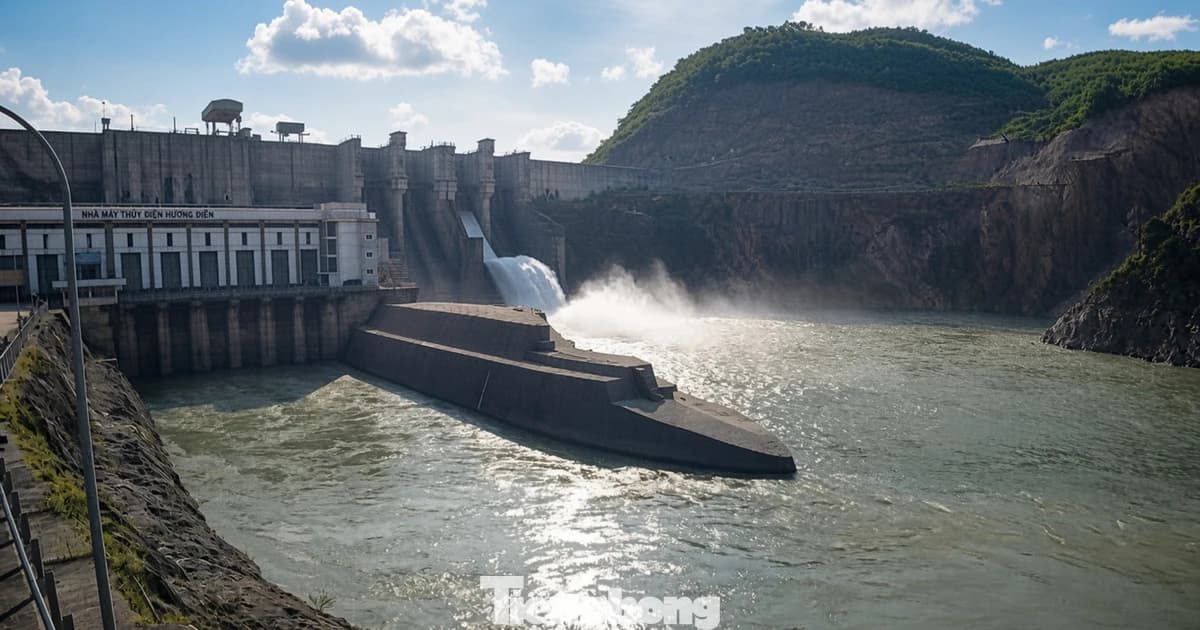

According to Tri An Hydropower Company, at 8:00 AM on October 3rd, the upstream water level of Tri An reservoir was 61.68 meters, while the downstream water level at the plant was 6.1 meters. The inflow into the reservoir reached 2,030 m³/s, significantly higher than the total amount of water being released downstream.
Currently, Tri An Reservoir is discharging 610 m³/s through the spillway, while simultaneously operating the power generation units with a flow rate through the turbines of approximately 776 m³/s.
Given the high water inflow into the reservoir, Tri An Hydropower Company has announced that it will continue to regulate the reservoir to ensure the safety of the structure and the downstream area.

From 13:00 on October 3rd, the water discharge rate through the spillway was increased to 762 m³/s. The flow rate through the power generation turbines fluctuated between 460-800 m³/s, depending on the dispatching method of the National Water Management Agency (NSMO). Accordingly, the total amount of water flowing downstream was in the range of 1,202-1,562 m³/s.
By 3 PM on the same day, the discharge rate through the spillway was further increased to 915 m³/s. Combined with the water flow through the turbines (460-800 m³/s), the total water flow downstream ranged from 1,375 to 1,715 m³/s.
The Tri An Hydropower Company stated that water regulation will be implemented flexibly, depending on weather conditions, water inflow into the reservoir, the water level of the Tri An reservoir, and the downstream water level of the river at the Bien Hoa hydrological station.
The operating unit has notified the Civil Defense Committees at all levels and relevant local authorities to coordinate, direct, and inform people in the downstream areas to proactively take preventive measures and mitigate potential impacts caused by water regulation.
According to the National Center for Hydro-Meteorological Forecasting, at 3:30 PM, the water level on the Dong Nai River (Dong Nai City) at the Ta Lai station is rising slowly and remains below alarm level 2.
The National Center for Hydro-Meteorological Forecasting warns that over the next 24 hours, water levels on the Dong Nai River at the Ta Lai station will fluctuate between Level 1 and Level 2.
Flooding on rivers has the potential to cause inundation in low-lying areas along the riverbanks, affecting activities such as waterway transportation, aquaculture, agricultural production, people's lives, and socio- economic activities.
Source: https://tienphong.vn/thuy-dien-tri-an-tang-xa-tran-hon-1700-m-nuoc-do-ve-ha-du-moi-giay-post1881944.tpo