

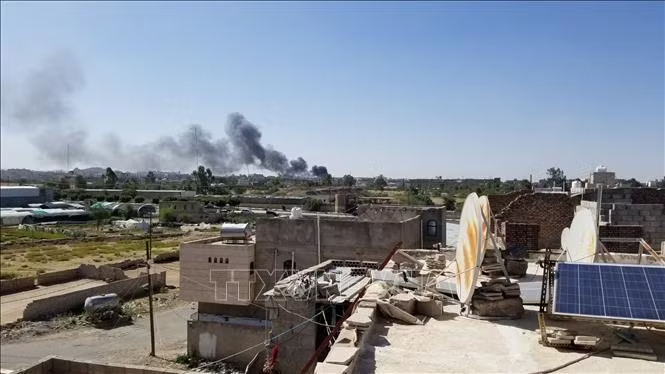
Smoke rises from a military position in the Al-Siyanah area after an airstrike targeting Houthi forces in the Yemeni capital, Sanaa. (Photo credit: THX/VNA)
In a statement broadcast on the Houthi-run al-Masirah television channel, Houthi military spokesman Yahya Sarea declared that the attack had achieved its objectives, with "direct strikes" causing fires at the targeted locations. He stressed that the attack was in response to what Houthi forces described as Saudi Arabian airstrikes on Yemen's capital Sanaa and other Houthi-controlled areas earlier in the day.
In a separate statement that same day, Sarea said 60 airstrikes and missile attacks had targeted Yemen in the past 24 hours, bringing the total number of such attacks since the latest escalation of the conflict began to 1,410. According to Sarea, the attacks targeted areas in the provinces of Sanaa, Saada, Taiz, Hajjah, and Marib, and he asserted that civilian sites were among the targets.
The statement was issued after a series of large explosions rocked Sanaa on the afternoon of October 3 (local time). Residents confirmed hearing more than seven explosions in a short period, along with the sound of fighter jets overhead and smoke rising from the mountainous areas of Al-Nahdayn and Jabal Attan, key military positions controlled by Houthi forces.
Meanwhile, Houthi rebels and Yemeni government forces continued fighting on October 3rd to gain control of key high points in the southwestern province of Taiz. Yemeni government forces, largely backed by Saudi Arabia, announced a new series of military operations targeting Houthi positions across the country.
On social media platform X on October 3rd, Yemeni government spokesman Majid al-Nuzaili stated that the army had carried out 257 attacks on Houthi positions, troop movements, and military assets, using fighter jets, UAVs, artillery, missiles, and multiple rocket launchers. He claimed that at least 700 Houthi fighters had been killed or wounded so far, and 170 military vehicles and other equipment had been destroyed.
In response to these reports, the Saudi Arabia-led coalition described the Houthi claim that they had targeted the Saudi capital Riyadh as a "diversion," arguing that it was intended to mask the losses the Houthis were suffering.
Speaking to the Asharq Al-Awsat newspaper, Arab coalition spokesman Turki Al-Maliki emphasized that the human losses suffered by the Houthi group in Taiz province, southwestern Yemen, and on other fronts are leading them to seek "illusory victories."
Al-Malik said these statements were intended to distract attention from the group's losses, the growing public outrage over the group's activities, and its links to external agendas.
Tensions between Houthi forces and Saudi Arabia have escalated after the group announced a ban on ships linked to Riyadh docking in Red Sea ports on July 20, followed by an escalation in cross-border missile and drone attacks between the two sides.
The confrontation intensified in September amid fighting between the Houthi rebels and Yemeni government forces, heavily backed by Saudi Arabia. The Houthi rebels captured the Red Sea port city of Mocha on September 10 and the strategically important island of Mayyun just one day later.
According to VNA
Source: https://baoangiang.com.vn/saudi-arabia-tan-cong-thu-do-cua-yemen-a498753.html