

The aspiration to get rich from the low-lying fields of my homeland.
After graduating from high school, Le Duy Trinh, born in 1996, from Ta Phan village, Ninh Chau commune, Quang Tri province, bid farewell to his hometown to work in distant Russia, hoping to find a stable job and income. However, after 10 years of hard work in a foreign land, he looked back and realized he was still empty-handed, having saved very little capital.
After many sleepless nights in the cold climate, he went online and was moved by stories of young people his age who had successfully started businesses in their own fertile homeland. The thought of establishing a career in his hometown burned in his heart. Finally, Trinh decided to return, carrying with him the ambition to revive the precarious single-crop rice fields, where year-round only sedges and rushes grew wild due to flooding.
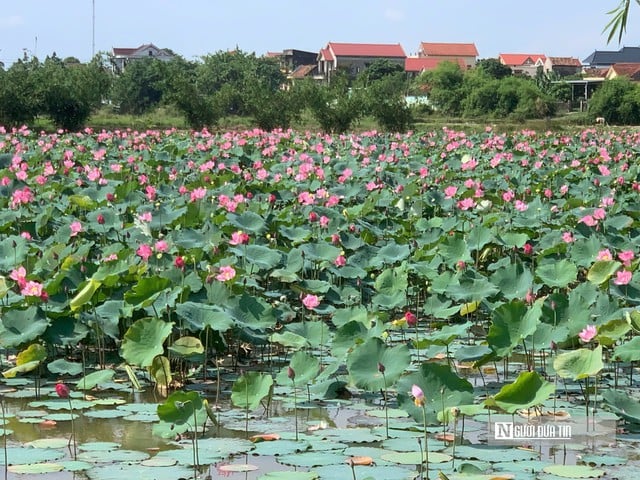
From low-lying rice paddies, Mr. Trinh boldly invested in growing pink lotus, which has yielded outstanding economic value.
"I realized that the unique characteristics of the flooded area were a great advantage for lotus cultivation, so I started researching and exploring. My passion was ignited, and I bought books and newspapers, went online to learn about lotus cultivation models, and compiled traditional experience to build my foundation," Trinh shared.
At the end of 2022, Mr. Trinh asked his family for permission to convert 1 hectare of unproductive rice paddy land into a lotus pond. The beginning was difficult; he traveled all the way to Dong Thap to buy seeds, but due to unsuitable soil conditions, the lotus plants he brought back never grew green.
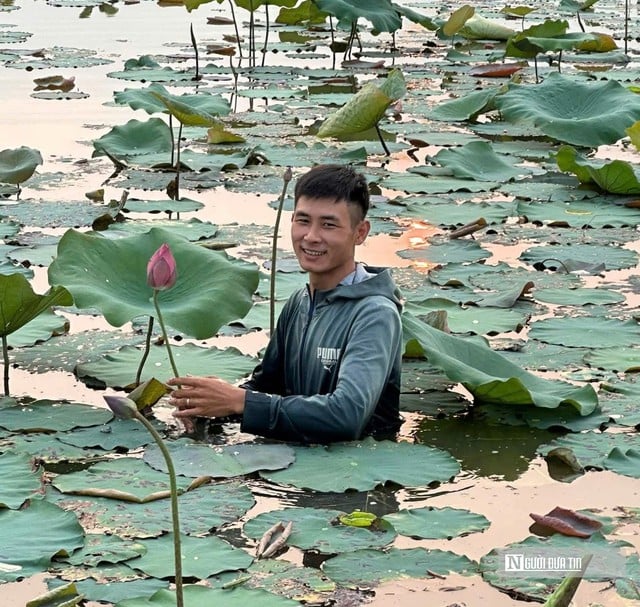
After a long period of research, Mr. Trinh decided to bring the pink lotus variety to Ninh Chau and help it thrive there.
Undeterred, he continued to seek out experienced lotus growers to learn from them, then went to Hue to buy pink lotus seeds to plant. A few months later, seeing the lotus plants growing with lush green leaves emerging from the water, Mr. Trinh breathed a sigh of relief. That year's pink lotus crop was a success, as he had his first products – lotus roots and lotus seeds – to sell.
From barren swamp to multi-value agricultural cooperative
Having determined he was on the right track, Mr. Trinh encouraged neighboring farmers to rent his land at a higher price than growing rice. From those initial areas, he gradually expanded the lotus growing region, forming a lotus field of approximately 8 hectares.
Mr. Trinh excitedly shared with the reporter: "After successfully experimenting with the pink lotus variety, I have expanded its cultivation to the entire area. To date, all the lotus ponds are healthy, with large leaves, abundant and beautiful flowers, and blooming in the right season."
Building on his initial success, and to create his own brand and facilitate transactions, Mr. Le Duy Trinh boldly established the Ta Phan Agricultural Production - Business - Service - Trade - Tourism Cooperative (Ta Phan Cooperative), with himself as Director. The cooperative specializes in producing and trading products from lotus plants and operates a tourism service model for visitors.
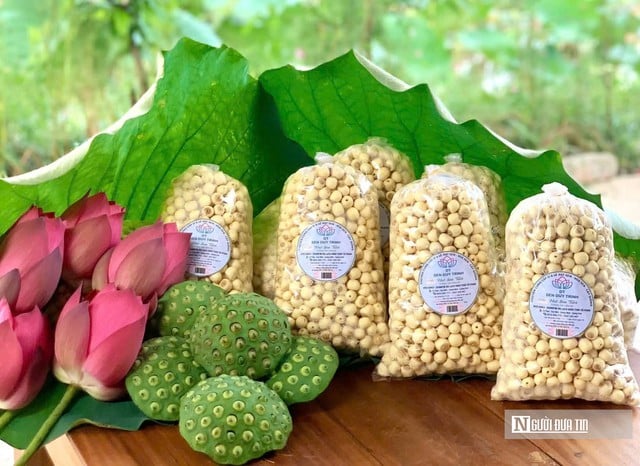
Besides raw products...
Understanding that selling only fresh nuts would result in unstable product value, entirely dependent on seasons and traders, Mr. Trinh decided that the cooperative should pursue a path of commodity production, deep processing, and building a strong brand.
To date, with a total investment of approximately 3 billion VND, Ta Phan Cooperative has completed its cold storage system, heat dryers, vacuum packaging machines, and modern processing equipment. Instead of selling raw lotus products, many refined lotus products have been created, including two products that have achieved OCOP 3-star certification.
All products undergo strict quality control, are labeled with QR codes for traceability, and have extensive coverage on e-commerce platforms and social media.
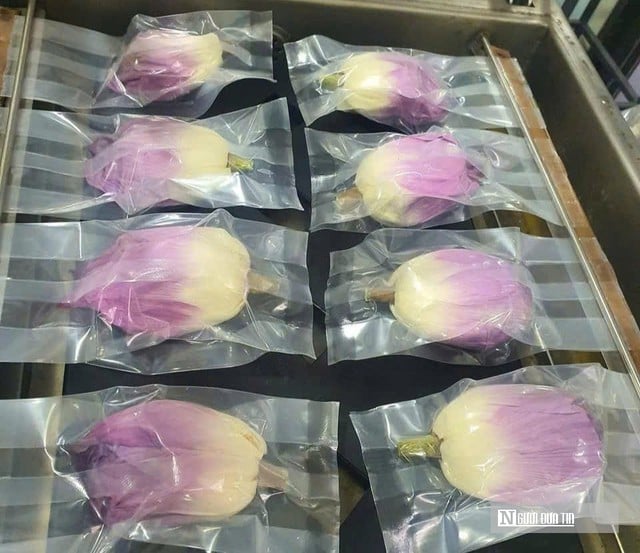
Refined products derived from lotus have emerged.
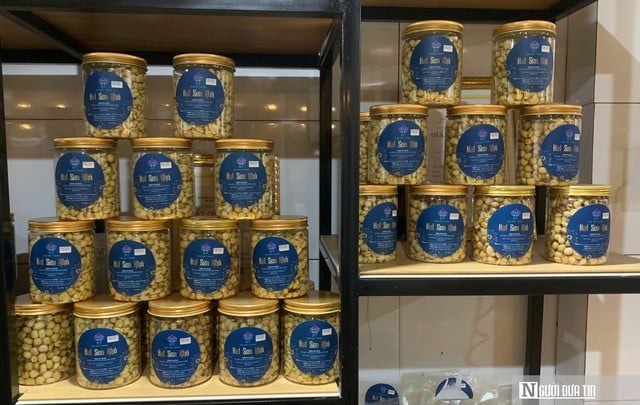
This includes products with proper labeling and traceability information.
Beyond just processing, during the lotus blooming season, the cooperative's vast lotus fields transform into an ideal ecotourism destination. Visitors from all over flock to visit, take photos, and experience the area, opening up a promising avenue for combining advanced agriculture with rural tourism.
Economic development linked to the community.
The development of Ta Phan Cooperative has not only brought success to Mr. Trinh personally, but more importantly, it has completely changed the production mindset of the people in the challenging Ninh Chau region.
From a low-yielding, swampy area, the lotus plant is becoming a raw material for developing a value chain, from planting, harvesting, preliminary processing, preservation to processing and consumption.
For Mr. Trinh, the effectiveness of the model is not measured solely by revenue or profit. What he aims for is to create additional livelihoods for local people.
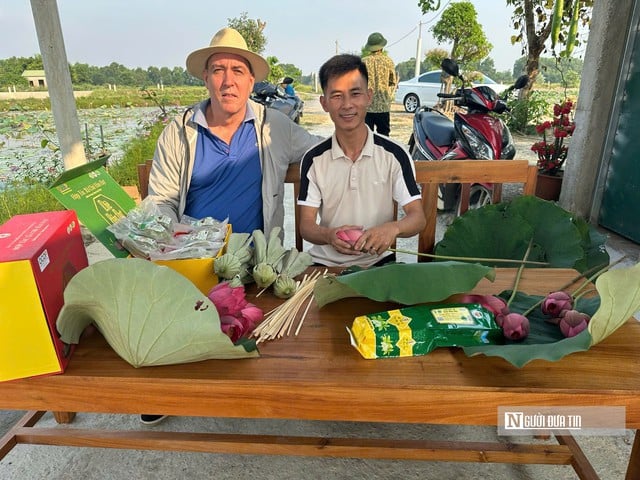
Tourists from all over the world come to visit, take photos, and experience the area, opening up a promising avenue for combining advanced agriculture with rural tourism.
Currently, the model provides regular employment for approximately 5-10 workers, with an income of around 10 million VND/person/month; and also creates seasonal jobs for about 20 workers, with an income of around 8 million VND/person/month.
Linking with 20 lotus-growing households also helps to form a raw material area and expand opportunities for local farmers to participate in the production chain. The establishment of the Ninh Chau Lotus Growing and Processing Professional Farmers' Association in May 2026 will further strengthen this value chain linkage.
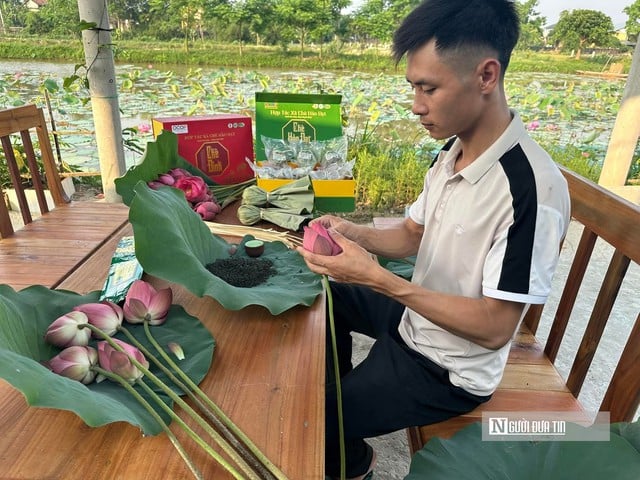
For Mr. Trinh, the effectiveness of the model is not measured solely by revenue or profit. What he aims for is to create additional livelihoods for local people.
Mr. Trinh stated: "Establishing a stable raw material supply area is crucial for commodity production. When people are confident about the market for their products, the area planted with lotus can be maintained stably, and the cooperative can also be more proactive in processing and selling."
Speaking with reporters, Mr. Nguyen Quang Ninh, Chairman of the Ninh Chau Commune Farmers' Association, said that Le Duy Trinh, who returned from working abroad with nothing, has proven that with determination and innovative thinking, the younger generation can absolutely become wealthy and shine on their own homeland. Le Duy Trinh's model not only demonstrates effectiveness in transforming inefficient agricultural land but also reflects the daring spirit of rural youth. In particular, his collaboration with local households and development of OCOP products has contributed to adding value to local agricultural products.
Besides focusing on economic development, Mr. Trinh also actively participates in local activities. Currently, the Farmers' Association at all levels is finalizing the dossier to propose that the Chairman of the Quang Tri Provincial People's Committee award Mr. Trinh a Certificate of Commendation to recognize his outstanding achievements in the farmers' emulation movement for excellent production and business.
Source: https://www.nguoiduatin.vn/qua-ngot-bat-ngo-cho-chang-trai-quyet-doi-doi-vung-dat-ruong-trung-204261003092735419.htm