


5 TOD locations along metro line 2
According to the Ho Chi Minh City Department of Construction, the preparation of TOD (Transit-Oriented Development) planning associated with urban railway lines is being carried out simultaneously with the infrastructure investment process.
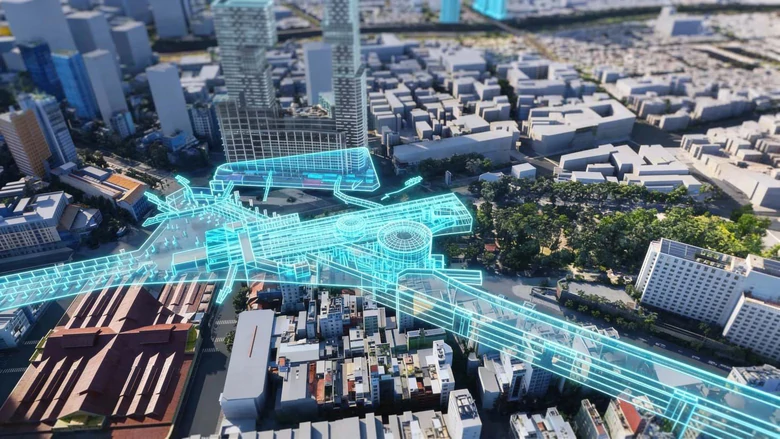
Perspective view of the Ben Thanh underground station complex, the intersection between metro line 1 and metro line 2.
Regarding Metro Line 2 Ben Thanh - Tham Luong, the city has approved the TOD (Transit-Oriented Development) planning boundary in Decision No. 3651/QD-UBND dated June 19, 2026. The dossier is being finalized and is expected to be submitted for appraisal and approval in December 2026.
Five TOD (Transit-Oriented Development) zones along Metro Line 2 have been identified, totaling nearly 940 hectares. These include the Ben Thanh - Tao Dan station area, approximately 188.57 hectares, located in the city center; the Dan Chu, Hoa Hung, Le Thi Rieng, Pham Van Hai, and Bay Hien station areas, covering 265.07 hectares and spanning various existing residential areas; and the Nguyen Hong Dao station area, covering 43.81 hectares.
At the northwestern gateway, the area encompassing Ba Queo, Pham Van Bach, and Tay Thanh stations covers 148.92 hectares. Notably, the Tham Luong station and depot area, spanning 292.81 hectares, is the largest and serves as the final hub for train operation and maintenance.
Mr. Vu Van Vinh, Director of Project Management Board 2, Ho Chi Minh City Urban Railway Management Board, said that the task of developing the planning was assigned by the city to the Urban Development Management Board under the Department of Planning and Architecture. The Urban Railway Management Board is coordinating by providing information and designs for metro line 2 to update the planning project.
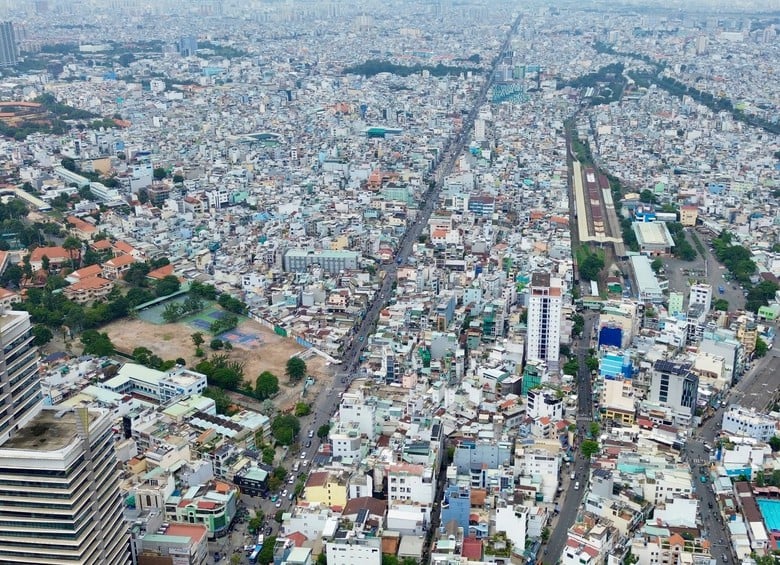
There are 5 TOD (Transit-Oriented Development) locations along Metro Line 2, stretching from the city center of Ho Chi Minh City to the northwestern gateway.
Currently, the Urban Development Management Board is recruiting domestic and foreign consultants to develop planning for five areas.
The TOD (Transit-Oriented Development) planning is seen as a crucial step in linking urban development with investment in urban rail, instead of allowing areas around stations to develop spontaneously after the transportation infrastructure is completed.
According to Resolution No. 21/2026/NQ-HĐND, the development orientation for TOD (Transit-Oriented Development) is to arrange mixed-use land and buildings around train stations, combining housing, commerce, services, offices, and public facilities. Public transportation is identified as the primary mode, while pedestrian and bicycle paths are organized to ensure convenient and safe access to train stations for the public.
The scale of development must also be commensurate with the capacity of technical and social infrastructure, while simultaneously exploiting added value from land, underground and above-ground spaces, linked to green requirements, energy saving, and climate change adaptation.
Prepare the underground corridor as well.
A notable aspect of the preparation for Metro Line 2 is the consideration of connectivity between stations and TOD (Transit-Oriented Development) areas right from the design stage.
Mr. Vinh stated that at some TOD locations, the project has planned for underground connections, thereby facilitating the connection of corridors from surrounding land areas to the station system.
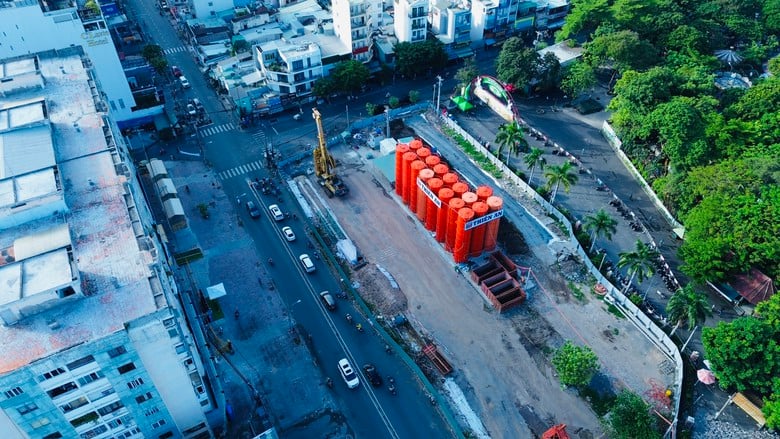
The area where the Le Thi Rieng station is under construction.
For example, in the Hoa Hung area, Hoa Hung station is planned to connect with Saigon station of the national railway line. In the national railway plan, this area has a new square connecting to Cach Mang Thang Tam street. Therefore, Metro Line 2 has planned an underground corridor connection point to the square area.
In the Tao Dan area, the project also includes provisions for underground access to the station's entry and exit points. This was studied during the planning phase of Metro Line 2 and the revised plan was approved at the end of December 2025.
However, Metro Line 2 will not immediately construct all of these connecting corridors. According to a representative of the Urban Railway Management Board, the project will build the necessary waiting areas, ensuring the required structure so that investors can connect later.
This approach aims to minimize the need for demolition and reconstruction when the land surrounding the station is developed according to TOD (Transit-Oriented Development) plans, thereby avoiding wasting resources.
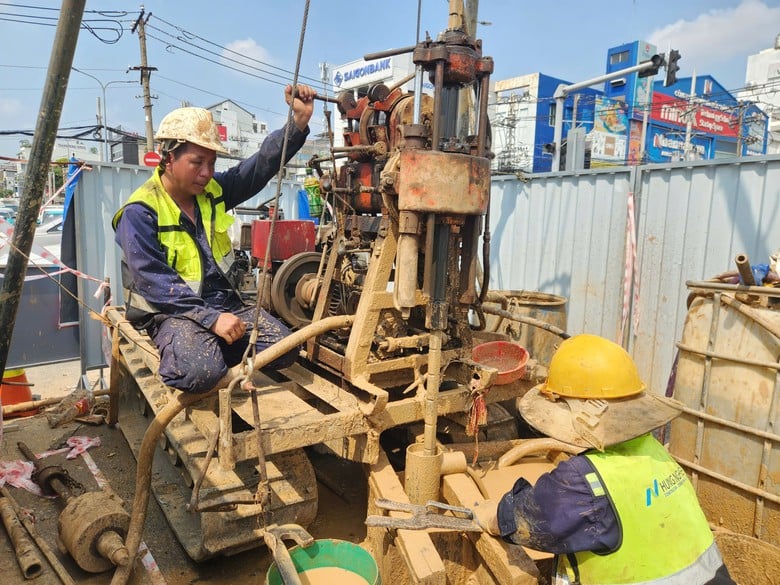
Geological drilling for Metro Line 2 has been completed.
According to Mr. Vinh, Metro Line 2 is currently being fully funded by the city's budget. Meanwhile, the development of TOD (Transit-Oriented Development) zones is expected to mobilize additional resources from the private sector.
The city has mechanisms and policies in place for urban development linked to railways, creating favorable conditions to attract investors to participate in the development of TOD (Transit-Oriented Development) zones according to approved plans.
Notably, during the investment research process for urban railway lines, some investors have shown interest in linking railway projects with land plots and TOD (Transit-Oriented Development) sites along Metro Line 2.
Specifically, when studying the Thu Thiem - Long Thanh route, THACO Group proposed that the city allocate reciprocal land associated with the TOD (Transit-Oriented Development) locations of metro line 2, including the Bay Hien and Tay Thanh areas.
According to representatives of the Urban Railway Management Board, this is a sign that investors are beginning to show interest in urban development models linked to railways and the city's specific policies.
According to the Department of Construction, the city is under immense pressure to complete eight priority railway lines and sections within the next four years, while simultaneously implementing TOD (Transit-Oriented Development). The major challenges currently are the progress of land acquisition and the enormous capital requirements for infrastructure investment.
Source: https://baoxaydung.vn/metro-so-2-lam-san-cua-cho-don-tod-192261004153949779.htm