
On the occasion of the successful conclusion of the Asia-Pacific Dialogue on Heritage and Authenticity, Deputy Minister of Foreign Affairs Ngo Le Van, Chairman of the Vietnam National UNESCO Committee, gave an interview to the press about the significance of the Conference:
- Could the Deputy Minister please share his assessment of the results of the Asia-Pacific Dialogue on Heritage and Authenticity Conference held in Hanoi and Ninh Binh? In your opinion, what were the hallmarks of Vietnam's hosting of this international event?
Deputy Minister Ngo Le Van: The Asia-Pacific Dialogue on Heritage and Authenticity was a great success. As a leading high-level and large-scale policy dialogue forum in the region, bringing together world leaders and experts on heritage such as the Director of the World Heritage Centre, the Chair of the 49th World Heritage Committee, and ambassadors of World Heritage Committee member states, the Conference discussed one of the core, long-standing issues of the World Heritage Convention and achieved important results with four outstanding highlights.
Most notably, the adoption of the Hanoi Document on Heritage and Authenticity marked a significant shift in thinking and methodology for heritage preservation in the region and globally. For the first time, a clear and well-founded Asia-Pacific perspective was incorporated into the global discussion process, building upon the Nara Document of 1994 and the Nairobi Document of 2025.
According to Lazare Eloundou Assomo, Director of the UNESCO World Heritage Centre, the adoption of the Hanoi Document is a significant milestone in the international community's shared commitment to implementing the 1972 World Heritage Convention.
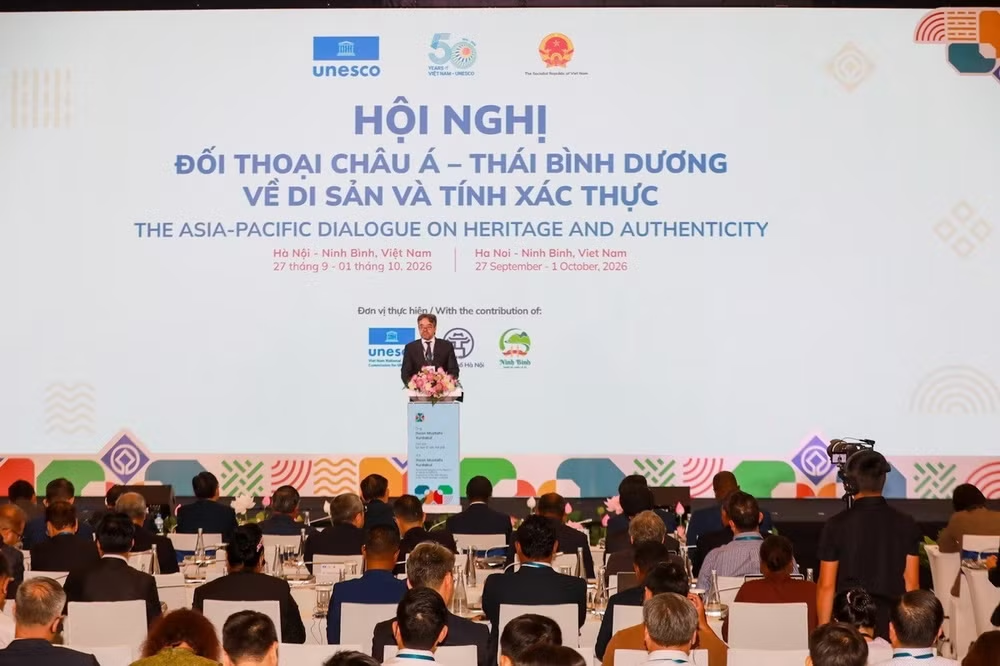
A view of the Asia-Pacific Dialogue on Heritage and Authenticity conference on September 28, 2026. (Photo: Khanh Hoa / VNA)
Secondly, there is the mark of our initiating role and leadership capacity. Vietnam not only hosted the conference but also, as a co-chair, directly participated in shaping the content and formulating global heritage policies.
At the opening session, Minister Le Hoai Trung outlined four major directions: recognizing authenticity based on respect for cultural diversity; emphasizing responsibility towards history and future generations, especially when applying digital technology and artificial intelligence to heritage; placing the community at the center and as the main subject; and translating awareness into action. These directions were all reflected in the Conference's final document. At the closing session, the Director of the Lazare World Heritage Centre, Eloundou Assomo, affirmed that the world heritage community owes this landmark contribution to Vietnam.
Thirdly, there is the impact of policy linked to practice. For the first time, a policy conference on authenticity was directly linked to a specific conservation event: the groundbreaking ceremony for the Kính Thiên Palace preservation, restoration, and rehabilitation project on September 29th, along with a survey trip to Tràng An and Tam Chúc . Delegates not only discussed the concept but also directly witnessed how Vietnam preserves heritage at Thăng Long Imperial Citadel – a prime example of cooperation and exemplary model in ensuring authenticity, enhancing outstanding global value, and effectively solving the problem of balancing conservation and development right at the heritage site.
At the same time, international participants considered Vietnam a "particularly significant destination" for this global dialogue, as the relationship between heritage preservation and socio-economic development strategies in Vietnam serves as a vivid practical model.
Fourthly, hosting in Hanoi and Ninh Binh demonstrates strong organizational capabilities. This contributes to affirming Vietnam's organizational capacity, positioning it as a reliable partner and destination for cultural, heritage, and multilateral dialogue initiatives in the region, thereby enhancing Vietnam's standing and soft power.
- Mr. Deputy Minister, what message does the creation of an international document on heritage bearing the name Hanoi, coinciding with the 50th anniversary of Vietnam-UNESCO relations, convey regarding Vietnam's position and role in cultural diplomacy and current multilateral mechanisms?
Deputy Minister Ngo Le Van: The successful organization of the Conference by Vietnam in coordination with UNESCO, with the adoption of the Hanoi Document coinciding with the 50th anniversary of Vietnam-UNESCO relations, affirms Vietnam's new role and mindset in multilateral foreign relations and cultural diplomacy.
First and foremost, this marks a new stage in the development of Vietnam-UNESCO relations over the past 50 years: from receiving support and participation to actively contributing. In 1981, in Hanoi, the Director-General of UNESCO called on the world to join hands in saving the ancient capital of Hue when Vietnam was still facing many difficulties after the war.
Forty-five years later, also in Hanoi, Vietnam, together with UNESCO and international experts, developed a strategic document on heritage. This is vivid evidence of the country's progress and the depth of the Vietnam-UNESCO partnership after half a century.
This also demonstrates Vietnam's capacity and prestige in initiating, connecting, and participating in shaping major strategic and policy issues at the regional and global levels. The World Heritage Centre's proposal for Vietnam to host the Conference shows UNESCO's trust in Vietnam.
In conjunction with Vietnam's initiative on the International Decade for Culture for Sustainable Development 2027–2036, adopted by the United Nations General Assembly, the Hanoi Document affirms Vietnam's capacity to contribute both in terms of policy direction and expertise, participating in the development of international standards on culture and heritage, and contributing to human civilization.
This also marks a milestone in cultural diplomacy, creating space and resources to serve national development. The conference contributes to concretizing the guidelines of the 14th Party Congress, Resolution No. 80-NQ/TW on the development of Vietnamese culture, Resolution No. 06-NQ/TW on implementing the foreign policy guidelines of the 14th Party Congress, and Resolution 26-NQ/TW on developing Vietnamese tourism into a key economic sector in the new era, transforming cultural resources into resources that directly serve national development goals, promoting soft power, and enhancing the nation's position.
- Vietnam hopes that the Hanoi Document "will not remain merely an awareness but will become a guide for action." After the Conference, what will Vietnam do to translate the recommendations of the Hanoi Document into policies and practices for managing and preserving heritage, and to disseminate them throughout the Asia-Pacific region?
Deputy Minister Ngo Le Van: We believe the value of the Hanoi Document lies in its ability to be put into practice. Vietnam will implement it simultaneously at three levels: global, regional, and national.
At the global level, as Vice-Chair of the World Heritage Committee, Vietnam will closely coordinate with the Committee Chair, the World Heritage Centre, and the advisory bodies ICOMOS, ICCROM, and IUCN to present the Conference results at the 49th Session of the World Heritage Committee in Istanbul, Türkiye in 2027. The goal is for the recommendations of the Hanoi Document to contribute to the refinement of the guidelines for implementing the Convention, helping to make the World Heritage List increasingly balanced, representative, and credible.
At the regional level, Vietnam will concretize the three proposals raised at the Conference: establishing an Asia-Pacific Heritage Cooperation Network; coordinating with UNESCO to periodically organize regional training programs for the next generation of heritage experts; and maintaining this form of dialogue as a regular regional forum. In 2027, Vietnam will host APEC Year; we will integrate the message of culture and heritage as a bridge between economies, promoting sustainable tourism, creative industries, and people-to-people exchanges.
At the national level, the Government will direct ministries, sectors, and localities to seriously absorb the results of the Conference; and to study and incorporate the recommendations of the Hanoi Document into the process of guiding the implementation of laws and policy documents on culture and heritage. The focus will be on assessing authenticity based on scientific evidence, combining material sources, documents, oral traditions, the environment, and community knowledge; in restoration and preservation, it is necessary to clearly identify what remains, what has changed or been lost; to prioritize conservation from the planning and construction stages of projects; and to ensure community participation from the beginning and that the community is the primary beneficiary. The Hanoi Document will also serve as a direct reference guide for Vietnam's ongoing nomination dossiers such as Oc Eo-Ba The, Co Loa, Cu Chi Tunnels, Con Moong Cave, Van Long-Kim Bang-Tam Chuc, etc.
Simultaneously, efforts are being made to strengthen communication, translation, and dissemination of the Hanoi Document to heritage management boards, research institutes, universities, and the community, so that the Hanoi Document becomes a shared knowledge, promoting effective participation of the community and people in preserving and promoting heritage values.
- The groundbreaking ceremony for the Kính Thiên Palace is a highly anticipated event of great significance for Vietnam, for Hanoi, and for the Thang Long-Hanoi Heritage Conservation Center. In your opinion, what kind of support have we received from international friends and UNESCO? What important tasks will we continue to undertake in the future to best preserve and promote the value of the Thang Long Imperial Citadel World Heritage Site?
Deputy Minister Ngo Le Van: Thang Long Imperial Citadel is a sacred symbol of the nation, the center of political power for 13 centuries in Vietnam. The commencement of the Kinh Thien Palace project is of special significance. Thanks to persistent and sustained research and cooperation over the past 15 years, especially in the last three years, for the first time in the nearly 55-year history of the World Heritage Convention, the World Heritage Committee has agreed to change the status quo in the core area of the heritage site. This year marks a historic milestone, with a decisive step in supporting the restoration of the Kinh Thien Palace.
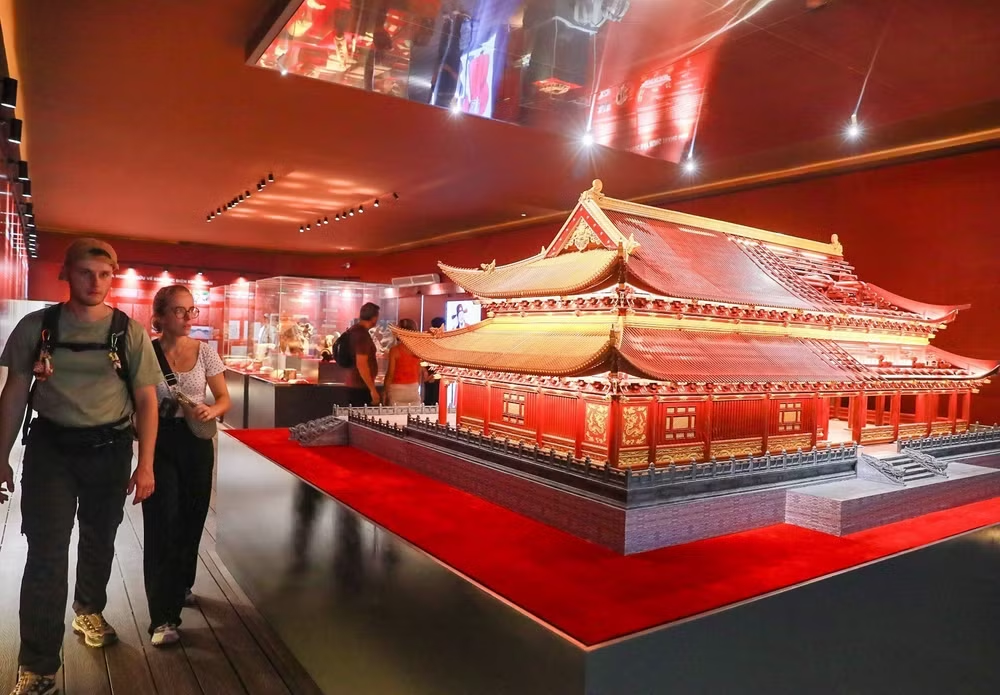
International tourists visit the exhibition space dedicated to the Kính Thiên Palace, Thăng Long Imperial Citadel. (Photo: VNA)
Throughout this process, we have received invaluable support and cooperation from UNESCO, its member states, and international experts. The World Heritage Centre and ICOMOS provided dedicated advice during the dossier preparation. The Committee members highly appreciated Vietnam's proactive, serious, responsible, and scientific approach in cooperating and fulfilling all commitments since the heritage site was inscribed in 2010, responding to international recommendations, adhering to the World Heritage Convention, and contributing to enhancing the site's outstanding universal value.
The Director of the World Heritage Centre, Lazare Eloundou Assomo, along with ICOMOS experts, affirmed that Thang Long Imperial Citadel holds significant value not only for Vietnam but also for the world, due to its unprecedented nature and connection to new issues related to the development of the heritage site. They considered it a "miracle" and a contribution from Vietnam, opening up new directions in the preservation and promotion of world heritage values.
He emphasized that this is a model of cooperation between a member state and UNESCO and its advisory body, a prime example of heritage preservation for other countries, and a contribution of Vietnam to human civilization. Ambassadors and international delegates considered the results of cooperation on Thang Long Imperial Citadel as valuable experience that should be widely shared with other member states.
This achievement is thanks to the close attention and guidance of the Party and State leaders, the close coordination between Hanoi, the Ministry of Foreign Affairs, the Vietnam National UNESCO Committee, the Ministry of Culture, Sports and Tourism, and scientists both domestically and internationally.
In the coming period, we need to continue to seriously implement the commitments and recommendations of the Committee and the Heritage Vision, strengthen cooperation with UNESCO, ICOMOS, and international experts to implement conservation, restoration, and rehabilitation on a scientific basis, ensuring authenticity, integrity, and outstanding universal value, contributing to recreating the nation's history, reviving the strength of millennia of convergence and pride in our origins, and meeting the aspirations of present and future generations.
- Thank you very much, Mr. Deputy Minister!
(VNA/Vietnam+)
Source: https://www.vietnamplus.vn/khang-dinh-nang-luc-cua-viet-nam-trong-tham-gia-xay-dung-chuan-muc-quoc-te-ve-di-san-post1139627.vnp