

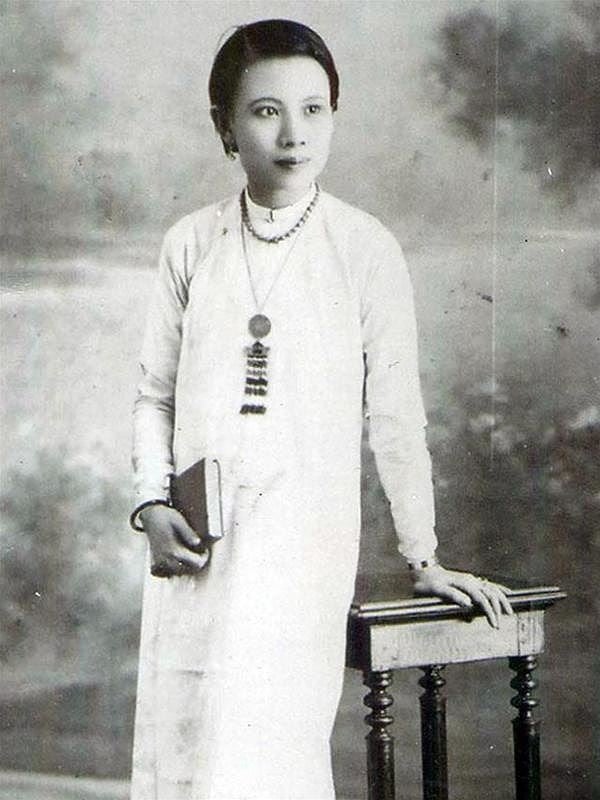
This is not merely a theatrical excerpt, but a heartfelt manifesto about the revival of traditional art and the "Vietnamization" of traditional plays by a female intellectual from Quang Nam province.
Concerns about the national stage
At the beginning of the 20th century, traditional theater faced a profound crisis due to the rise of Western culture and cải lương (reformed opera). In the preface to the play "Princess Huyền Trân," Ms. Huỳnh Thị Bảo Hòa (under the pen name Ms. Vương Khả Lãm) pointed out two root causes of the decline of traditional opera: firstly, traditional operas were limited to a few outdated plays borrowing from Chinese stories (Dương Chấn Tư, Sơn Hậu, Lý Phụng Đình…), with lyrics containing too many Chinese characters, making it difficult for the general public to understand; secondly, the actors and actresses lacked education, only knowing how to perform in a formulaic manner, leaving the singing entirely to the stagehand behind the curtain.
Saddened by the scenes of actors appearing "green in, red out" depicting foreign affairs, while the audience praised the loyal and righteous heroes, she reflected, "These aren't our stories at all!" Huynh Thi Bao Hoa, using her own money and effort, established a theater troupe in Da Nang at the end of 1931 with over 20 artists, acquiring new curtains and costumes to modernize the art. Although the troupe faced financial difficulties due to the 1932 economic crisis, this firsthand experience spurred her to write. She was determined to create a purely Vietnamese work, reforming the staging style while bringing national history to the theatrical stage.
Bringing Vietnamese history and national culture to the stage.
The greatest pioneering value in Huynh Thi Bao Hoa's *Princess Huyen Tran* lies in its emphasis on national self-reliance through language and subject matter. Instead of borrowing from foreign storylines, she chose a tragic historical turning point in the Tran dynasty: the peaceful marriage of the Dai Viet princess to the Champa king, Che Man.
Linguistically, she boldly abandoned the scholastic style of interpretation and cumbersome allusions. The dialogue and melodies (spoken lines, male songs, spring songs, lamenting songs, etc.) were expressed in a simple, concise, and lyrical vernacular that anyone could understand and feel. The aesthetic pinnacle of the play lies in the scene where Huyền Trân stops before the temple of Lady Triệu in the Bồ Điền mountain range, where she uses the sound of her lute to play the mournful Nam Bình melody: “Leaving the country for a thousand miles / What kind of love is this? / Borrowing the color of lipstick and powder / To repay the debt to Ô-Lý…”. This is not merely a lament of personal fate, but a hymn praising the noble sacrifice of a Đại Việt woman for the destiny of the nation.
A humanistic, modern perspective on the status of women.
As one of the pioneering female writers of the early 20th-century reform movement, Huynh Thi Bao Hoa infused the character of Huyen Tran with a very new feminist spirit. In the script, Huyen Tran is not a passive woman blindly obeying the dictates of filial piety, but a woman clearly aware of her position and civic responsibility: "The village of women is easily defeated by the heroic men… wanting to adorn the land with beauty and virtue, I have cast aside my needlework and devoted myself to the study of history and literature."
Upon hearing news of the war and the court's intention to forge an alliance with Champa, she did not resent her father or reproach her elder brother, but voluntarily declared: "For the sake of a little bit of beauty, I will gladly repay my debt to the nation!" At the same time, the author subtly portrays the delicate and profound friendship between Huyền Trân and the renowned official Trần Khắc Chung. Khắc Chung offered the princess as a sacrifice for the country, and then, driven by a greater cause and gratitude, braved the vast ocean to travel to Champa to devise a plan to "summon the soul on the floating bridge," rescuing the princess from the ancient customs of the South. The spirit of "forgetting personal feelings for the country" of both characters is depicted with great empathy, further enhancing their noble character.
A proud heritage on the banks of the Han River.
Concluding the 3 acts and 14 scenes of the script, the final scene, where Tran Khac Chung and Huyen Tran's boat cuts through the waves heading towards Thang Long to the resounding sound of the "lich tich tinh tang" lute echoing across the vast expanse of water and sky, leaves an enduring impression of the integrity of loyalty and love.
Written in Da Nang on a winter day in 1933, the work of writer Huynh Thi Bao Hoa was ahead of its time, laying a solid foundation for the reform movement of traditional theater. In the preface, she humbly stated: "Without adhering to old customs and being bound by old traditions, although simple, it truly resembles national literature and belongs to the history of our country. It can be called a reform of traditional theater, contributing a small part to national literature."
In the year of the Horse (2026), marking 720 years since Princess Huyen Tran's legendary journey through the central region of Vietnam, revisiting and honoring the script of a daughter of Quang Nam province becomes even more meaningful. This work not only demonstrates the vibrant life of national history in the flow of performing arts, but also represents the profound pride of the land and people of Quang Nam in the country's literature and theater.
Source: https://baodanang.vn/huynh-thi-bao-hoa-khat-vong-viet-hoa-tuong-3354092.html