

Deputy Prime Minister Ho Quoc Dung (far left) and Minister of Science and Technology Vu Hai Quan (center) attend the ceremony to respond to the National Innovation Day 2026.
Hanoi continues to lead the Local Innovation Index (PII) in 2026 with 63.80 points. Meanwhile, Cao Bang ranks last with 21.22 points.
The PII 2026 results, developed by the Ministry of Science and Technology, aim to measure the innovation capacity and innovation outcomes of localities, thereby providing a basis for assessing strengths and weaknesses and identifying solutions for socio-economic development based on science, technology, and innovation.
Top 10 localities leading in PII 2026
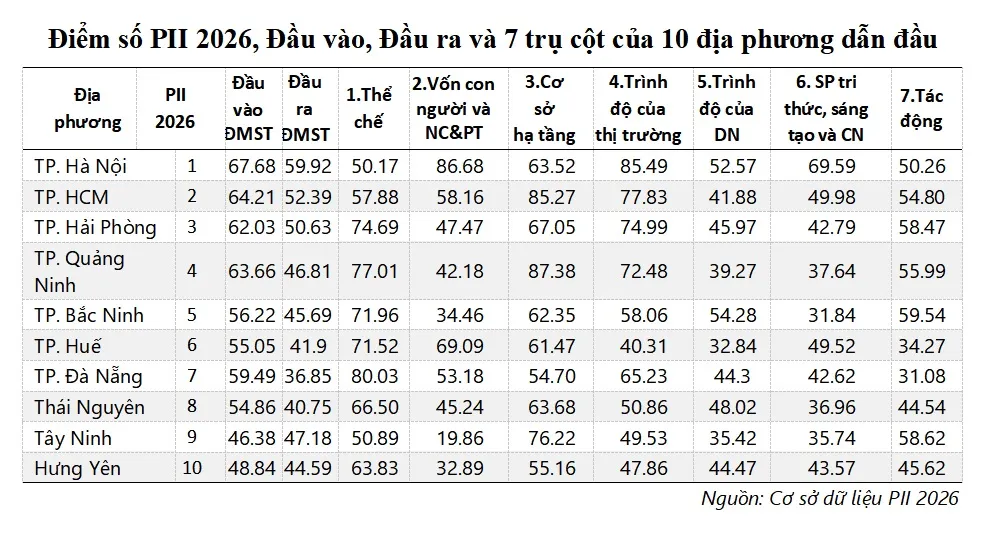
According to the PII 2026 analysis and assessment results, the top 10 localities nationwide are Hanoi, Ho Chi Minh City, Hai Phong, Quang Ninh, Bac Ninh, Hue, Da Nang, Thai Nguyen, Tay Ninh, and Hung Yen.
Among the top 10 localities, 7 are centrally-governed cities. By region, 5 are in the North, 2 in the Central region, and 2 in the South.
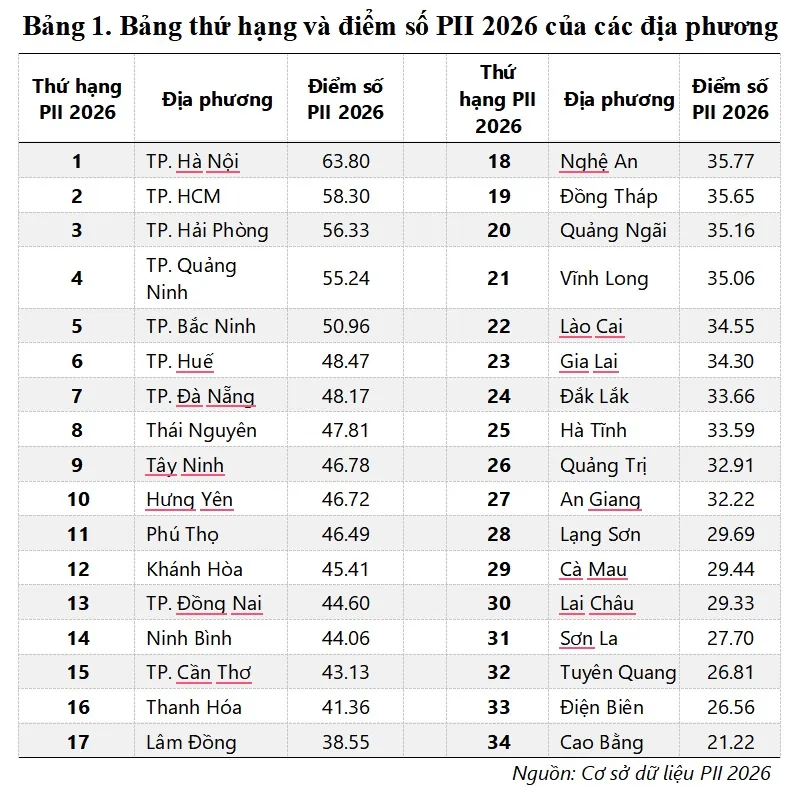
Hanoi scored 63.80 points, ranking 1st; Cao Bang scored 21.22 points, ranking 34th.
The PII 2026 comprises 52 component indicators.
The PII is built upon the framework and methodology of the Global Innovation Index (GII) for measuring innovation, with a broad approach to innovation. The index reflects not only innovations from research and development but also encompasses smaller innovations across various aspects of life.
In 2026, the PII will comprise 52 component indicators, divided into 7 pillars. Of these, the 5 input pillars include: Institutions; Human Capital and Research and Development; Infrastructure; Market Development Level; and Enterprise Development Level.
The two output pillars include: Knowledge, innovation, and technology products; and Impact.
The data for building the PII 2026 was collected from two main sources. Of the 52 indicators, 40 used officially published statistics and state management data from ministries, state management agencies, and organizations at the central level; the remaining 12 indicators were collected and provided by local authorities, along with supporting documentation.
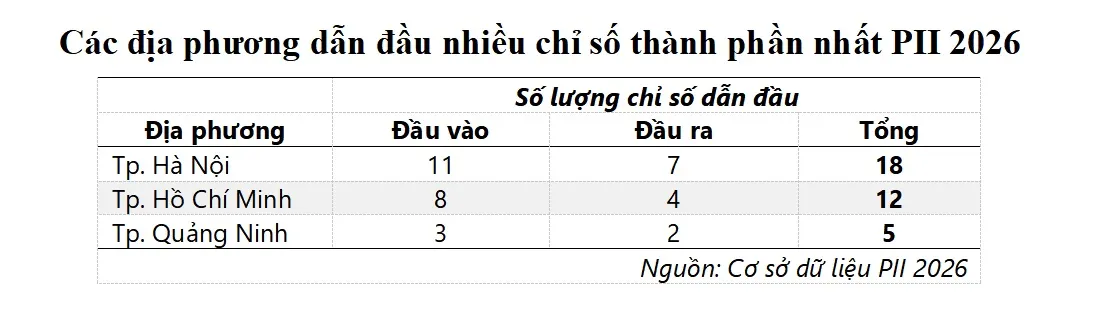
Hanoi leads in 18 out of 52 component indicators.
According to the PII 2026 results, Hanoi leads in 18 out of 52 component indicators. Notable indicators include research and development human resources, research and development spending, the number of science and technology organizations, the percentage of businesses engaged in research and development, and the percentage of businesses engaged in innovation.
Hanoi also leads in several output indicators related to intellectual property such as inventions, utility models, plant varieties, trademarks, industrial designs, as well as some indicators related to poverty reduction and human development.
Ho Chi Minh City ranked second in the number of leading component indicators, with 12 out of 52 indicators. Notable indicators include science and technology organizations, general infrastructure, credit for the private sector, microfinance, business density, research and development enterprises, innovation enterprises, and newly established enterprises.
Quang Ninh ranked third, leading in 5 out of 52 component indicators, including digital infrastructure, credit for the private sector, investment projects in industrial clusters, OCOP (One Commune One Product) program, and poverty reduction rate.
Tools for assessing local innovation capacity.
The PII (Profit Index) was officially implemented nationwide from 2023, following a pilot program in several localities in 2022. The Ministry of Science and Technology collaborated with the World Intellectual Property Organization (WIPO) and relevant agencies to develop and implement this index.
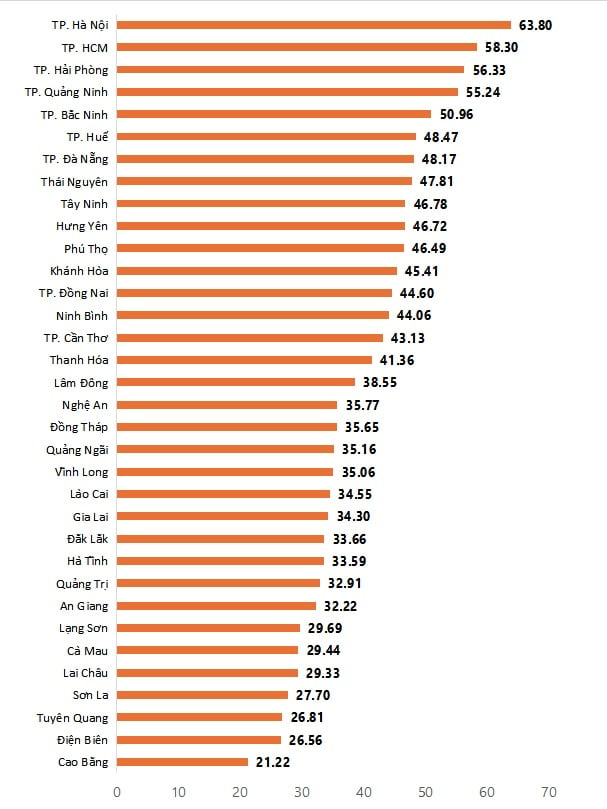
Source: PII 2026 Database
The PII index provides an overall picture of the socio-economic development model based on science, technology, and innovation in each locality. The results are used as a basis for identifying strengths and weaknesses, formulating policies, and selecting appropriate development solutions.
In addition, PII allows for the assessment and comparison of the capacity and performance of science, technology, and innovation activities among localities, as well as the quality of state management in this field.
In 2026, the PII development process will be carried out according to international standards and procedures implemented in previous years. The index framework will be reviewed and adjusted based on the current data status, practical context, and characteristics of Vietnamese localities.
PII results in 2026 by Pillars
- Pillar 1. Institutions: The top 3 localities are Da Nang City, Quang Ninh City, and Hai Phong City, respectively.
- Pillar 2. Human Capital and Research and Development (R&D): The top 3 localities are Hanoi, Hue, and Ho Chi Minh City, respectively.
- Pillar 3. Infrastructure: The top 3 localities are Quang Ninh City, Ho Chi Minh City, and Tay Ninh, respectively.
- Pillar 4. Market development level: The top 3 localities are Hanoi, Ho Chi Minh City, and Hai Phong, respectively.
- Pillar 5. Level of business development: The top 3 localities are Bac Ninh City, Hanoi City, and Thai Nguyen, respectively.
- Pillar 6. Knowledge, creativity and technology products: The top 3 localities are Hanoi, Ho Chi Minh City and Hue, respectively.
- Pillar 7. Impact: The top 3 localities are Phu Tho, Bac Ninh City, and Ninh Binh, respectively.
Source: https://vtv.vn/ha-noi-dan-dau-chi-so-doi-moi-sang-tao-cap-dia-phuong-pii-2026-100261004134139866.htm