

 |
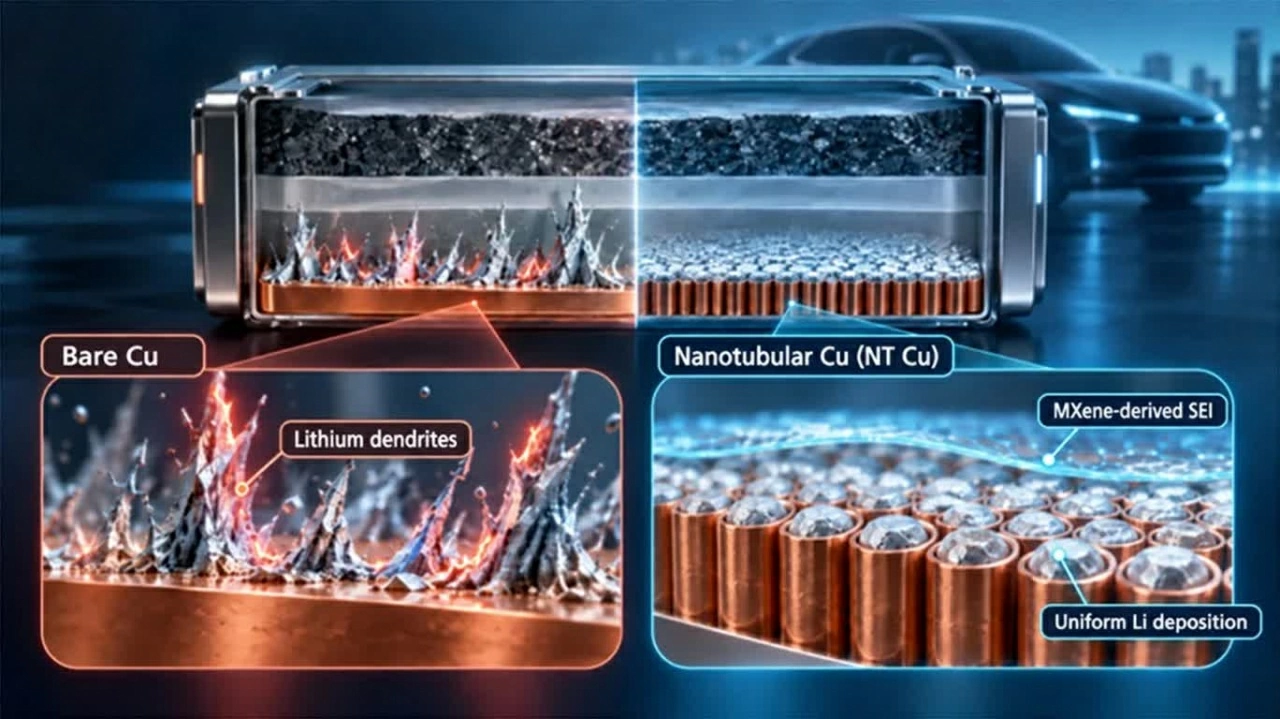
The copper nanostructure helps distribute lithium more evenly when charging electric vehicle batteries, contributing to limiting the formation of harmful crystal branches. (Source: KAIST) |
Korean scientists have applied microfabrication techniques used in the semiconductor industry to improve the copper current-collecting surface of anode batteries, thereby helping lithium deposit more evenly during charging and limiting dendrite formation.
The research, published in the international scientific journal Advanced Functional Materials, was conducted by a team of scientists at the Korea Advanced Institute of Science and Technology (KAIST), Kyungpook National University, and the National NanoFab Center of Korea.
One promising approach to increasing the energy density of electric vehicle batteries is the anode-free battery. Unlike conventional batteries that use materials like graphite to store lithium during charging, this design allows lithium to be deposited directly onto a thin copper foil.
Removing the anode material reduces weight and saves space, allowing the battery to store more energy without increasing its size. However, this design also poses a significant challenge in terms of durability.
Over multiple charge and discharge cycles, lithium can accumulate unevenly on the copper surface, forming sharp, branched structures called dendrites. The protective layer on the lithium surface can also become less stable, increasing unwanted reactions with the electrolyte, thereby affecting performance and shortening battery life.
To overcome this limitation, the research team applied microfabrication techniques used in the semiconductor industry. First, the scientists coated the copper foil with a layer of MXene approximately 10 nanometers thick. This is an ultra-thin, two-dimensional material that acts as a support layer for the formation of a lithium fluoride (LiF)-rich protective film during battery operation. This film helps limit the reaction between lithium and the electrolyte, and also helps prevent dendritic growth.
The research team also used secondary sputtering lithography (SSL), a precision micro-processing technique in semiconductor manufacturing, to create a network of microscopic tubes on the copper surface. Each tube is approximately 300 nanometers in diameter and 150 nanometers high, increasing the surface area by about four times compared to a flat copper sheet.
The larger surface area allows lithium to disperse more widely and evenly during charging, rather than concentrating at a few points and developing into sharp branches. Analyses also confirmed the uniform formation of a nanoscale protective layer on the MXene surface.
Professor Jinwoo Lee of KAIST said the new method can simultaneously create uniform lithium deposition sites and a stable protective layer without significantly altering the electrolyte composition or adding excess lithium.
According to the research team, this solution could extend battery life with only a very small increase in weight and volume, thereby opening up avenues for developing smaller, lighter electric vehicle batteries with higher energy density.
Source: https://baoquocte.vn/han-quoc-ap-dung-cong-nghe-ban-dan-mo-huong-cai-tien-pin-xe-dien-449945.html