

Neutrinos are cosmic particles with very small masses. Scientists cannot directly observe these particles, but must measure the sparks of light or charged particles produced when neutrinos collide with other matter.
Francis Halzen, an 82-year-old Belgian scientist, began studying neutrinos in the 1980s. His work focuses on neutrinos that have the potential to provide data on the evolution of the universe, and is conducted at the IceCube Neutrino Observatory in Antarctica.
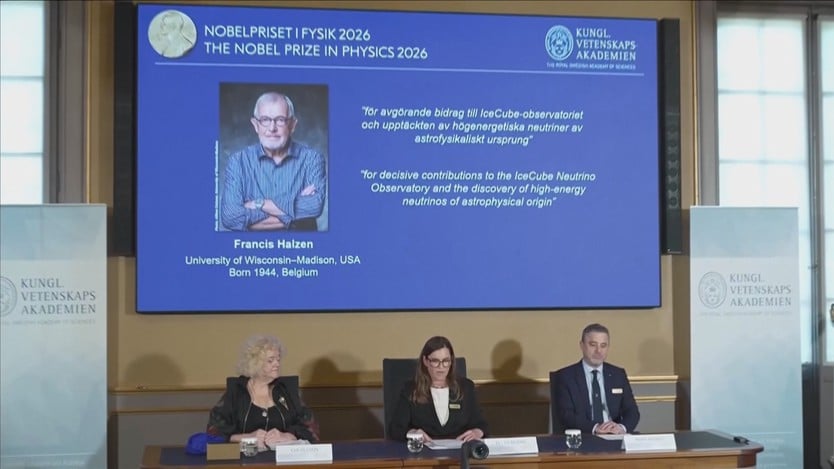
Jørgen Watne Frydnes, Chairman of the Nobel Committee, stated: "Mr. Halzen has created a crucial measuring instrument that has paved the way for a new field in astronomy."
In 1988, Professor Halzen first proposed the idea of using the monolithic ice sheet in Antarctica to "capture" neutrinos. When a high-energy neutrino rarely collides with an atomic nucleus in the ice, it produces an extremely faint flash of light. The pristine, geologically stable, and earthquake-free Antarctic ice sheet is the ideal environment for sensors to detect this phenomenon without interference.
This seemingly impossible idea has become a reality with the IceCube Observatory – a 1km³ ice block in Antarctica with a network of light sensors, completed in 2011. Thanks to IceCube, Professor Halzen and his colleagues were the first to detect high-energy neutrinos originating outside the solar system, opening up a completely new method of observing the universe (neutrino astronomy). Professor Francis Halzen's work not only solved a decades-long technical problem but also provided humanity with an invaluable tool to continue exploring previously unknown cosmic phenomena.
This is the second Nobel Prize to be announced in this year's Nobel season, following the Nobel Prize in Physiology or Medicine. The next prizes to be announced include the Nobel Prize in Chemistry (October 7th) and the Nobel Prize in Literature (October 8th). The winner of the Nobel Peace Prize will be announced on October 9th in Oslo, Norway . The Nobel Prize in Economics will conclude the 2026 Nobel season on October 12th.
Source: https://htv.vn/giai-nobel-vat-li-2026-vinh-danh-kham-pha-hat-vu-tru-neutrino-222261006213406701.htm