

Photo: Hoang Anh
Technology playground
The new wave of technology, with the rise of artificial intelligence ( AI ), the Internet of Things (IoT), and automation, is profoundly changing every field, from daily life and social governance to industrial production lines.
At the awards ceremony for the AIROC 2026 International Robotics Competition - Northern Region, held at New School Secondary School (Ha Dong Ward, Hanoi), experts stated that education today cannot simply stop at transmitting knowledge, but must equip learners with independent thinking skills, adaptability, creativity, and the ability to master technology.
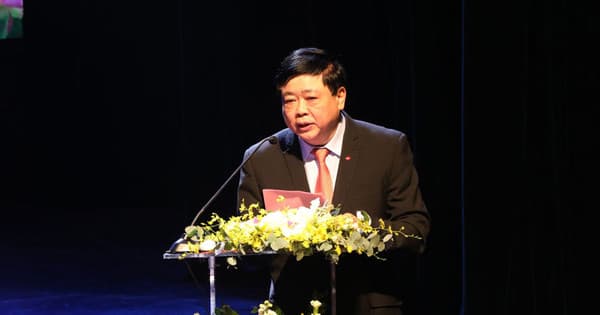
Mr. Nguyen Viet Khiem, Deputy Director of the Institute for School Design Research ( Ministry of Education and Training ), and Head of the Organizing Committee of the competition, stated that AIROC 2026 was officially launched four months ago, opening up a nationwide technology playground for students aged 6 to 18. To date, AIROC 2026 has attracted 2,000 students nationwide, demonstrating the growing influence of STEM education and the passion for science and technology among young people.

The Northern regional finals alone featured 700 students from nearly 50 schools, competing in four categories: beginner, intermediate, advanced, and elite. This was not just a competition about programming or robot control, but also a place where students could challenge their thinking skills, creativity, teamwork, and ability to apply their knowledge to solve practical problems.
Through the theme "Synapse City," the competition introduces students to real-world problems, from environmental pollution control to urban operation and management. Using the Leanbot robot ecosystem, combined with the Digital Twin and Pythaverse platforms, students not only learn how to program robots to perform tasks but also develop critical thinking skills, experimentation, error analysis, and solution refinement.
After the rounds of competition, the Organizing Committee compiled the scores, announced the results, and awarded prizes to the teams with outstanding achievements in the beginner, intermediate, advanced, and elite categories, with a total of 4 first prizes (10 contestants), 14 second prizes (35 contestants), 23 third prizes (55 contestants), and 40 consolation prizes (94 contestants)...

Teams that meet the selection criteria according to the official results will continue to prepare for the AIROC 2026 International Finals, scheduled to take place on November 29, 2026 in Phu Tho province. This is an opportunity for contestants to interact, learn, and test their skills against international teams.
“The greatest value of AIROC lies not only in the trophies or medals, but in the skills that students accumulate through each challenge. When a program doesn't work as expected, they learn to find the cause and make adjustments. When faced with a difficult problem, they learn to persevere, cooperate, and find solutions. These are essential qualities for becoming competent citizens in the digital age,” Mr. Nguyen Viet Khiem confidently stated.
Connecting technology with practice.
Experts believe that the "Synapse City" problem not only presents technical requirements but also relates to practical situations in urban management. On a grid-based simulation model, the robot performs three main tasks: identifying polluted areas; transporting neutralizing blocks to the treatment site; and recovering the polluting blocks and bringing them back to the laboratory for analysis. Through this, students are introduced to how to apply technological knowledge to solve specific problems.
In reality, the wave of artificial intelligence and robotics applications in manufacturing is creating an urgent need for highly skilled technology personnel. To meet practical needs and realize national digital transformation goals, education needs to shift strongly from theoretical instruction to practical application, fostering a technological mindset throughout the learning process, starting from the secondary school level...

Assessing the need for educational innovation linked to practical applications, Mr. Dinh Viet Truong, Chairman of the Board of Directors of Edison AI Robotics Academy, stated that the shift towards automation is strongly underway in large corporations. The cost of investing in robots has decreased significantly while operational efficiency consistently surpasses expectations. Coupled with the increasing cost of manual labor, the application of robots has become the optimal choice to help businesses ensure the progress and quality of international orders.
This aligns with the direction set forth in Resolution No. 57-NQ/TW dated December 22, 2024, of the Politburo on breakthroughs in the development of science, technology, innovation, and national digital transformation. The Resolution identifies robotics, automation, and AI as strategic technology groups, and sets a target that by 2030, the contribution of total factor productivity to economic growth will exceed 55%, and the rate of innovative enterprises will exceed 40%.
However, modern machinery is only effective when a business possesses a high-quality workforce capable of programming, monitoring, and handling emerging technical issues.
Therefore, it is necessary for all levels of education in Vietnam to promote synchronized and interconnected technology skills training from an early age to prepare human resources for automated production. At the primary school level, focus should be placed on stimulating interest and the ability to explore technology through STEM education; at the lower secondary level, increased experiential learning and familiarization with programming and robot control should be encouraged; and at the upper secondary level, training content needs to delve deeper to provide clear career orientation. At the college and university levels, training institutions must closely connect with businesses so that students acquire practical skills instead of just theoretical knowledge.

In addition to innovative teaching methods and public-private partnerships in line with Resolution 57-NQ/TW, financial support policies are creating a crucial leverage point, helping students confidently pursue science, technology, engineering, and mathematics (STEM) fields.
"Early training orientation from schools, the actual needs of businesses, and educational credit policies are key to helping Vietnam master technology and enhance the competitiveness of its economy in the digital age," Mr. Truong affirmed.
They also added that eligible students studying these fields can now access preferential loan packages of up to 5 million VND per month with an interest rate of 4.8% per year, and a limit of up to 500 million VND without requiring collateral, to cover tuition and living expenses.
The AIROC 2026 program in Vietnam is a collaboration between the Institute for School Design Research (Ministry of Education and Training), the Ministry of Science and Technology, the Vietnam Automation Association, Hoa Co Pharmaceutical Co., Ltd., Vietnam Education Technology Joint Stock Company, and Pythaverse…