The entire political system is involved.
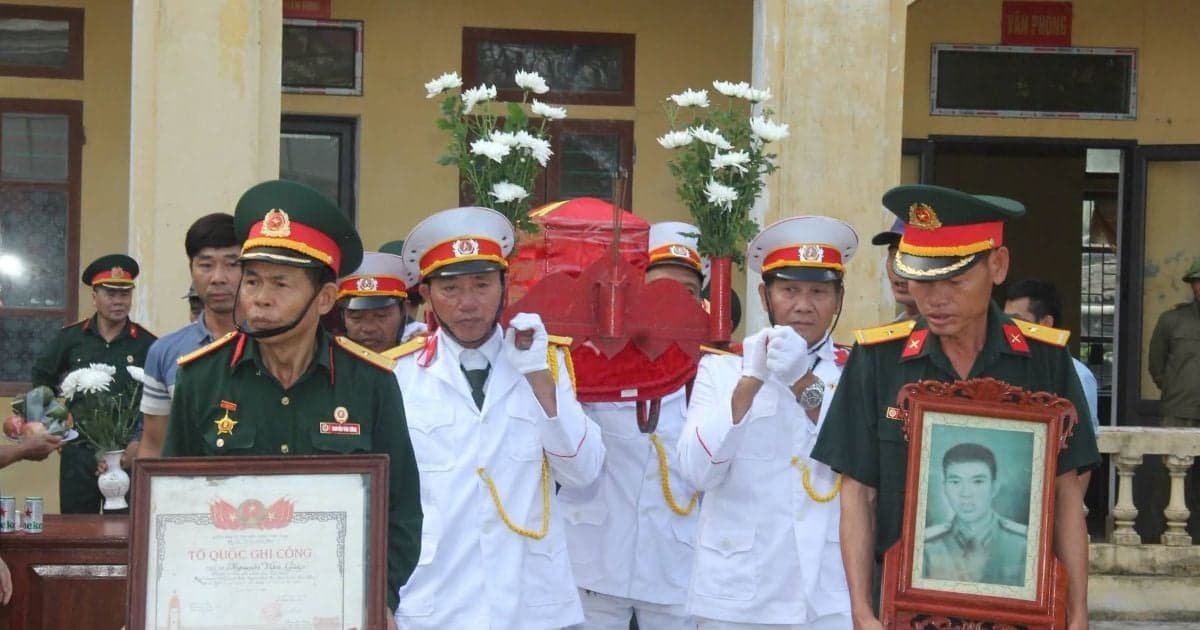
Hai Phong is a land rich in revolutionary traditions, with over 300,000 young people enlisting in the army during the resistance wars, and more than 60,000 outstanding individuals bravely sacrificing their lives for the independence and freedom of the Fatherland and for noble international duties. Among them, many martyrs remain buried on the battlefield or in their original burial places, their locations and identities still unknown.
Imbued with the national principle of "Drinking water, remembering the source," the military and people of Hai Phong have wholeheartedly devoted themselves to searching for and collecting the remains of martyrs who sacrificed their lives in the wars, with the motto "As long as there is information about martyrs and their graves, we will continue to search for and collect their remains."
According to a survey conducted in 114 communes, wards, and special zones, Hai Phong currently has 383 martyrs' cemeteries with a total of 55,679 graves. Of these, 27,520 graves have complete information; 25,407 graves have partial information; and 2,752 graves lack information. Only 22 graves without information have had biological samples taken, while the remaining 2,730 graves require further testing.
These figures highlight the enormous workload, while the process of searching for and identifying fallen soldiers faces numerous difficulties. The war is long over, the landscape has changed due to socio -economic development; many units have been disbanded or merged; and witnesses are becoming increasingly scarce. Many fallen soldiers' graves are located in public cemeteries without headstones, making verification even more challenging. Yet, above all, the hope of reunion remains burning brightly in the hearts of the fallen soldiers' families.
Hai Phong was chosen as the focal point for the 3rd Military Region's mission to search for, collect, and identify the remains of fallen soldiers. Immediately after the "500-Day Campaign" was launched, the city reorganized the 515 Steering Committee, assigning specific responsibilities to each member, agency, unit, and locality.
The City Military Command plays the role of a standing agency, coordinating with departments, agencies, and local authorities to organize surveys, verifications, searches, collection, and sampling of the remains of fallen soldiers.
The city established 8 sampling teams, 2 teams for receiving and preserving samples, 2 teams for transporting and handing over samples, along with support teams to ensure security and safety. Biological samples are managed according to strict procedures, with records and handover minutes at each stage, from the cemetery to the temporary storage location and the Military Forensic Institute.
Behind their dust-covered protective suits, under the scorching sun and the pressure of rigorous professional requirements, the officers, soldiers, and medical staff work quietly with a sense of responsibility, dedication, and profound gratitude. Each remains sample collected according to proper procedures represents another ray of hope that the heroic martyrs will soon be returned to their rightful places, to their homeland and families.
Ensuring that each grave is excavated according to proper procedures also requires careful guidance and preparation from the communes, wards, and special zones. Many days before the excavation, officials from these communes, wards, and special zones coordinated field surveys and prepared the necessary logistical conditions. These seemingly simple tasks are crucial links in ensuring the entire process runs smoothly and efficiently.
Along with mobilizing manpower, Hai Phong allocated significant resources to the campaign. In addition to funding from the central government, the city provided nearly 12.4 billion VND to support sample collection and related activities at the site; and allocated over 2.9 billion VND for the task of searching for, collecting, commemorating, and burying the remains of martyrs and civilians who died in Mai Son village, Vinh Bao commune.
With a spirit of speed and determination, racing against time, by the end of August 23rd, the city's sampling teams had completed the task of collecting samples of unidentified remains of martyrs at 228 out of 228 martyrs' cemeteries in 94 communes and wards, achieving 100% of the plan, 3 months ahead of the schedule assigned by the Steering Committee 515 of Military Region 3.
Authorities have excavated 2,566 graves of fallen soldiers, of which 1,943 biological samples were found to be suitable for DNA testing to identify the remains of soldiers whose identities are still unknown.
Nhi Chieu Ward has the highest number of unidentified graves requiring DNA testing in the city. With a large workload and a high number of unidentified graves needing samples, the officers and soldiers consistently demonstrated a spirit of "overcoming the sun and rain," completing the work ahead of schedule.
Lieutenant Colonel Vu Viet Trung, Commander of the Nhi Chieu Ward Military Command, stated that the work of collecting, preserving, transporting, and handing over samples of fallen soldiers' remains is unprecedented in many localities. The time allocated for sample collection and handover is short, and the personnel involved are mostly performing these duties in addition to their primary responsibilities. This places a very heavy burden on the city and the local Party committee and government.
Immediately after receiving the assignment, the unit proactively advised the local Party committee and government to implement the "500-day and night campaign to search for, collect, and identify the remains of fallen soldiers," while mobilizing the maximum number of militia and local forces to participate in the implementation.
Creating a database to identify the remains of fallen soldiers.

Alongside the collection of remains, the development of a DNA database of martyrs' relatives is being implemented on a large scale. The city police, in coordination with the Department of Administrative Management of Social Order (C06, Ministry of Public Security), the Department of Interior, specialized units, and local authorities, are reviewing and verifying information on martyrs and their relatives; and updating the data to the National Population Database.
During the peak period from June 27th to July 3rd, 2026, the City Police established 5 collection teams, deploying at 45 centralized sampling points. As a result, 20,929 DNA samples of relatives of fallen soldiers were collected out of a total of 22,730 cases under review, achieving a 92% success rate. Each collected DNA sample not only adds scientific data but also opens up further opportunities to identify those who have sacrificed their lives.
The Department of Internal Affairs has reviewed, researched, and corrected information, providing information on martyrs for 1,297 cases to standardize information on the identities of martyrs for the purpose of management and implementation of policies for martyrs' families, as requested by organizations and individuals.
According to Mr. Dao Trong Duc, Standing Committee Member of the City Party Committee, Vice Chairman of the City People's Committee, and Head of the City's 515 Steering Committee, in the coming period, Hai Phong will continue to identify the search, collection, and identification of the remains of martyrs as a particularly important task. The city will implement and complete the second phase of the "500-Day Campaign" ensuring strictness, uniformity, and scientific approach, completing it ahead of the deadline set by the National 515 Steering Committee and Military Region 3.
Intensify the search for and collection of remains of martyrs located outside cemeteries where information has been fully verified; complete DNA sampling for remaining relatives eligible for sampling; coordinate with the Military Forensic Institute to expedite the examination and comparison of remains samples with DNA data of relatives, and promptly clarify the identities of cases with sufficient scientific evidence.
Towards the 80th anniversary of the Day of War Invalids and Martyrs (July 27, 1947 - July 27, 2027), the "500 Days and Nights in Hai Phong" journey is continuing, not only as a responsibility to the past but also as a profound expression of gratitude from today's generation to those who fell for the independence and freedom of the Fatherland.
NGUYEN THAO
---------------------
Next episode: Forever etched in memory
.