
Common mistakes that cause rice cookers to break down quickly.
The pot is placed in the wrong position.
According to VTC News, you need to ensure that the inner pot of the rice cooker is properly positioned so that the bottom of the pot makes maximum contact with the thermostat. If the thermostat makes uneven contact, the rice will be undercooked and undercooked, and the thermostat will also fail prematurely.
Place the rice cooker on the stovetop with both hands, then gently rotate it from side to side to ensure even contact between the pot and the heating element. Also, make sure to distribute the rice evenly in the pot for better cooking and a tastier result.
Put the rice directly into the pot and wash it.
For convenience, most housewives wash rice directly in the pot. This process causes scratches, which over time will damage the non-stick properties of the pot.
Furthermore, researchers have confirmed that when the non-stick coating wears off, the health of those who eat rice cooked in this electric rice cooker is at risk due to harmful substances from the non-stick coating and the metal layer of the pot. Therefore, rinse the rice in a large bowl or sieve before putting it in the rice cooker.
Press the "cook" button multiple times.
To reheat rice or create a crispy bottom layer, cooks often overuse the "cook" button because it can heat the pot to the desired temperature.
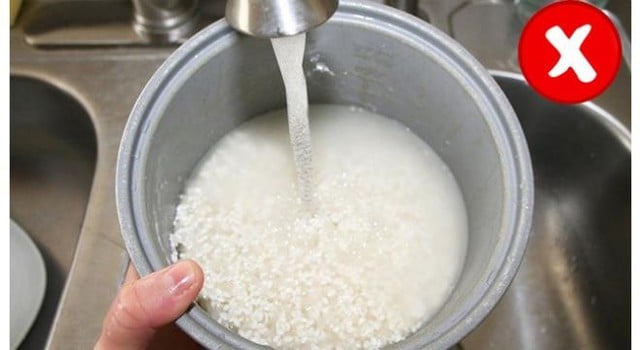
For convenience, most housewives wash rice directly in the pot. This process causes scratches, which over time will damage the non-stick properties of the pot.
This action directly affects the thermal relay, damaging the temperature sensor, causing the rice cooker to switch off prematurely, resulting in undercooked rice and premature damage to the cooker. To ensure the longevity of your rice cooker, it's best to only use it for cooking rice and avoid pressing the "cook" button too many times.
Place the inner pot containing water into the outer pot.
Before cooking rice, you need to thoroughly wash the inner pot. After adding rice and water, many people immediately place the wet inner pot into the main rice cooker and plug it in. Water, rice grains, or leftover dirt at the bottom can affect the contact between the inner pot and the heating element.
Repeating this process will cause more dirt and grime to accumulate in the contact area, making cleaning even more difficult. Therefore, after washing the inner pot, you need to wipe it clean and dry before placing it back into the outer pot.
Tips for keeping your rice cooker clean and energy-efficient.
Cleaning the steam vent: According to VOV, this is one of the dirtiest and most bacteria-prone areas of a rice cooker. The steam vent collects the foam that rises during cooking and expels excess steam from the pot. Over time, it easily becomes clogged with yellow deposits.
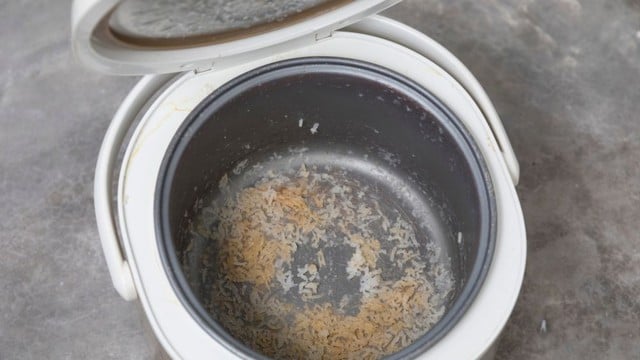
For loose food particles, rice grains, etc., that get stuck, you can turn the pot upside down and gently shake it to let them fall off.
Each type of rice cooker has a different valve design; some are easy to remove, while others are quite difficult to clean. Therefore, please read the user manual or ask the salesperson for instructions on how to easily disassemble them.
Cleaning the inside of the rice cooker: The inside of the rice cooker (where the inner pot is located) is where spilled rice grains and possibly foam from overflowing during cooking often accumulate. If not cleaned properly, these can build up and cause burning during cooking. Because this area is small and quite difficult to clean, you can use small, damp cloths or sponges to wipe it. For loose residue, rice grains, etc., that are stuck, you can turn the cooker upside down and gently shake it to dislodge them.
Additionally, you should also pay attention to cleaning the top and bottom of the lid, and cleaning the rubber gasket inside the rice cooker. Some types of rice cookers have an inner lid that is attached to the outer lid and cannot be removed, so use a damp cloth to wipe it clean and then wipe it again with a dry cloth.
Source: https://giadinh.suckhoedoisong.vn/nhung-sai-lam-khien-noi-com-dien-gia-dat-do-van-rat-nhanh-hong-17226100216541436.htm