
Accordingly, the Ministry of Culture, Sports and Tourism assigned the Department of Cultural Heritage to preside over and coordinate with the Department of Culture and Sports of Ninh Binh province and other relevant agencies and units to organize the program of exhibitions, seminars, propaganda, exchanges, performances and practices of cultural heritage at the Hoa Lu Ancient Capital historical and cultural relic site, Ninh Binh Museum and Long Giang Museum, Ninh Binh province.

The program includes exhibitions, dissemination of information, exchanges, performances, and practices of cultural heritage at the Hoa Lu Ancient Capital Historical and Cultural Relic Site, Ninh Binh Museum, and Long Giang Museum in Ninh Binh province.
Practicing and transmitting cultural heritage through generations.
According to the Ministry of Culture, Sports and Tourism , the program aims to honor, introduce, and spread the typical values of Vietnamese cultural heritage; raise awareness and responsibility of the community and society in protecting and promoting the value of cultural heritage; and create a space for exchange and connection between regions, communities, artisans, heritage practitioners, and the people and tourists.
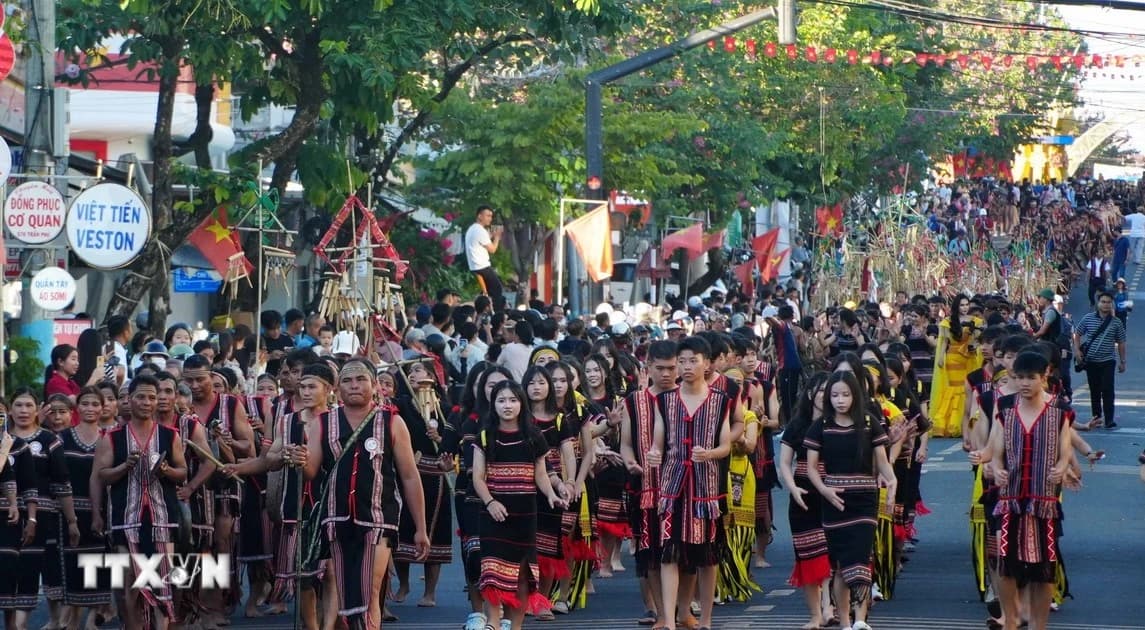
Through activities involving exchange, sharing, and heritage practice, the program contributes to strengthening the bonds between communities, ethnic groups, and regions; consolidating and promoting the strength of national unity; and respecting cultural diversity. In particular, the activities aim to promote the leading role of communities in preserving, practicing, and transmitting cultural heritage across generations.

Delegates attending the opening ceremony of the program.
The main activities include: an exhibition of photographs of Vietnamese cultural heritage at the Hoa Lu Ancient Capital historical and cultural relic site, showcasing typical images of Vietnamese cultural heritage, reflecting the richness and diversity of heritage types associated with the history, life, and cultural identity of various communities.
This event promotes, facilitates, showcases, and practices Vietnamese cultural heritage, with the direct participation of artisans, practitioners, and communities from various localities. The unique cultural heritages and forms presented include: Hanoi pho, Nam Dinh pho, Thanh Tri rice rolls, Thai Nguyen tea cultivation and processing techniques, Quang An lotus tea making, Dong Ho folk paintings, tò he (traditional toys), seated tug-of-war, Ba Duong Noi village kite festival, calligraphy, Ninh Hai embroidery, and the traditional game of throwing the ball... along with heritage education activities, exchanges, and experiences for the public.
This is a practical activity aimed at creating an environment for practicing and transmitting heritage within the community, promoting the leading role of artisans and practitioners; strengthening exchanges and connections between ethnic communities and regions, contributing to consolidating national unity, respecting cultural diversity, and bringing heritage closer to the public, especially the younger generation.

The booth showcases Thanh Tri rice rolls.
Within the framework of the event, the exhibition space "Armed Forces of Military Region 7 – Continuing the Journey of Gratitude" introduces a system of documents and images reflecting the results of the search and collection of the remains of martyrs during the "500 Days and Nights" Campaign and other gratitude activities in Military Region 7, combined with a model of the A-shaped tunnel for the public to visit. The exhibition space "950 Years of Thang Long Imperial Academy (1076-2026)" has 3 main themes: The birthplace of scholarship; Imperial Academy - the first national school; The journey of preserving and promoting the Van Mieu - Imperial Academy relic.
To innovate the approach to cultural heritage for the younger generation, the Organizing Committee, in collaboration with the National Museum of History, implemented a cultural heritage education activity: “Exploring Heritage - Spreading Vietnamese Identity” for approximately 100 fifth-grade students from Trang An Primary School (Branch 2). Through engaging interactive experiences, both direct and online, (“Flag-waving drills”, “Searching for the hidden number”...), the activity contributed to fostering love and a sense of responsibility among young people towards protecting and promoting the value of cultural heritage in the digital age.
In addition, there will be a seminar on the management of antiquities and the training of personnel for antiquities appraisal, aiming to exchange expertise, share experiences, and discuss issues related to the management of antiquities and the training of personnel for antiquities appraisal. This will contribute to improving professional capacity, management efficiency, identification and assessment of the value of antiquities, meeting the requirements for protecting and promoting the value of cultural heritage in the current situation.
In addition, the first "Representative Ancient Artifacts of Ninh Binh Province" exhibition in 2026 will showcase representative ancient artifacts, contributing to the promotion of the historical, cultural, and traditional values of Ninh Binh province. The Long Giang Private Museum will be inaugurated at the Long Giang Museum, Vang Ngoc residential area, Tay Hoa Lu ward, Ninh Binh province, under the auspices of the Ninh Binh Provincial Department of Culture and Sports, in coordination with the Department of Cultural Heritage.

Deputy Minister of Culture, Sports and Tourism - Mr. Ho An Phong delivered the opening speech at the Exhibition of Vietnamese Cultural Heritage.
Increase opportunities to enjoy cultural values.
Speaking at the opening of the Vietnam Cultural Heritage Exhibition on November 21st, the Deputy Minister of Culture, Sports and Tourism, Mr. Ho An Phong, emphasized that Resolution No. 80-NQ/TW dated January 7, 2026, of the Politburo on the development of Vietnamese culture has identified important strategic directions, affirming that culture and people are the foundation, endogenous resources, and great driving force for national development; while also emphasizing that the people are the creators and beneficiaries of culture. The documents implementing Resolution No. 80-NQ/TW continue to demand innovation in management and cultural development; promoting science, technology, innovation, digital transformation , and the development of the cultural industry.
This is also an opportunity to strengthen exchanges and connections between regions and communities; to awaken pride and responsibility in each individual in preserving, transmitting, and promoting national cultural identity. " The exhibitions, performances, practices, exchanges, and heritage education activities will help the public, especially the younger generation, gain a deeper understanding of the history, traditions, knowledge, and creativity of communities; thereby fostering love for heritage, awareness, and responsibility to protect Vietnamese cultural heritage, " Mr. Ho An Phong confidently stated.
To ensure the activities are effective, the leaders of the Ministry of Culture, Sports and Tourism requested that agencies and units continue to coordinate closely, ensuring quality, safety, and adherence to the plan; museums and heritage management boards should play a role in introducing, connecting, and disseminating the value of cultural heritage. At the same time, they hoped that artisans, practitioners, and the community would actively share their knowledge, skills, and experiences; and that the people and tourists would actively participate, experience, and work together to protect the heritage.
According to the Ministry of Culture, Sports and Tourism, through a series of activities, the program contributes to strengthening the connection between cultural heritage and contemporary life, between preservation and development; affirming the role of artisans, practitioners, and the community in protecting and promoting the value of intangible cultural heritage. This is also an opportunity to promote heritage education, cultural exchange between regions, and awaken pride and responsibility in each individual in preserving and transmitting the national cultural identity.