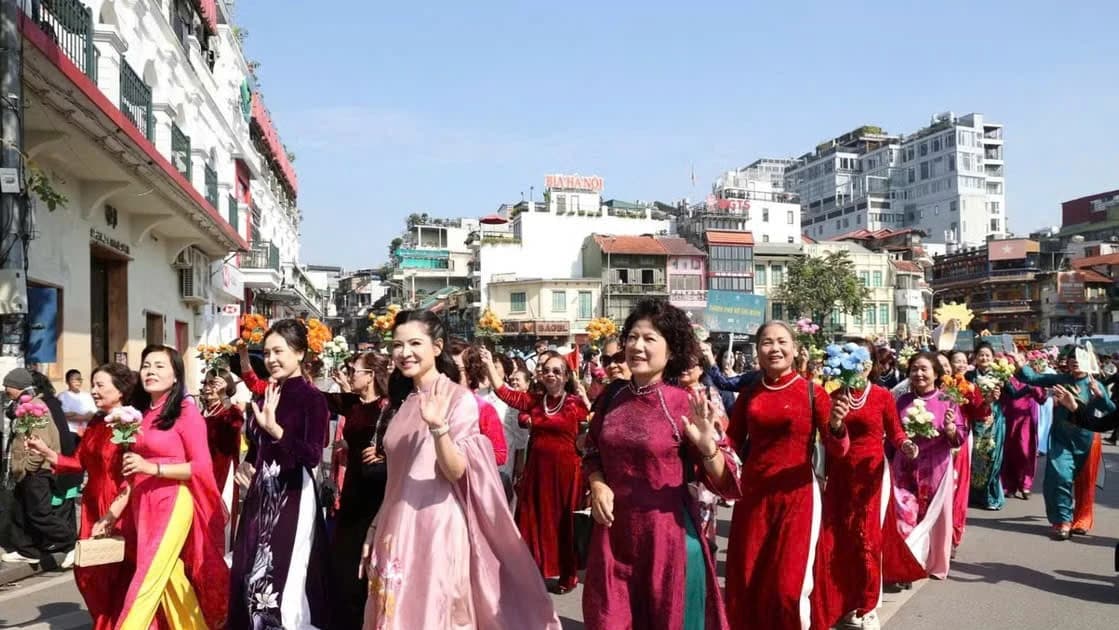
Groups of artisans, artists, and citizens parade to celebrate Vietnam Culture Day in Hanoi . Photo: Hanoi Department of Culture, Sports and Tourism.
✦ Economy & Culture
From a festival to an opportunity for economic development.
Directive document
Resolution No. 80-NQ/TW dated January 7, 2026, of the Politburo on the development of Vietnamese culture sets the goal that by 2030, cultural industries will contribute 7% of GDP; and by 2045, cultural industries and the creative economy will strive to contribute 9% of GDP.
These goals demonstrate that cultural development cannot be limited to preserving heritage, organizing festivals, or building institutions. More importantly, it must involve creating competitive cultural products that generate markets and bring economic benefits to people and businesses.
Notably, the policy of taking a paid day off on Vietnamese Culture Day opens up a new perspective on the cultural economy. When workers have more time to rest, visit tourist attractions, enjoy art, and participate in community activities, the demand for cultural consumption is likely to expand.

The unique art programs bring the public closer to Vietnamese culture. Photo: Hai Nguyen
Cultural festivals and weeks not only attract people to visit and enjoy art, but also stimulate demand for food, shopping, transportation, accommodation, and related services. A prime example is the Hanoi Tourism Ao Dai Festival 2026, which both honors traditional cultural values and opens up opportunities for developing unique cultural tourism products.
Mr. Nguyen Tien Dat
General Director of AZA Travel Company - Vice President of Hanoi Tourism Association
"We can take it a step further, from organizing ao dai events lasting a few days to building regular ao dai experiences, so that visitors to Hanoi, regardless of the season, have the opportunity to wear ao dai, explore the heritage, and create beautiful memories.
From that idea, he came up with the concept "Hanoi - City of Ao Dai Experience Spaces," aiming to connect traditional attire with the distinctive cultural spaces of the capital city.
If implemented properly, a traditional cultural product can create jobs for tailors, artisans, designers, photographers, tour guides, and service businesses. This is a way to transform cultural value into economic value while preserving identity.
One of the biggest challenges is how to ensure that Vietnamese Culture Day not only creates excitement on November 24th, but also promotes the development of the cultural market throughout the year.
CULTURAL HIGHLIGHTS
Culture Day has become a brand.
❖
The highlight of this year's Vietnam Culture Day is the "Colors of Vietnam" concert, which will take place at My Dinh National Stadium on the evening of November 24th. This is a meticulously planned artistic program, bringing together a large number of artists, and is expected to further affirm Vietnam's capacity to organize large-scale artistic events.
However, while an art program may attract tens of thousands of viewers, if it's only held once and then ends, its economic benefits are difficult to sustain in the long run. Therefore, we need to shift from a mindset focused on event organization to developing a cultural ecosystem.
Associate Professor Bui Hoai Son, Deputy Head of the Central Propaganda Department, assessed that the biggest change is the increasing direct involvement of culture in shaping the country's future. Professor Son stated: “In the context of digital transformation and deep integration, culture is also present in how we design a city, build a national brand, develop tourism, produce films, organize concerts, create video games, or introduce Vietnamese handicrafts to the international market . ”
 Major event
The "Brother Says Hi" concert was a spectacular event at My Dinh Stadium. Photo: Organizing Committee
 Public appeal
The concert "Brother Overcoming a Thousand Obstacles" in Hung Yen attracted a large audience. (Photo: Organizing Committee)
 Elaborate preparation
The dress rehearsal for the "Colors of Vietnam" concert before the big event. Photo: Organizing Committee

High art
Rehearsal of artistic performances at the "Colors of Vietnam" concert. Photo: Organizing Committee
A notable aspect of this year's Vietnamese Culture Day activities is the adoption of policies offering free or discounted tickets and services. However, from an economic perspective, free activities can be seen as a tool to encourage public access, experience, and gradually develop cultural consumption habits, rather than the sole model for long-term market development. This raises a new requirement: for culture to create economic value and drive growth, in addition to welfare activities for the people, it is necessary to cultivate the habit of paying for quality cultural products, while maintaining policies that support access for low-income individuals, workers, and vulnerable groups.
Vietnamese Culture Day is an opportunity to expand the market for cultural products and services and promote the development of the cultural industry.
Except for events of special political significance, such as some large-scale state-organized programs, a prerequisite for the development of the cultural industry is that audiences must develop a culture of paying to enjoy artistic events.
Director Viet Tu
The orientation towards building Vietnam Culture Day into a cultural brand has received attention from many localities. Hanoi has identified this direction in Plan No. 100-KH/TU, with the goal of gradually making Vietnam Culture Day in Hanoi an annual cultural milestone, linked to the development of tourism, cultural industries, and the creative economy. From individual activities to a cultural ecosystem, from a single festival to a year-round series of products, this is a process that requires the participation of the State, businesses, creators, and the community.
✦
Resolution No. 80-NQ/TW
In line with Resolution No. 80-NQ/TW, it is necessary to shift from a cultural management mindset to a development-oriented one, making Vietnamese Culture Day a driving force to promote the cultural industry, expand markets, create jobs and sustainable revenue, and contribute to economic growth.
In celebration of Vietnam Culture Day
Organized over 400 programs and activities nationwide.
34
Provinces and cities are responding in unison.
>400
Unique cultural programs and activities
~100
Activities at the Hanoi Creative Design Festival
Ms. Huyen Anh (37 years old, Hanoi) and her son visited the exhibition "Hanoi - City for Peace & Creativity" at 47 Hang Dau Street (free admission from November 21 to 24) early in the morning of November 23.
According to her, the exhibition helps children engage with the history, heritage, and cultural identity of the capital city in a vivid way. Prior to this, her family also attended the opening ceremony of Vietnam Culture Day at Hoan Kiem Lake on November 21st, with a parade of thousands of artisans and artists.
In celebration of Vietnam Culture Day, Hanoi is organizing numerous activities such as free admission to several historical sites and museums, film screenings, exhibitions, and art exchanges. The Hanoi Creative Design Festival 2026 is also taking place with nearly 100 activities for residents and tourists.
Across the country, 34 provinces and cities organized more than 400 programs and activities in various forms, from art performances and heritage experiences to exhibitions and product introductions of traditional crafts. Each locality chose an organizational approach linked to its own cultural characteristics, contributing to showcasing regional identity and bringing traditional values closer to community life.
NORTH
Bac Ninh organizes programs related to the Quan Ho folk singing heritage; Quang Ninh has cultural and artistic activities associated with Yen Tu...
Central and Central Highlands regions
In Hue, activities showcasing the ao dai (traditional Vietnamese dress), Hue folk singing, Bai Choi (traditional Vietnamese theater), and traditional crafts honor the ancient capital; Gia Lai introduces gongs and drums; Khanh Hoa opens a Cham space...
Southern
The event features various forms of activities related to local culture, from traditional folk music and festivals to culinary spaces and community cultural exchanges.

47 Hang Dau
Visitors experience the exhibition space "Hanoi - City for Peace & Creativity". Photo: Chi Long

Hoan Kiem Lake
A procession of artisans, artists, and citizens paraded enthusiastically during the opening ceremony. Photo: Hanoi Department of Culture, Sports and Tourism.
VIETNAMESE CULTURE DAY Connecting Community Heritage
Bringing heritage closer to the public.
Traditional cultural spaces emerge into the streets, radiating vibrant energy through the rhythmic movements of artisans and the enthusiastic reception from the community.
Participating in the heritage parade in Hanoi (November 21), the Dao Thuc folk water puppet troupe (Thu Lam commune) brought familiar puppets and figures from traditional art to introduce to the public. Mr. Dang Minh Hung, head of the Dao Thuc folk water puppet troupe, said the troupe has 33 members, 30 of whom directly participated in the parade, and 3 were responsible for presentations at the exhibition area.
“We are delighted to participate in the parade, bringing the images and characters of Dao Thuc water puppetry to introduce to everyone. This is an opportunity for the public to learn more about traditional art and the values preserved by generations. I hope that through activities like this, water puppetry will become more widely known, and more people will love and be interested in this folk art.”
Mr. Dang Minh Hung, Head of the Dao Thuc Folk Water Puppet Troupe, shared:

Artisans participate in a heritage parade in Hanoi (November 21). Photo: Minh Vu
To showcase a heritage deeply rooted in community spirit, Mr. Nguyen Van Bien - Deputy Head of the Management Board of Tran Vu Temple and Cu Linh Pagoda (Long Bien Ward, Hanoi) - participated in the parade with the seated tug-of-war ritual of Tran Vu Temple. This ritual is associated with the local traditional festival and was inscribed by UNESCO in 2015.
“Sitting tug-of-war is an activity deeply rooted in community life, where everyone participates and cooperates to create collective strength. When this ritual is recreated in a shared space like Vietnam Culture Day, we hope that everyone will feel the spirit of solidarity and unity of the community expressed through this traditional activity. That is what gives the sitting tug-of-war ritual its meaning and why it needs to be preserved.”
Mr. Nguyen Van Bien, Deputy Head of the Management Board of Tran Vu Temple and Cu Linh Pagoda relics.

Cultural space
The series of events contributes to connecting the community and bringing cultural heritage closer to the public. Photo: Hanoi Department of Culture, Sports and Tourism.
From nationwide events to the presence of artisans and heritage practitioners in public spaces, Vietnam Culture Day opens up more opportunities for culture to be shared in community life. Traditional values are continued not only through preservation, but also through the participation, experience, and connection of the people.
LINH HUONG