Following the reorganization of the administrative apparatus and units, Party building work at the grassroots level in the province has undergone many changes, gradually adapting to the two-tiered local government model.
Party committees at all levels have focused on consolidating their organizations, improving the quality of party members, assigning suitable cadres, innovating leadership methods, and promoting digital transformation . Through these efforts, the leadership role of grassroots party organizations continues to be enhanced, contributing to the successful implementation of political tasks in the localities.
 |
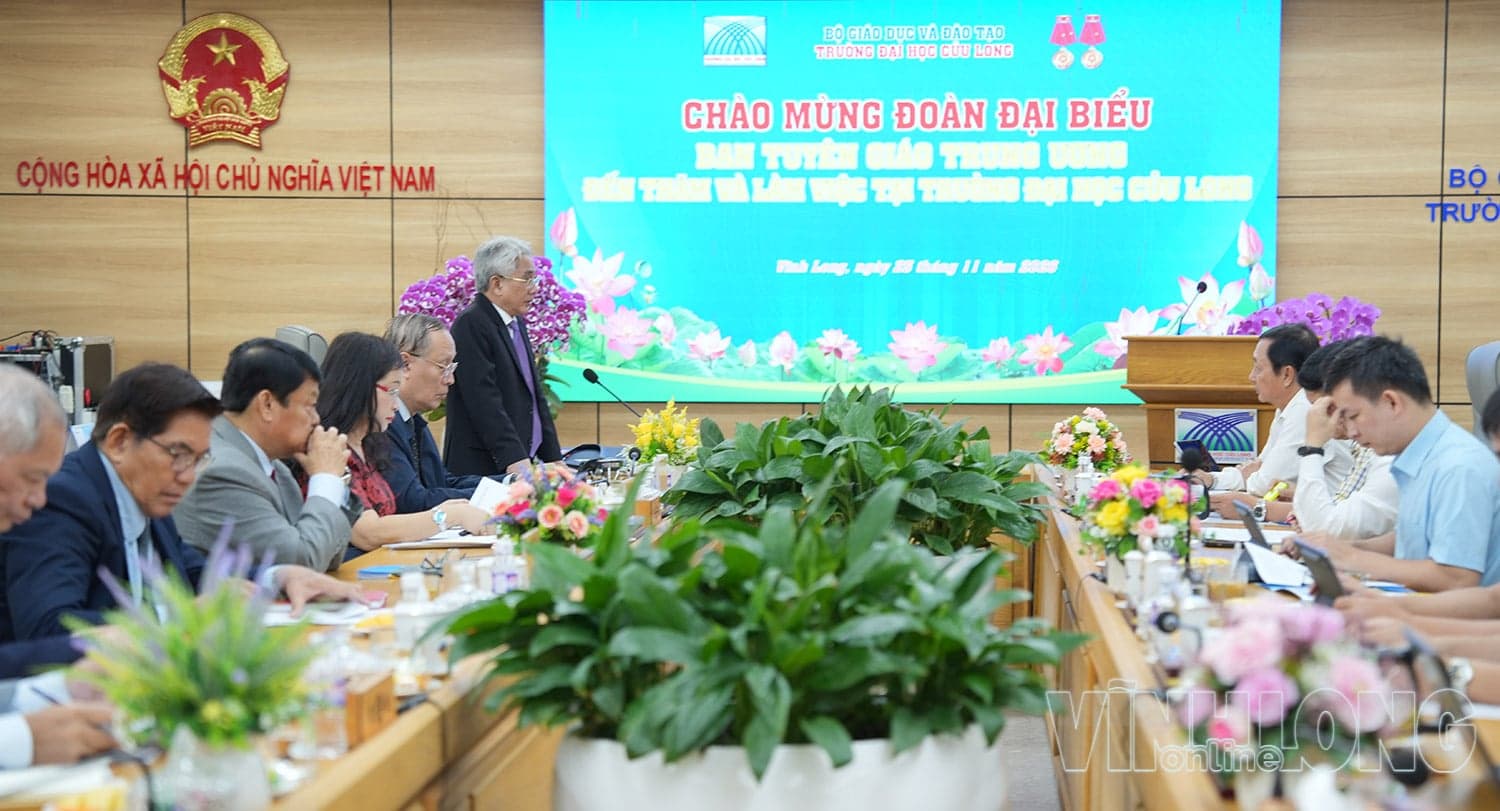
| Comrade Lam Minh Dang - Deputy Secretary of the Provincial Party Committee (second from the right) presides over the 2026 meeting on grassroots Party building work. |
Strengthening the organization and improving the quality of Party members.
Following the reorganization, the provincial Party Committee has 130 subordinate Party committees, 3,851 grassroots Party organizations with 156,491 Party members. The entire province has 124 commune-level administrative units, and the organizational scale and management areas have changed, while the workload at the grassroots level has increased, placing higher demands on the leadership and management capacity of the Party committees.
In 2026, political and ideological work received attention from Party committees at all levels. The province organized 7 conferences to study and thoroughly understand Party resolutions, with over 98% of Party members participating in each session. The restructuring and transfer of Party organizations and members were carried out in accordance with the new model. The quality of Party branch meetings gradually improved, with 94-98% of Party members participating in regular meetings; over 90% of Party branches were rated good. 100% of Party branches implemented the electronic Party member handbook.
Party membership development has yielded positive results. By November 20, 2026, the province had admitted 4,630 new party members, achieving 101% of the annual plan. Party member management has been strengthened through the application of information technology; Party organization data has been standardized to 100%, and party member data to 99%; 141,529 party member files have been digitized, reaching 98%.
In Ham Giang commune, the work of recruiting and developing Party members is implemented in conjunction with the characteristics of the area, which has a large Khmer population. The commune's Party Committee currently has 27 subordinate Party branches with 728 Party members, of which over 80% are Khmer. In 2026, the commune's Party Committee sent 36 individuals to participate in a Party awareness training course, through which 26 new Party members were admitted, achieving 113% of the target.
Comrade Ngo Thi Dieu Huong, Deputy Secretary of the Party Committee of Ham Giang commune, said: The commune Party Committee assigns specific targets for recruiting new Party members to each Party branch, linking the results of Party member development with the evaluation and ranking of Party branches and their leaders. Propaganda and mobilization work is carried out in accordance with the customs and traditions of the Khmer people; promoting the role of Party members, influential individuals, and mass organizations in identifying and nurturing outstanding individuals. For young people working far from home, Party branches proactively maintain contact, taking advantage of holidays and Tet (Lunar New Year) to understand their thoughts and create opportunities for their participation in training programs.
Along with the development of Party members, personnel work was adjusted to meet the requirements of the reorganization. The province transferred 139 civil servants and public employees from departments and agencies to communes and wards; and recruited 863 non-specialized personnel to work as civil servants at the commune level. 40 training courses were organized with 3,989 participants including cadres, civil servants, and public employees.
Innovate leadership methods, focusing on the people.
Organizational and personnel changes require grassroots Party committees to adjust their leadership methods, assign tasks more clearly, and enhance the role of each organization within the political system. In Cho Lach commune, the Party Committee identifies the Fatherland Front and other mass organizations as important forces in propaganda, mobilization, monitoring the situation, and organizing movements in residential areas.
According to Comrade Le Thi Hoang Oanh, Secretary of the Party Committee of Cho Lach commune, the Party Committee has reformed its leadership approach by defining common tasks, clearly assigning responsibilities, and strengthening coordination among organizations. Mass organizations are assigned to participate in specific tasks such as digital transformation, supporting production development, e-commerce, and social welfare. The "Digital Youth Union Member" model has attracted 2,135 participants. With this approach, the commune aims to achieve and surpass all 34 targets set in the resolution by 2026.
One area of focus for Party committees at all levels is integrating the study and practice of Ho Chi Minh's ideology, ethics, methods, and style into the daily work of cadres and Party members. The province currently has over 2,000 models and exemplary practices that have been developed and maintained. In Cau Ke commune, the model "Those above set a good example, those below actively follow" is linked to "Accompanying the poor." Through "Listening to the people," the commune has received and resolved over 1,520 opinions and suggestions. The locality has also established 14 community digital technology groups in 14 hamlets to support people in using digital utilities.
Along with the innovation of leadership methods, inspection, supervision, and mass mobilization work continued to be strengthened. The Provincial Party Committee and its Standing Committee completed 21 out of 21 inspection and supervision teams for 51 Party organizations and 31 Party committee members. The Fatherland Front at all levels chaired 930 supervision sessions at 484 agencies and units; 342 out of 350 recommendations were accepted and resolved, achieving a 97.7% success rate. This contributed to raising the responsibility of organizations and individuals in performing their duties and promptly identifying issues that needed correction.
Social welfare work continues to receive the support of all sectors of the population. Throughout the province, over 492 million gifts worth 169.4 billion VND were distributed; 1,959 new solidarity houses were built worth 118.9 billion VND, and 126 houses were repaired with a budget of 4.1 billion VND. These activities contribute to improving people's lives and strengthening the close relationship between the Party, the government, and the people.
Speaking at the 2026 conference on grassroots Party building work, Comrade Lam Minh Dang - Deputy Secretary of the Provincial Party Committee - acknowledged the achievements in grassroots Party building work, especially the consolidation of organizations after restructuring, the development of Party members, the innovation of leadership methods, and the application of information technology.
Regarding future tasks, the Deputy Secretary of the Provincial Party Committee requested that Party committees at all levels continue to innovate in studying and understanding resolutions; effectively implement Directive 07-CT/TW of the Politburo , Directive 50-CT/TW of the Secretariat, and Guidance 04-HD/TU of the Provincial Party Standing Committee; improve the quality of Party branch activities, promote the "Four Good Party Branches" model, and pay attention to creating sources and developing Party members to ensure quality. The evaluation and ranking of Party organizations and Party members must be based on the results of task performance; and at the same time, strictly implement Conclusion 107-KL/TW and Conclusion 123-KL/TW of the Politburo on job positions, placement, and training of cadres in accordance with practical requirements.
The Deputy Secretary of the Provincial Party Committee noted that inspection and supervision work should focus on areas prone to violations; promoting the role of the Fatherland Front and mass organizations in social supervision and criticism, and implementing democracy at the grassroots level. By December 2026, the goal is to complete the standardization of data, digitize party member records, and activate the electronic Party Member Handbook. Party building work must be linked to the implementation of political tasks, accelerating the disbursement of public investment capital, collecting budget revenue, building new rural areas, taking care of people during Tet (Lunar New Year), and maintaining security and order at the end of the year.
Recent changes in grassroots Party building have contributed to enhancing the leadership capacity and fighting strength of Party organizations and improving the quality of local activities. In the new context, each Party committee and Party organization must continue to play its leading role, improve the quality of its cadres and Party members, and use the effectiveness of task implementation and the satisfaction of the people as a measure of success. This is also a condition for consolidating people's trust and building increasingly clean and strong Party organizations from the grassroots level.
Text and photos: SON TUYEN