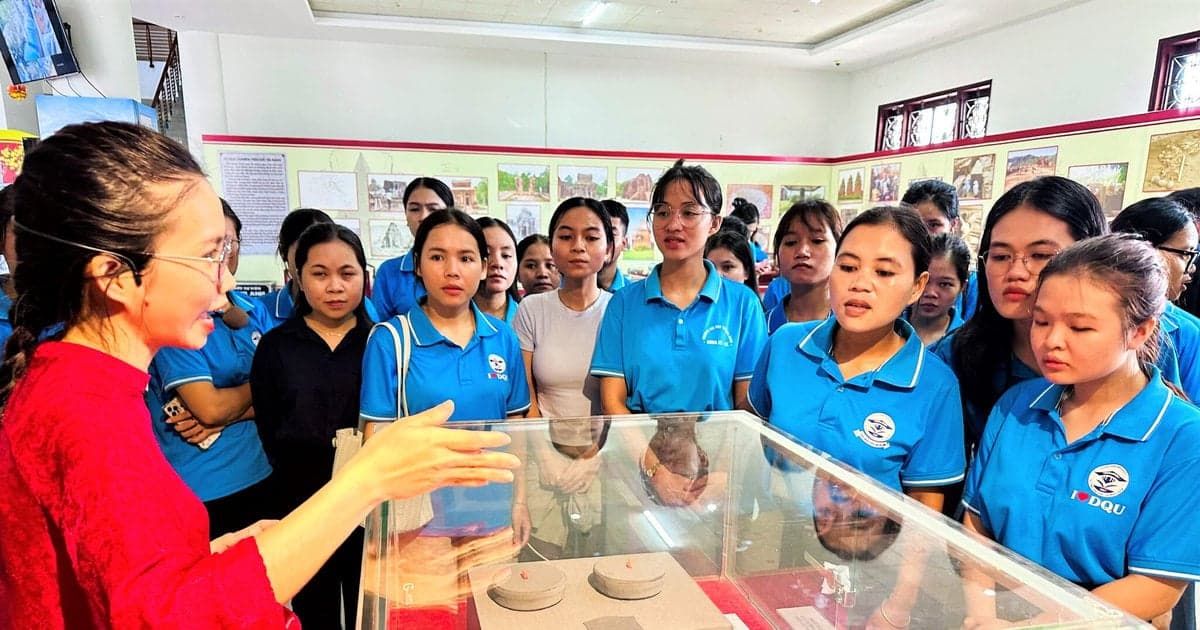
The classes are directly taught by trained commune police officers and soldiers using standard textbooks to guide the villagers. They are also supported by members of the Commune Police Youth Union, the Party Secretary, the village head, the head of the Fatherland Front Committee, village elders, and other influential people. The lessons take place in a friendly atmosphere, helping students confidently practice reading and writing.
According to Major Bling Dieu, Head of the Security Team of Avuong Commune Police, the class helps the Co Tu people improve their Vietnamese communication skills, gradually gain confidence in using smartphones, conduct banking transactions, and handle administrative procedures in the locality.
For Ms. Alang Thi Vui (born in 1982, residing in Chorlang village), the class brought special joy. Previously, due to illiteracy, she often had to use her fingerprint whenever she needed to sign documents. Now, with the dedicated guidance of the police officers, she has gained more confidence in communication and hopes to be able to handle personal tasks independently.
"Knowing how to read and write Vietnamese has given me the confidence to communicate and sign documents for work, instead of having to use my fingerprint like before," Ms. Vui shared.
Similarly, Ms. Alang Thi Xin expressed that when police officers encouraged people in the village to participate in the literacy class and directly taught them to read and write, the villagers were very excited and actively registered.

Following the initial success, on November 12th, the Avương Commune Police Department inaugurated its second training course in Agiốc village with 45 participants from the Cơ Tu ethnic group. This activity contributes to concretizing the criterion of "Closest to the people" in the "Three Best" emulation movement of the People's Police force.
The unique aspect of this class is the two-way interaction: police officers teach Vietnamese to the local people; conversely, the students become teachers of the Co Tu language to officers and soldiers who are not yet fluent in the local language. Through this, each lesson not only imparts knowledge but also helps both sides to better understand and bond with each other.
The course lasts 3 months, with flexible scheduling to suit the working and production conditions of the local people. The commune police aim for all 45 trainees to complete the course, enabling them to read and write Vietnamese fluently and use some basic digital tools. The unit also provides books, notebooks, and pens for all trainees.
According to the plan, after summarizing, evaluating, and refining the method from the pilot phase in Chơrlang village, the commune police will expand the model, striving to complete universal access to all 12 villages in the area within 36 months.
According to Lieutenant Colonel Ngo Van Thin, Head of the Avuong Commune Police, knowing how to read and write Vietnamese not only helps the people proactively participate in digital transformation, confidently use online public services, and firmly grasp the policies and laws of the Party and the State; but also creates opportunities for commune police officers to interact and learn the Co Tu language from the people.
This further strengthens the close relationship between the police force and the people, contributing to ensuring security and order and consolidating the nationwide movement for safeguarding national security in border areas.