

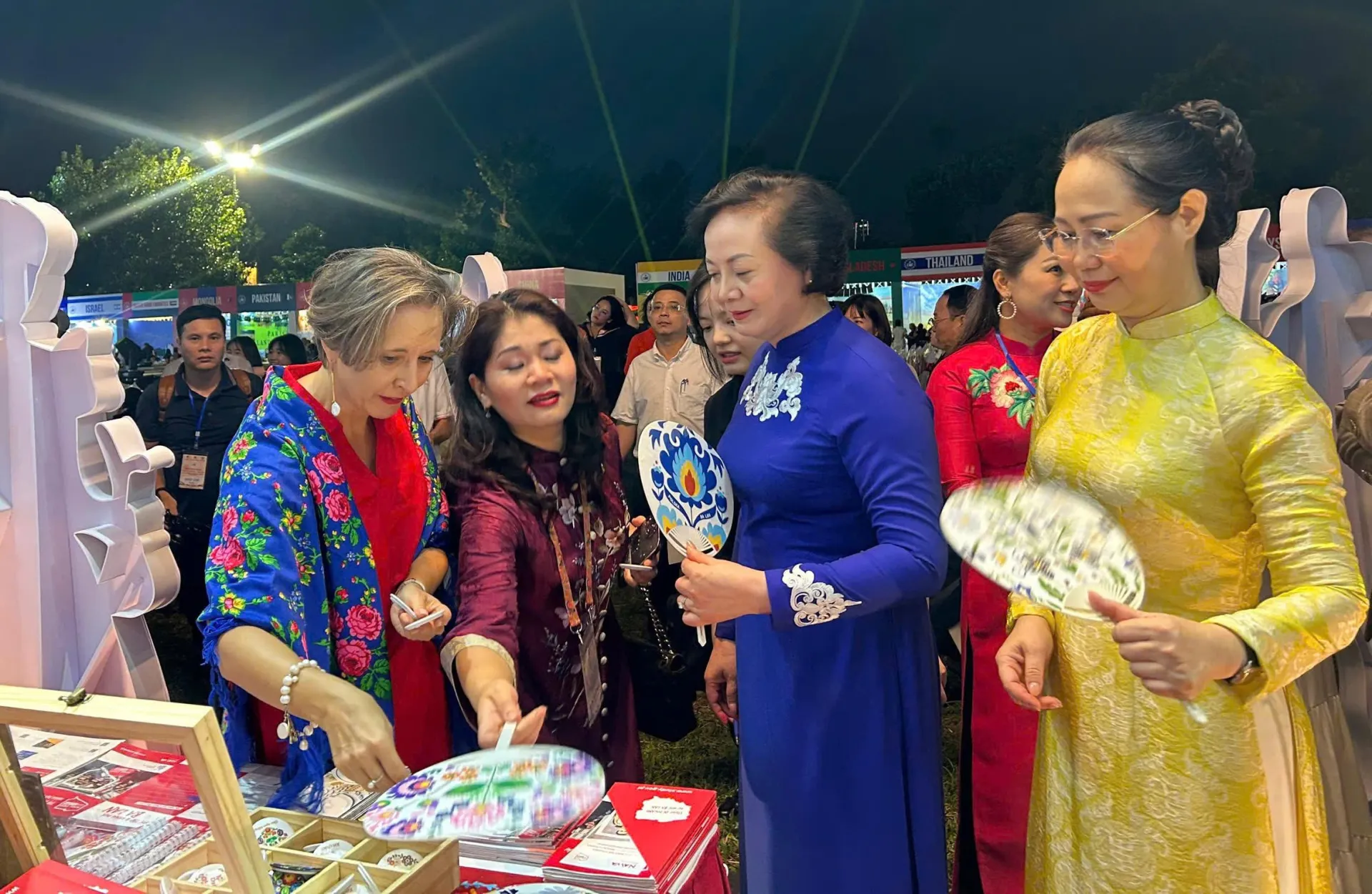
Deputy Prime Minister Pham Thi Thanh Tra visits a booth at the festival. (Photo: Thu Phuong)
A bridge connecting cultures.
This year's festival holds profound significance as it coincides with the 50th anniversary of Vietnam's membership in UNESCO. Beyond the scope of a typical performance event, the festival is a space for multi-dimensional cultural dialogue – where the timeless heritage of nations shines together, where art becomes a common language for understanding, strengthening friendship, and working towards a peaceful and sustainable future for the international community.
Over the four days of the festival, with 45 cultural spaces, 35 food stalls, film programs from 20 countries, fashion spaces from 15 countries, and the participation of 19 international art troupes, the diverse activities allowed the public to discover the unique characteristics of Vietnam and the participating countries.
Highlights included the opening program "Convergence of Heritage - Shaping the Future," which blended traditional Vietnamese elements such as folk songs from the three regions of Vietnam, Hue Royal Court Music, and Quan Ho folk songs from Bac Ninh, with the participation of international art troupes and contemporary forms of expression. International delegates also visited the Vietnam National Ethnic Culture and Tourism Village to learn about the customs, crafts, folk art, and cuisine of Vietnam's ethnic communities. The "Colors of Five Continents" parade brought 15 international art troupes from Europe, Africa, Asia, and South America along with Vietnamese artists along the streets. Traditional costumes, music , and street art created a visual approach, bringing cultures closer to the public.
As Deputy Prime Minister Pham Thi Thanh Tra stated at the opening ceremony: “This is a bridge to foster friendship, understanding, and trust among nations to jointly build a peaceful, humane, and sustainably developed world for humanity. With the miraculous power of culture, connecting people across all distances and differences, so that no border can separate empathy, sharing, and aspirations for peace and development.”
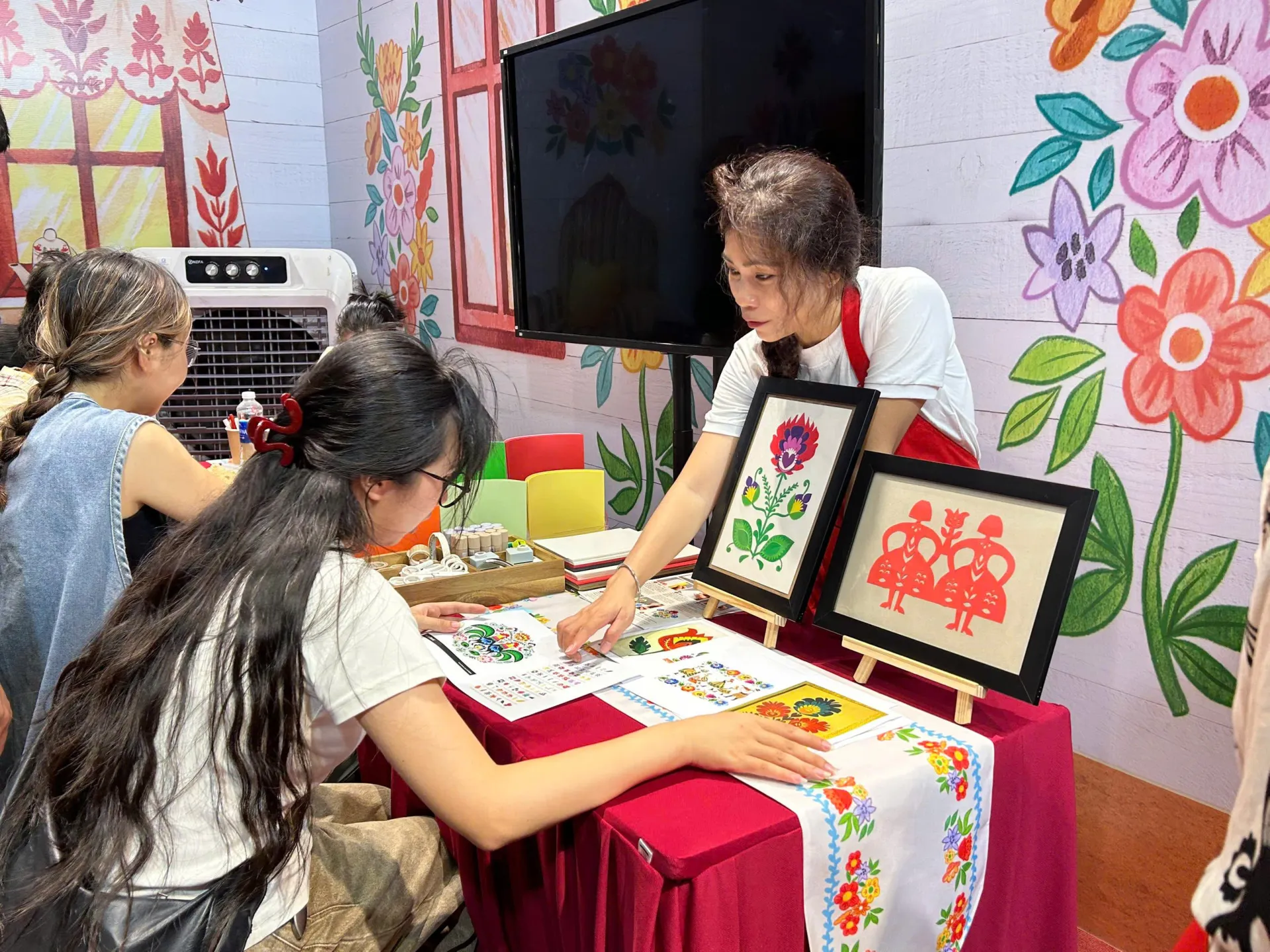
A booth offering hands-on experience in drawing traditional Polish patterns. (Photo: Thu Phuong)
Hanoi - a meeting point of diverse cultures.
The Thang Long Imperial Citadel, a World Heritage site in the heart of Hanoi, has been chosen as the central venue for the 2026 World Cultural Festival. Within this space steeped in the historical landmarks of the capital city, Vietnamese cultural values will have the opportunity to harmonize with the distinctive characteristics of many other nations.
Returning to Hanoi for the second time shows that the festival is increasingly being placed in close connection with the city's cultural life. Hanoi has the advantage of a system of heritage sites, cultural institutions, and public spaces, creating conditions for international activities to reach a wider audience. From here, the image of the capital is presented through multiple layers of value, from its historical depth to the vitality of a city actively expanding cultural activities to the community.
Notably, the Thang Long Imperial Citadel itself lends a special layer of significance to this encounter. With a history spanning over a millennium, the heritage site preserves traces reflecting the continuous development of Thang Long - Hanoi. Bringing the cultural values of many nations to this profound heritage site creates a continuity between what has been preserved over time and what is present in contemporary life.
From Thang Long Imperial Citadel, activities extend to Ho Guom pedestrian street and the Vietnam Ethnic Groups Cultural and Tourism Village, creating different approaches for the public. While the Imperial Citadel evokes historical depth and heritage, Ho Guom pedestrian street offers a sense of intimacy and openness, and the Vietnam Ethnic Groups Cultural and Tourism Village opens opportunities for international friends to learn about Vietnam's cultural diversity.
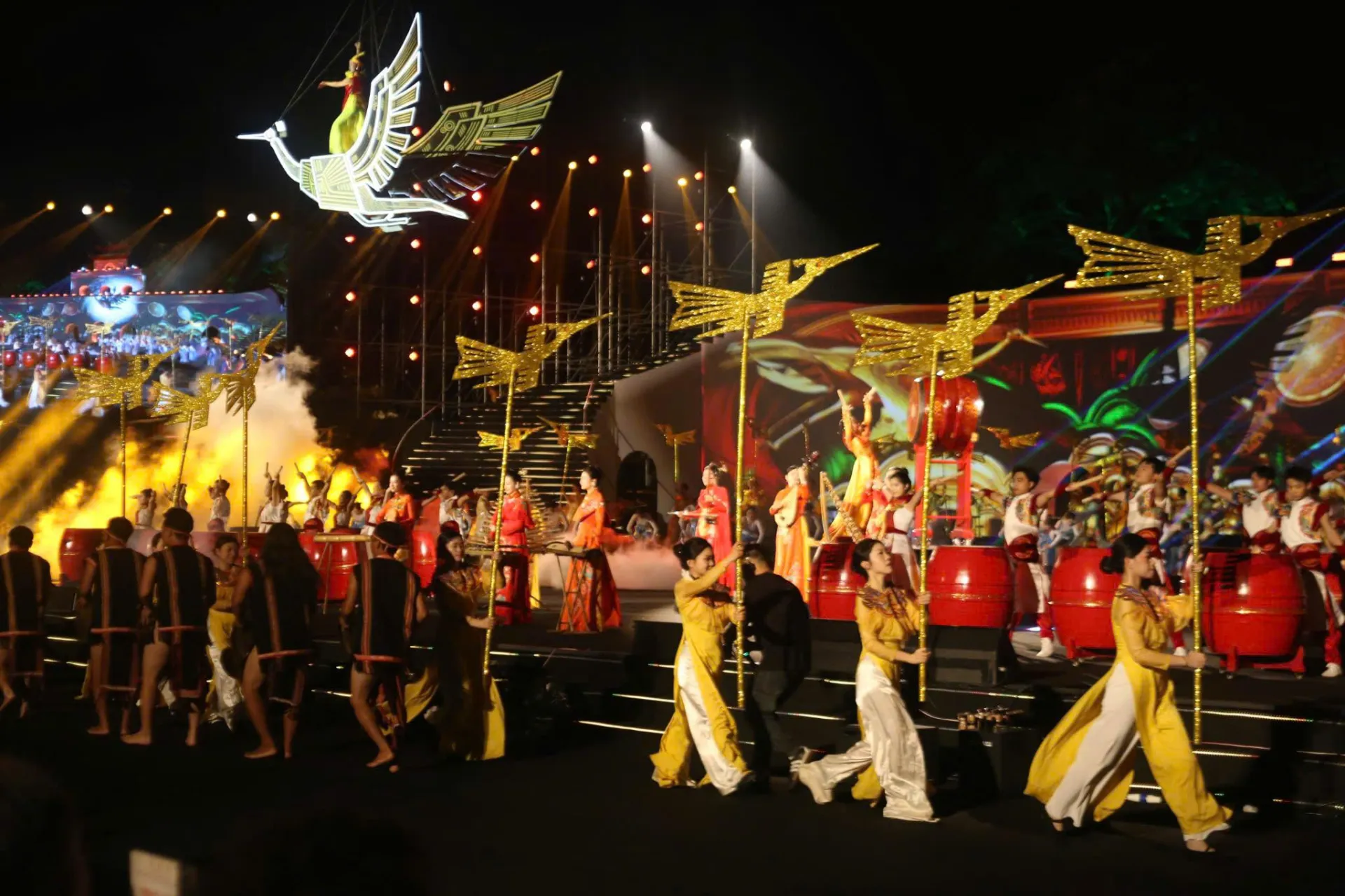
A spectacular opening day for the 2026 World Cultural Festival. (Photo: Viet Hoang)
From exchange to long-term cooperation
Beyond mere performances and exhibition spaces, the World Cultural Festival 2026 opens up a vision for a multilateral cultural cooperation mechanism, where initial exchanges are transformed into sustainable dialogues.
From a strategic development perspective, culture is seen as a powerful endogenous resource, capable of adapting and spreading in the context of globalization and digital transformation. Presenting this orientation, Deputy Prime Minister Pham Thi Thanh Tra affirmed: “In this journey, preservation must be linked to promotion, tradition to creativity, heritage to contemporary life, and culture to people and development; while simultaneously promoting the application of science, technology, and artificial intelligence to digitize, preserve, restore, and promote heritage, bringing genuine cultural values closer to the community, and especially to the younger generation.”
Notably, Vietnam's position in international cultural dialogue is increasingly affirmed through strategic steps of global significance. The "International Decade for Culture for Sustainable Development" initiative (2027-2036), initiated and proposed by Vietnam, was officially adopted by the United Nations in September 2026. This event confirms the international community's recognition of Vietnam's proactive role in making culture an essential driver for sustainable development.
Appreciating Vietnam's proactive role in making culture an essential driver for sustainable development, Mr. Lazare Eloundou Assomo, Director of the UNESCO World Heritage Centre, shared: “Culture doesn't just live in archives. Culture lives when people interact, share, and open their hearts to let culture touch their souls. A festival like this offers something that purely policy dialogues cannot: an opportunity to directly experience another culture, through music, stories, crafts, and how that culture is present in daily life.”
The artistic activities at the festival serve as a foundation for strengthening mutual understanding between nations, transcending mere diplomatic barriers. Establishing Hanoi as an annual cultural hub not only helps to honor world heritage sites but also affirms Vietnam's position as a connecting center where cultures converge to share aspirations for a peaceful, humane, and sustainable world.
Source: https://cuuchienbinh.vn/le-hoi-van-hoa-the-gioi-2026hoi-tu-di-san--kien-tao-tuong-lai-d44989.html