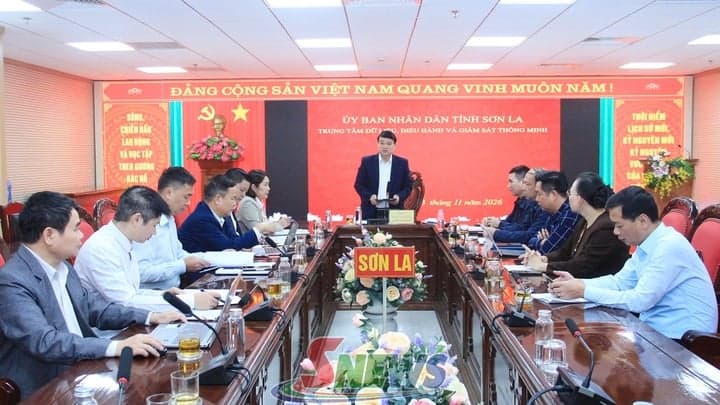
The workshop was held in a hybrid format, combining in-person and online participation with connections to several provinces and cities. Attending the workshop at the Son La provincial connection point were leaders from the Department of Justice and several related departments and agencies.
By October 31, 2026, central and local authorities had identified and compiled 43,702 legal documents, both in effect and not yet in effect, that were subject to the comprehensive review. Based on the criteria identified, the comprehensive review by central and local authorities proposed amendments, additions, replacements, partial repeal, and the issuance of new legal documents for 6,208 documents, while completely repealing 3,809 documents.
The agencies have proposed options and guidelines for integrating documents with closely related content or those needing to be regulated within the same policy chain, limiting the issuance of numerous detailed regulations, implementation guidelines, and specific measures for organizing the implementation of legal documents, as well as other policies on improving the structure of the legal system.

At the workshop, delegates focused on discussing, exchanging ideas, and contributing to the completion of the draft report on the results of the comprehensive review and solutions for the overall handling of the system of legal normative documents. They also proposed solutions for handling legal normative documents and improving legislation on the following topics: Implementing the policy of developing the state economy ; ensuring national energy security; promoting decentralization and clearly defining authority according to the principle of promoting the autonomy and creativity of localities; and promulgating legal regulations to create a synchronized legal basis for the operation of the three-tiered government apparatus, etc.
The Standing Agency of the Steering Committee for the Comprehensive Review of the System of Legal Normative Documents requests that ministries, sectors, and localities strengthen the leadership and guidance of Party committees and heads of agencies and organizations in handling the results of the comprehensive review of the system of legal normative documents, streamlining and perfecting the structure of the legal system. They should issue a plan for implementing the handling of the results of the comprehensive review of the system of legal normative documents as a basis for implementation, clearly defining the content, progress, and responsibilities for implementation. They should promote digital transformation, the application of information technology and artificial intelligence in the drafting of legal normative documents and the organization of law enforcement. They should standardize and improve the data from the comprehensive review of the system of legal normative documents, and regularly update, monitor, and supervise the results of handling legal normative documents.