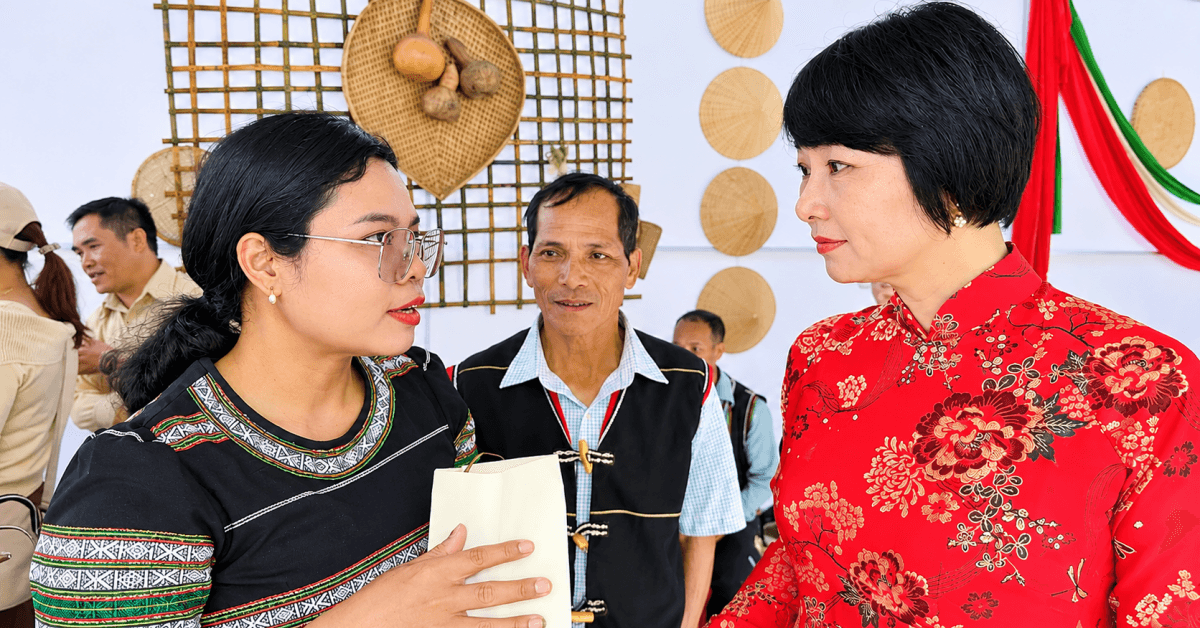
Preserving the cultural values of the K'Ho people.
Lam Dong is the long-standing home of the K'Ho ethnic group, with many unique cultural values preserved through generations. These cultural features not only create a distinct identity for the community but also constitute a valuable resource for tourism development.
In order to preserve these values, Lam Dong province has implemented Project 6 "Preserving and promoting the fine traditional cultural values of ethnic minorities associated with tourism development," under the National Target Program for socio -economic development of ethnic minority and mountainous areas giai đoạn 2021-2030.
The sites selected for conservation investment include the traditional K'Ho ethnic village in Dung K'Si hamlet, Lac Duong commune, and the traditional K'Ho ethnic village in Klong Trao 1 hamlet, Di Linh commune.

In Dung K'Si village, the K'Ho ethnic traditional village project has a total investment of over 13 billion VND, including the construction of a gate, flagpole, rest pavilions, community center, traditional activity house, restrooms, green spaces, yards, water supply and drainage systems, and other auxiliary facilities. The project was put into use on September 30, 2024.
Meanwhile, in Di Linh commune, traditional villages are also given priority in terms of management, preservation, and promotion of local cultural values.
Ms. Nguyen Thi Huynh Nguyet, Head of the Culture and Social Affairs Department of Di Linh commune, said that the K'Ho ethnic traditional village continues to be included in the national program for preserving and promoting the fine traditional cultural values of ethnic minorities associated with sustainable community tourism development in Lam Dong.
According to Ms. Nguyet, after the establishment of the management board, the village's activities have been maintained stably and achieved positive results. Currently, the traditional village is not only of interest to local people but also attracts tourists from many parts of the country to visit and learn about the traditional culture of the indigenous people.
Ms. Ka Hung, Deputy Head of the K'Ho Traditional Village Management Board in Di Linh commune, commented that since the traditional cultural village was established, the local government has shown great interest and created favorable conditions for its development.
With the attention and guidance of the local government, the members of the management board have strived to preserve and promote the cultural values of the K'Ho ethnic group.

"We hope that future generations, from the elderly to the young, will know and continue to preserve traditional cultural values such as the K'Ho script, cuisine , and traditional crafts."
"In addition to focusing on preserving old values, the village management board also explores and learns new methods and innovative models to combine conservation with the effective promotion of ethnic culture, bringing K'Ho culture closer to tourists and the community," Ms. Ka Hung shared.
Continue developing traditional villages in conjunction with community tourism.
Beyond investing in infrastructure, Lam Dong province continues to identify the preservation of indigenous culture as one of the foundations for developing community-based tourism in the new phase.
According to Plan No. 3271/KH-UBND dated March 15, 2026, of the Lam Dong Provincial People's Committee on the implementation of the Community Tourism Development Project in Vietnam, Dung K'Si village (Lac Duong commune) and Klong Trao 1 village (Di Linh commune) continue to be identified as potential locations for developing community tourism associated with K'Ho culture in the 2026-2030 period.
For Dung K'Si village, the province aims to preserve the traditional cultural village and promote the remaining K'Ho cultural values. The locality has the advantage of being located along National Highway 27C, connecting Lam Dong with Khanh Hoa.
Activities such as gong competitions, traditional dances, outdoor folk games, and cultural events have been identified as products that can attract visitors.

In Klong Trao 1 village, the advantages for developing community tourism come from the landscape of mountains, valleys, lakes, forests, rice fields, and tea hills. In addition, the locality still preserves many traditional cultural features of the K'Ho people, such as longhouse architecture, gong performances, Xoan singing, harvest festivals, and ethnic cuisine.
The province's plan aims to combine cultural experiences with distinctive agricultural products such as macadamia nuts, durian, and coffee, thereby creating additional tourism products and economic development opportunities for the people.
Besides the two locations mentioned above, Ka Sá village (Son Dien commune) is also being developed as a traditional K'Ho ethnic village linked to community tourism. This area has relatively pristine natural landscapes and is closely connected to the cultural life of the K'Ho people.
Traditional festivals such as the Nho Rohe festival (celebrating the new rice harvest), the rain-praying ceremony, and folk musical instruments like gongs, stone xylophones, gourd flutes, and bamboo flutes are considered valuable assets that can be exploited to develop tourism products with unique characteristics.

According to the plan, Lam Dong province aims to develop community-based tourism in a sustainable manner, linked to the preservation of cultural identity, protection of landscapes and the environment, while ensuring benefit sharing among all participating parties. The province also focuses on training and developing management skills, customer service skills, tourism interpretation, and the transmission of intangible cultural heritage to local people at community-based tourism destinations.
By 2027, the province aims to have at least 30% of recognized community tourism destinations with regularly performing traditional cultural and artistic groups; and at least 40% of owners of community tourism service providers trained in tourism management.
The continued inclusion of K'Ho traditional villages in the community-based tourism conservation and development program demonstrates Lam Dong's efforts to combine heritage preservation with local economic development. In this process, the participation of the community itself, from village management boards to successive generations of residents, is crucial to ensuring that traditional cultural values do not fade away but continue to be passed on and disseminated.