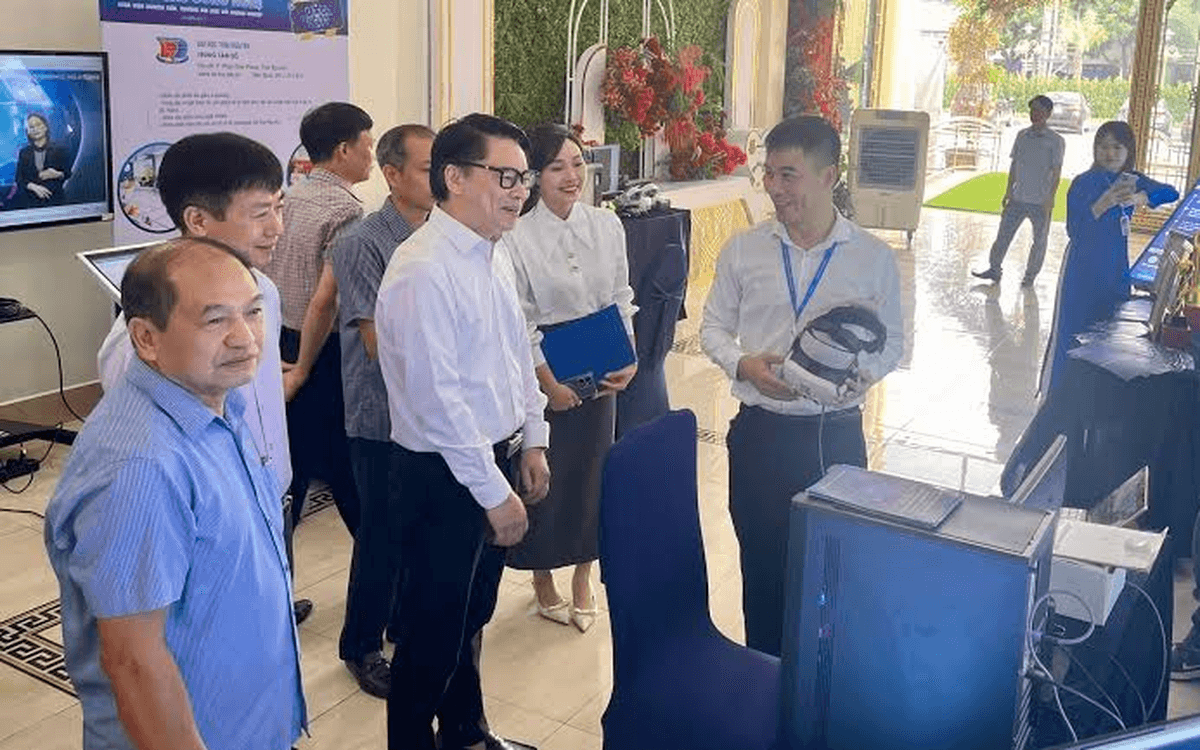


At the event, leaders of the Central Policy and Strategy Committee and the Ministry of Science and Technology affirmed the highest political determination of the Party and Government in creating a breakthrough legal framework and removing institutional "bottlenecks" to promote research and development (R&D) capacity in the semiconductor industry.
Specifically, realizing the vision of mastering core technologies.
In his opening remarks and orientation for the workshop, Mr. Nguyen Hoang Giang, Member of the Central Committee of the Party and Deputy Head of the Central Policy and Strategy Committee, emphasized that in the context of increasingly intense global strategic competition, the semiconductor industry has become a foundational industry, playing a particularly important role in economic development, technological self-reliance, and national standing.

Comrade Nguyen Hoang Giang - Member of the Central Committee of the Party, Deputy Head of the Central Policy and Strategy Department.
Recognizing this importance, the Party and State have recently issued a series of groundbreaking policies and strategic directions aimed at developing science, technology, innovation, and digital transformation . Notable examples include Resolution No. 57-NQ/TW of the Politburo and Resolution No. 19 of the Central Committee of the 14th Party Congress (issued on July 28, 2026) on reforming Vietnam's development model.
Deputy Head of the Central Policy and Strategy Committee Nguyen Hoang Giang also reiterated the consistent directive of General Secretary and President To Lam on the need to choose the right priority direction, focusing on building technological capacity linked to research and production to create products with real value.
According to the Deputy Head of the Central Policy and Strategy Committee, the crucial issue now is how to organize the implementation so that the guidelines and policies truly come to life and transform into endogenous technological capabilities.
Given limited resources, Vietnam needs to clearly define its roadmap for the next 5, 10, and 20 years; effectively operate the "five stakeholders" linkage model (State - Scientists - Businesses - Investors - Banks/ Education ) to gradually participate substantially in high value-added stages of the global semiconductor value chain.
The government takes decisive action: Removing "bottlenecks" with unprecedented financial mechanisms.
To concretize the Party's resolutions, the Government and the Ministry of Science and Technology have recently been working diligently to complete the legal framework with many outstanding mechanisms, directly addressing the inherent barriers of the semiconductor industry.

Deputy Minister of Science and Technology Le Xuan Dinh delivered a speech at the workshop.
Speaking at the workshop, Deputy Minister of Science and Technology Le Xuan Dinh analyzed that the global semiconductor revenue is experiencing rapid growth (projected to reach approximately US$1.65 trillion in 2026 and US$2.1 trillion in 2027), indicating fierce competition on a global scale.
According to Deputy Minister Le Xuan Dinh, although Vietnam has recorded encouraging initial steps with the participation of enterprises such as Viettel and FPT in designing 5G and IoT chips, our R&D capacity is still hampered by three major "bottlenecks": the cost barrier of investing in cleanroom infrastructure and experimental chip foundry; a severe shortage of chief engineers; and delays and inflexibility in the financial mechanism for core technology research.
To thoroughly remove these barriers, Deputy Minister Le Xuan Dinh pointed out that, in implementing the High-Tech Law, the Government has issued Decree No. 260/2026/ND-CP along with a series of guiding circulars from the Ministry of Science and Technology with breakthrough policies that approach international standards, with notable highlights.
Accepting risks and contracting to the final product, shifting strongly from an allocation mechanism to a "commissioning" mechanism stemming from the practical needs of businesses. The State applies a final product contracting mechanism linked to specific evaluation milestones; in particular, it stipulates exemption from liability when core technology research fails due to objective risks if the correct procedures have been followed.
With maximum financial support for testing and elite personnel, all products in the strategic technology category, such as semiconductor chips, will receive state support covering up to 100% of the testing (chip manufacturing) costs domestically and internationally. For the first time, a legal framework allows for special incentives of up to 300 million VND/month for chief engineers and leading scientists, equivalent to the incentives offered by top research centers in the region.
Regarding investment in shared infrastructure, in accordance with Prime Minister's Decision 1483, the Ministry of Science and Technology has promptly put into operation the National Center for Semiconductor Chip Produced Production Support. In the near future, the center will provide high-performance server systems, licensed integrated circuit design software (EDA), and internationally standardized testing and measurement laboratory systems at preferential costs to research institutes, universities, and businesses.

The speaker presented a paper at the event.
Smart positioning in a niche market.
With a favorable legal framework already established, Deputy Minister Le Xuan Dinh emphasized that Vietnam will intelligently position itself by focusing R&D efforts on specialized chip lines and niche segments linked to strategic technologies such as: edge AI chips, IoT chips, power chips for green energy, and 5G/6G telecommunications equipment.
The synergy between the Party's strategic guidelines and the Government's decisive and substantive action plans and policies, along with those of the Ministry of Science and Technology, is creating new momentum, paving the way for the Vietnamese scientific and business community to confidently venture forward and gradually master core technologies in the semiconductor era.