In the context of rapid digital transformation , the demand for building a professional, elite, and modern People's Public Security force places increasingly high demands on information infrastructure, cryptography, and information security. As a specialized force, the Telecommunications and Cryptography officers of the Lam Dong Provincial Police Staff Department are gradually strengthening infrastructure and improving operational capacity, contributing to ensuring that information serving command and control remains uninterrupted and secure.

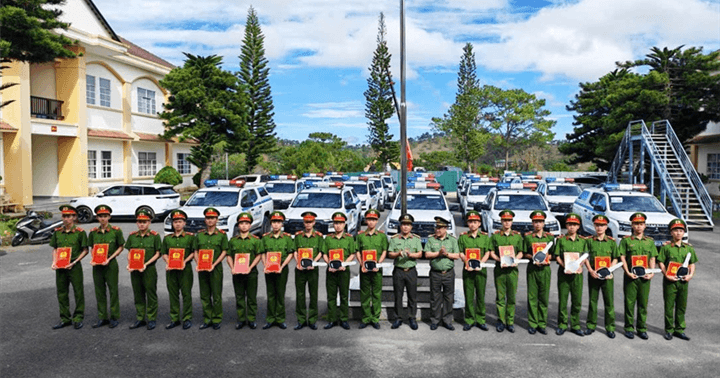
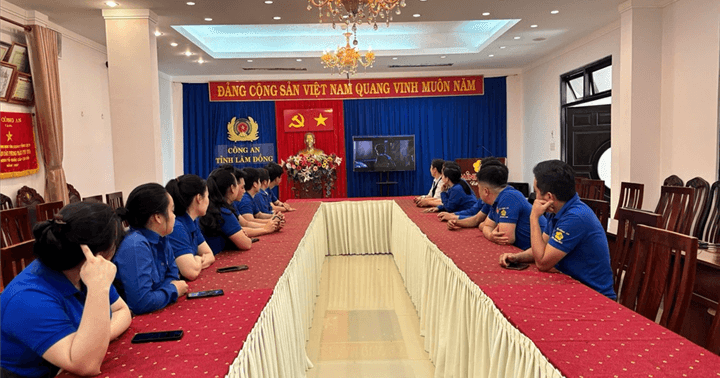
The Staff Department of the Lam Dong Provincial Police organized cryptography training for police officers from various units and localities.
Maintain seamless communication in all situations.
Lam Dong province has a large geographical area, with many mountainous and plateau regions, and significant distances between units and areas. Therefore, maintaining stable communication is always a crucial requirement for command and control.
The Telecommunications and Cryptography Force regularly organizes on-duty shifts, operates and inspects the system, promptly handles emerging situations, and ensures that information serving the direction of the Ministry of Public Security , the Provincial Police Directorate, and the leaders of various units is transmitted quickly, accurately, and securely.
Along with that, the Provincial Police have gradually invested in and upgraded the wireless communication system, providing communication equipment to serve the combat readiness work at units and localities, better meeting the requirements of the work in the new situation.
In addition to serving routine operations, the specialized forces also proactively develop plans to ensure communication for important tasks such as protecting political events, delegations, handling complex security and order situations, as well as serving in disaster response, flood and landslide relief, and rescue operations.

Officers and soldiers inspect and maintain the transmission network system, contributing to ensuring that communication remains uninterrupted and secure.
Alongside the wireless communication system, the transmission infrastructure and internal communication systems continue to be strengthened, upgraded, and expanded to meet practical requirements. This gradually enhances connectivity between the Provincial Police and other units and localities, effectively serving command, control, and information exchange throughout the entire force.

Officers and soldiers inspect walkie-talkie equipment, ensuring communication for the mission of protecting the event and the delegations.
Information security from the provincial level down to the grassroots level.
If telecommunications is the "conductor" of information, then cryptography plays a particularly important role in ensuring the safety and security of information within the scope of protection.
Cryptographic work is directly linked to the task of protecting state secrets, ensuring that important information and documents are transmitted and received through specialized systems and that security solutions are applied in accordance with regulations.
Along with the digital transformation process within the police force, specialized information and cryptographic infrastructure continues to be strengthened and expanded to the grassroots level, contributing to enhancing information security capabilities to serve command, control, and mission execution.
Through training and professional guidance, cryptography officers at various units and localities have gradually improved their awareness and skills in using equipment, strictly adhering to regulations on protecting state secrets and ensuring information security.
Proactively prevent information security risks.
The rapid development of information technology, artificial intelligence, and cyberspace is opening up many opportunities but also posing new demands on information security.
In response to this need, the Lam Dong Provincial Police Department has focused on shifting from incident response to proactive prevention from an early stage and from a distance; regularly monitoring and supervising the operation of information systems, promptly detecting and handling potential risks that could affect information security.
The task force is also strengthening coordination with professional units inside and outside the Provincial Police to inspect, evaluate, and address shortcomings and limitations; contributing to the protection of important information and data systems serving police work.
In the coming period, the Provincial Police will continue to focus on disseminating and thoroughly explaining regulations on telecommunications, cryptography, protection of state secrets, and information security to officers and soldiers; effectively utilize existing equipment; strengthen training and professional development of human resources; and gradually invest in and improve technical infrastructure in a synchronized, modern, and secure manner.
Along with improving technical capabilities, the human factor continues to be recognized as playing a crucial role. Every officer and soldier must enhance their sense of responsibility in using information systems, communication equipment, and protecting data; strictly adhere to security regulations, and avoid any negligence that could affect information security during the performance of their duties.
The Telecommunications and Cryptography force may not always be on the front lines, but behind every timely command, every stable operating system, and every secure information flow lies the constant, silent effort of technical personnel.
Maintaining smooth and secure information flow contributes to the continuous command and control of the entire force, creating a foundation for the Lam Dong Provincial Police to effectively carry out its nhiệm vụ of ensuring security and order and serving the people.
Staff Office


 Công an tỉnh Lâm Đồng