In the spirit of Resolution 80-NQ/TW and Resolution 26-NQ/TW, the people are both the subjects and the center of cultural innovation, participating in and benefiting from it.
The community preserves indigenous values and creates culture.

Wrapping banh tet (Vietnamese sticky rice cakes) in the days leading up to Tet (Lunar New Year) at Long Son Grand House - Photo: NGO VIET PHUOC
In Thieng Lieng hamlet, Thanh An commune (Ho Chi Minh City), households are jointly operating a community tourism model based on the "three no's" principle: no air pollution, no bus station, and no social vices. The locals regulate the number of visitors through a fair rotation system among the households.
They directly guide tourists to experience the process of raking salt in the fields, relaxing their feet in natural herbal baths, and enjoying simple folk music performances on the verandas of their homes.
Similarly, the Dao Ong Tran community at Long Son Grand House in Long Son commune (formerly Ba Ria - Vung Tau ) still preserves its traditional religious practices with black ao ba ba (traditional Vietnamese blouse), barefoot, neatly tied hair, and always willingly offers free vegetarian meals to visitors with natural hospitality.
Not far from there, the ancient fishing village of Phuoc Hai (Phuoc Hai commune), with a history of over 300 years, still maintains its daily life, isolated from the hustle and bustle of the city, with a lively fish market at 5:30 a.m. every day.
Tourism linked to ethnic cultures and religions also creates a noteworthy unique feature. Ho Chi Minh City is currently home to almost all 54 ethnic groups, with the largest populations being the Hoa, Khmer, Cham, and Cho Ro people.
This area is also home to 13 religions with over 2.8 million followers. This valuable endogenous resource is driving the development of cultural and religious tourism focusing on specific ethnic groups and beliefs.
Over the past year, the ecosystem of 15 mosques, 5 smaller mosques, and 7 Islamic community gathering points, along with the unique cultural heritage of this community, has successfully appealed to the exploratory interests of tourists from Indonesia, Malaysia , India, and the Middle East visiting Ho Chi Minh City, a rapidly growing segment of Halal tourists.
Many cultural tourism products in Ho Chi Minh City stand out with their unique identity, stemming from the initiatives of the community itself, those who are preserving the distinctive "local" essence of cultural life.
Empowering and genuinely benefiting from culture and tourism.
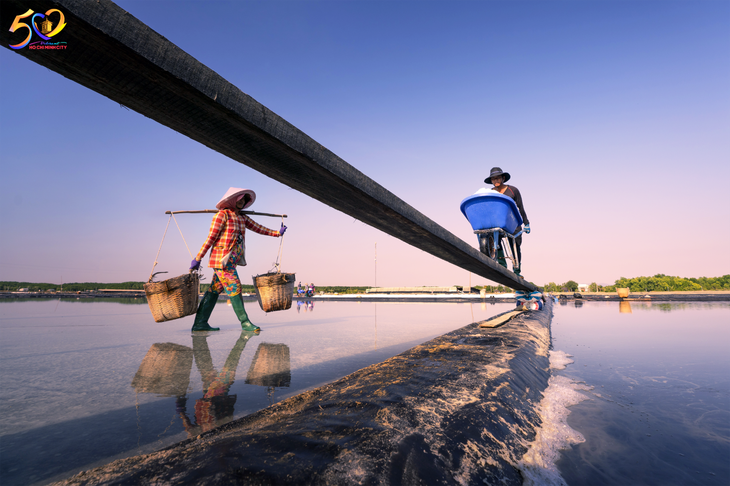
Thiềng Liềng hamlet, Thạnh An commune (Cần Giờ district) - Photo: CAO KỲ NHÂN
Despite positive results, the practical operation within a megacity also presents numerous complex challenges. The consolidation process lacks clear direction, and the booming trend of cultural tourism development could lead to fragmentation in governance and inequality in the sharing of economic benefits.
The community must genuinely benefit, not merely become a service provider or backdrop for tourism. The exploitation of cultural assets must go hand in hand with the protection of intellectual property rights, respect for community knowledge, and ensuring a fair sharing of benefits.
Without mechanisms to protect the rights of the community, tourism may generate short-term growth but at the same time erode the very cultural values that form the foundation of the destination.
To avoid a situation where local communities are merely suppliers, but rather co-owners of cultural products, Dr. Daisy Kanagasapapathy (RMIT University Vietnam) proposes solutions such as: Establishing community cultural councils where craft villages, temple and festival management boards, and heritage keepers can decide for themselves what can be displayed, commercialized, filmed, or kept private.
Rituals and festivals also need to be clearly separated between sacred spaces owned by the community – where visitors participate as guests respecting the local culture – and theatrical programs designed specifically for tourists, so as not to compromise authenticity.
For local products, there needs to be a certification label guaranteeing authenticity, along with a minimum price, to recognize artisans and prevent mass imitation. In addition, there must be a mechanism to protect local intellectual property rights by prioritizing local operators and requiring external investments to commit to a minimum percentage of local procurement and labor.
Revenue must be shared transparently according to a fixed ratio back to the craft village or heritage preservation group, with a portion allocated to skill transmission and restoration.
Finally, heritage maps are created using records compiled by the local people themselves, and guided by local guides who provide direct explanations, so that the cultural story truly originates from the community.
Leveraging institutional frameworks to elevate the city to the status of a Festival and Events City.

Banh mi (Vietnamese sandwiches) attracted more visitors to the Cho Lon Food Story 2024 event thanks to their Chinese-inspired stall design and tempting trays of steamed dumplings and grilled pate - Photo: TO CUONG
To integrate the cultural industry value chain with the tourism economy and the night-time economy, Resolution 80-NQ/TW, Resolution 26-NQ/TW, the Law on Urban Development, and the draft Law on Cultural Industry Development are creating key institutional levers.
Ho Chi Minh City has been empowered to implement mechanisms for mobilizing social resources, exploiting public assets, promoting public-private partnerships (PPP), and controlled testing mechanisms (sandbox)... After one year of merger, 8 key projects with a total investment of 253,033 billion VND have been started, most notably the Can Gio - Vung Tau sea route, estimated at 93,159 billion VND, and the Ben Nha Rong - Khanh Hoi Cultural Park, estimated at 29,317 billion VND, creating a strategic infrastructure link connecting culture and tourism.
By utilizing the institutional framework, Ho Chi Minh City can transform the functions of industrial buildings, factories, warehouses, and ports that are no longer in use efficiently into creative spaces, museums, or cultural and tourism complexes.
Located at the intersection of cultural industries and tourism is a series of large-scale festivals and events throughout the four seasons, such as the Southern Fruit Festival, the River Festival, the Bread Festival, the Ao Dai Festival, the Ho Chi Minh City International Tourism Fair, the Ho Chi Minh City International Marathon, the HOZO International Music Festival, the HIFF International Film Festival, the Cholon Food Story Festival, and many more.
Events and festivals have been expanded in the new post-merger space: Nguyen Hue Flower Street for Tet Binh Ngo 2026 will be held simultaneously in Saigon Ward, Thu Dau Mot and Vung Tau; Nghinh Ong Festival will be elevated to a series of inter-regional events from Can Gio to Thang Tam Temple; Ho Chi Minh City Tourism Week will cover all 168 wards, communes and special zones.
Ho Chi Minh City's position was affirmed when the World Travel Awards honored it as "Asia's Leading Festival and Events Destination" for five consecutive years (2022-2026).
In line with Resolution 59-NQ/TW on international integration in the new context, developing the cultural industry in conjunction with tourism through festivals has become a "soft diplomacy" channel, enhancing Ho Chi Minh City's soft power and brand on the international stage.
HUYNH THINH - UYEN BUI