A Vinhomes project in Hanoi - Photo: VHM
Global financial markets are under pressure as US stocks plummet, with technology and semiconductor stocks experiencing sharp declines across the board. Domestically, the stock market is showing cautious activity, while several noteworthy pieces of information regarding real estate and large-cap stock transactions are being released.
US stocks fell sharply.
- US stocks fell sharply, with the Nasdaq Composite losing 2.49% to 24,509.76 points. The S&P 500 dropped 1.92% to 7,416.59 points. The Dow Jones lost 1.41% to 51,608.17 points.
Nvidia shares fell 4.1%, triggering a sell-off across the semiconductor sector. The Philadelphia Semiconductor Index dropped 5.3%. Intel and Micron both lost more than 7%. According to Reuters , investors are concerned about overvaluation of AI stocks, a slowdown in data center construction, and uncertainties following CEO Jensen Huang's resignation.
The market is cautiously monitoring new US regulations restricting China's access to advanced AI chips. Nvidia's earnings report, expected on November 17th, has become a focal point of attention this week.
- World oil prices fell on November 16th. Brent crude for the nearest delivery month closed at $92.44 per barrel, down $3.40, or 3.6%. US WTI crude fell $2.84, or 3.2%, to $85.72 per barrel.
According to Reuters , the biggest factor currently putting pressure on the market is the prospect of global supply exceeding demand. The International Energy Agency (IEA) forecasts oil supply in the fourth quarter of 2026 to average 105 million barrels per day, exceeding demand by approximately 1.7 million barrels per day. This forecast reverses previous predictions of a supply shortage.
Weak demand in China is also contributing to the price drop. Meanwhile, the country's crude oil inventories are estimated to have increased by approximately 492,000 barrels per day.
Goldman Sachs forecasts the average Brent price in 2027 to be around $88 per barrel, and it could fall to $78 by December 2027.
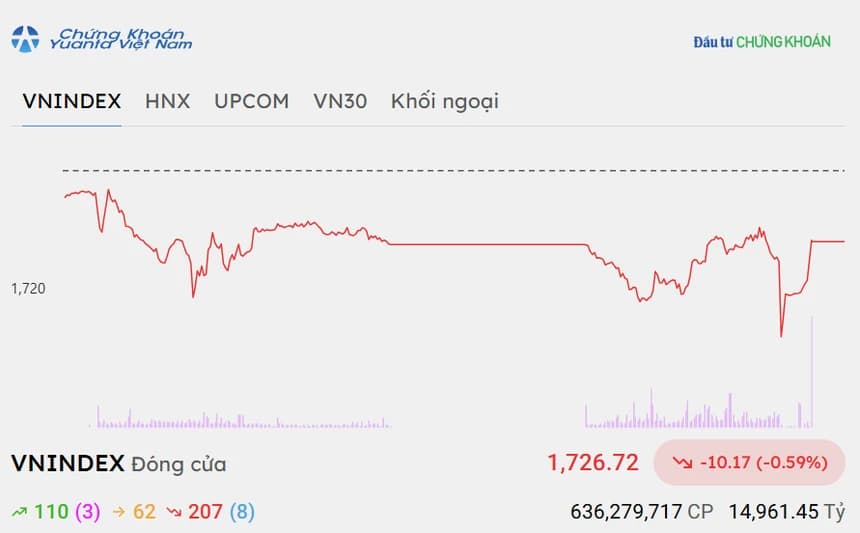
- Domestically, Vietnamese stocks closed the November 16th session with mixed results. The VN-Index surged in the early minutes of the session but quickly weakened towards the end. Investor sentiment remained cautious and lacked the momentum to sustain the upward trend.
The VN-Index edged up 1.96 points (+0.11%) to 1,736.89 points, with strong divergence among stock groups and red dominating the trading screen.
What's the domestic news like?
- The Hanoi People's Committee has approved the investment plan for the Binh Minh - Tam Hung multi-purpose urban area, with Vinhomes as the investor. The project covers an area of approximately 598 hectares, with a total estimated capital of 111,137 billion VND, of which approximately 94,466 billion VND is borrowed capital. The project is expected to include 6,747 resettlement plots, over 2 million m² of commercial apartment floor space, and nearly 1.32 million m² of social housing floor space, meeting the housing needs of over 105,000 people.
- The Dragon Capital-related fund group purchased 1.38 million TCH shares of Hoang Huy Financial Services Investment Joint Stock Company. This group increased its ownership stake from 4.9% to over 5%, returning to being a major shareholder of TCH. Specifically, Hanoi Investments Holdings bought 900,000 shares, Norges Bank bought 600,000 shares, and Samsung Vietnam Securities Master Investment Trust sold 120,000 shares.
- Ms. Bui Cao Ngoc Quynh, sister of Novaland Chairman Bui Cao Nhat Quan, purchased over 27.7 million NVL shares out of the registered 30 million shares. After the transaction, Ms. Quynh increased her ownership to over 36 million shares, equivalent to nearly 1.5% of the charter capital.
Conversely, earlier, Mr. Duong Van Bac - General Director of Novaland - sold more than 10.6 million shares. The two Deputy General Directors, Mr. Cao Tran Duy Nam and Ms. Tran Thi Thanh Van, sold a total of nearly 12.9 million shares.
Ms. Cao Thi Ngoc Suong, mother of Mr. Bui Cao Nhat Quan, also sold nearly 5.94 million shares. These transactions took place while Novaland was offering nearly 801 million shares to existing shareholders, expected to raise more than 8,000 billion VND.