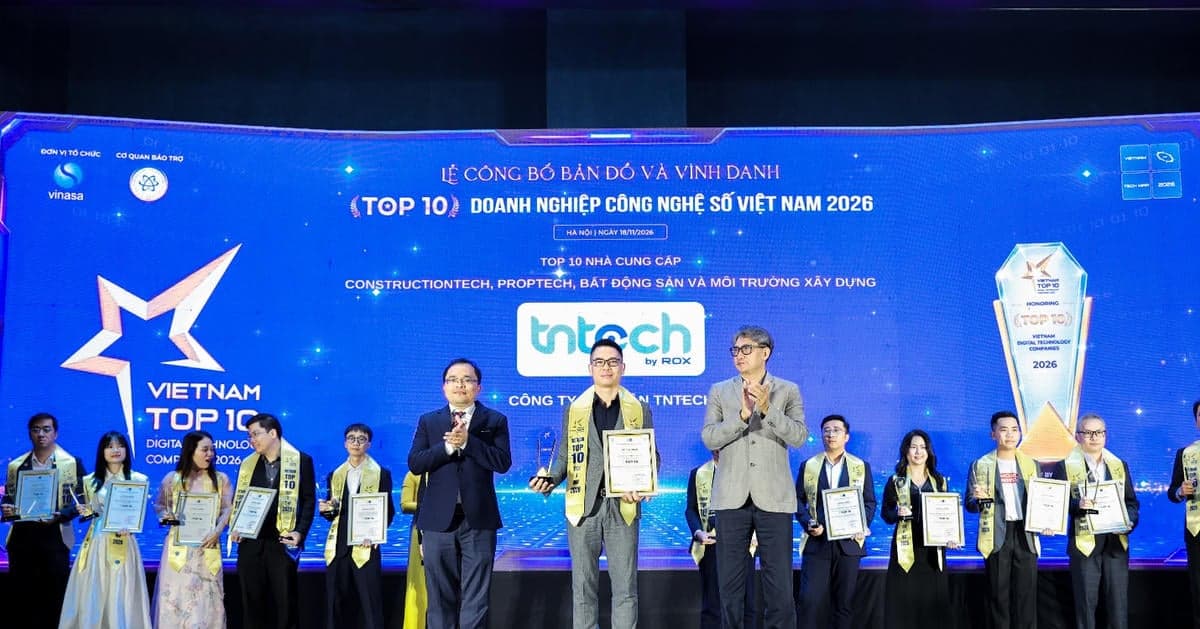
Under the patronage of the Ministry of Science and Technology (MOST), on the evening of November 18, 2026, within the framework of the Vietnam Artificial Intelligence Forum - AI360 2026, the Vietnam Software and Information Technology Services Association (VINASA) organized the Announcement Ceremony and Awarding of the Top 10 Vietnamese Digital Technology Enterprises of 2026.

According to the organizers, this year's selection program was implemented across 30 fields, including 15 technology fields and 15 application fields. 230 businesses registered accounts, of which 71 participated in the selection process with over 100 applications.
The Vietnam Digital Technology Business Map 2026 comprises 11 sectors with 108 business locations.
According to Mr. Nguyen Van Khoa, Chairman of VINASA, for businesses, the Map helps identify their position, determine their strengths, and guide investment, while also serving as an assessed profile of their capabilities. For customers – businesses and government agencies – the Map helps find suitable suppliers and reduces selection risks. For international partners and investors, the Map becomes a reliable gateway to access Vietnamese digital technology businesses.
The map is built using the TechMap methodology, based on the Gartner Magic Quadrant model, to identify business capabilities, assist customers and investors in finding suitable partners, and provide data for management and policy planning.
Notably, starting in 2026, VINASA will implement a mechanism for receiving applications, verifying, and updating businesses on the Top 10 Map throughout the year, instead of only organizing it in annual campaigns. The online map at https://top10ict.com will be open for customers, partners, and investors to access year-round. In addition, the Top 10 publication will continue to be presented at domestic and international events and sent to partner agencies and organizations.
Three key shifts in the transformation of Vietnamese digital technology businesses.
From over 100 business applications submitted for evaluation and selection, the organizing committee and the expert panel have drawn three noteworthy conclusions about the transformation of Vietnam's digital technology businesses.
Firstly , Vietnam is moving up to higher value-added stages in the global value chain, proactively integrating AI into practical operations. From a foundation in software outsourcing and electronic assembly, Vietnamese technology companies are gradually taking on more complex tasks such as participating in requirements definition, being responsible for individual modules, designing integrated circuits, and building and operating systems for international clients.
Notably, AI is the field with the highest number of entries this year, and also the field with the most business locations on the Map, with 19 locations. AI has been implemented in specific tasks such as detecting errors on production lines or shortening processing times.
Secondly , gradually mastering strategic products and technologies is crucial. According to experts, the most valuable step forward lies not only in production volume but also in empowering businesses to design, take responsibility for quality, and have the right to exploit the product.
At the national level, notable achievements have emerged, such as Viettel training a Vietnamese AI model with 120 billion parameters;and FPT putting its chip testing factory into trial operation. In this year's Top 10, many businesses also demonstrate a shift from project implementation to owning products capable of serving large-scale needs.
Typically, MoMo currently serves over 30 million users, connecting more than 500,000 businesses and small traders with over 70 banks and financial institutions. Meanwhile, Proton has developed the Javis AI-powered conversational banking platform, serving over 20 million users.
Thirdly , focus on solving practical problems in Vietnam. The domestic market is becoming a crucial environment for testing the capabilities of digital technology businesses, with three major sources of demand: infrastructure investment, the digital transformation needs of the public sector, and the demand for increased business productivity.
In this year's Top 10 Vietnamese digital technology companies, digital solutions for the public sector and economic industries have the largest number of businesses. Next is the system integration and enterprise technology deployment sector, which also has the second-highest number of businesses on the map, with 16 positions.
Many businesses have been providing direct solutions to essential sectors of the economy. Among them, SAVIS was honored as one of the Top 10 in the field of building digital government platforms, one-stop public service portals, and electronic authentication services. Meey Land develops a data ecosystem for the real estate market, focusing on planning, verification, and valuation using AI.
EVNICT is building digital management and operation systems for the power industry; CTIN is deploying solutions for telecommunications, government, businesses, and digital finance, with revenue increasing by 134% in 2025.

Top 10 Digital Technology Companies: Titles Come with Responsibility
Speaking at the ceremony, VINASA Chairman Nguyen Van Khoa emphasized: “ The Top 10 title is a recognition, but first and foremost, it is a public commitment .” This commitment reflects our responsibility to customers in maintaining the proven quality of our products, protecting data, ensuring transparency, and managing risks in accordance with the AI Law.
For the industry, businesses need to play a role in shaping standards, expanding supply chains for small and medium-sized enterprises (SMEs) and startups, and collaborating with research institutes and universities in training AI engineers. For the country, that responsibility is demonstrated through substantial investment in research, mastering core technologies and data, and creating "Make in Vietnam" AI products.
Setting high expectations for the capabilities and responsibilities of the digital technology business community, Mr. Nguyen Van Khoa emphasized: " The top ten AI brands in Vietnam by 2030 must come from this very hall ."
However, to realize that goal, in addition to the self-efforts of businesses, strong support mechanisms and policies are needed to facilitate research, development, product commercialization, and market expansion. Based on this, VINASA proposes four key solutions to promote science, technology, and innovation within the business community.
Firstly , expand the domestic market for Vietnamese science and technology products. VINASA proposes promoting the commissioning of science and technology tasks and digital transformation solutions, with acceptance criteria based on results; increasing the outsourcing of technology services and prioritizing the use of products and solutions from Vietnamese enterprises when they meet requirements, possibly referencing the Digital Technology Enterprise Map.
Secondly , new institutions need to be put into practice as soon as possible. There is a need for clear and consistent implementation guidelines for the Law on Science and Technology and Innovation, the Law on Digital Technology Industry, and the Law on AI. At the same time, mechanisms for controlled testing and risk acceptance in research and innovation should be expanded, and reasonable compliance costs for small and medium-sized enterprises (SMEs) and startups should be ensured.
Thirdly , unlock resources for strategic research, development, and technology. VINASA proposes creating conditions for businesses to access science and technology development funds, venture capital funds, and tax incentives for research and development (R&D) activities linked to actual results and products. Along with that, it is necessary to simplify intellectual property procedures and strengthen linkages between research institutes, universities, and businesses to quickly translate research results into products.
Fourth , accompanying the bringing of Vietnamese technology to the international market. According to VINASA, trade promotion and economic diplomacy activities should be linked to supporting businesses whose capabilities have been assessed and verified in accessing international markets and partners.
Alongside its recommendations on mechanisms and policies, VINASA is committed to continuously maintaining, updating, and enriching its mapping data year-round, creating a reliable reference source for management agencies; supporting its members in the implementation of new laws; and connecting Vietnamese businesses with domestic and international customers and partners.
The digital business roadmap needs to become a tool for identifying technological capabilities.
Speaking at the announcement ceremony, Deputy Minister of Science and Technology Pham Duc Long acknowledged VINASA's efforts in honoring and connecting the digital technology business community.
The Deputy Minister emphasized that the value of the map lies not only in showcasing leading businesses, but more importantly in identifying Vietnam's digital technology capabilities. This will serve as a basis for analysis, evaluation, and future steps.
“ For the Ministry of Science and Technology , we highly appreciate this Map. This is a valuable reference tool for the Ministry in formulating policies to develop the digital technology industry, identifying the capabilities of businesses, and determining the areas that the Ministry needs to prioritize and promote… ” , Deputy Minister Pham Duc Long stated.
Deputy Minister Pham Duc Long requested VINASA to regularly update and verify data so that ministries, sectors, and localities can utilize it to find partners that meet their actual needs.
For the technology business community, the Deputy Minister requested a change in approach, focusing on solving real-world customer problems instead of just introducing ready-made products; gradually mastering technology and collaborating to form an ecosystem.
The Ministry of Science and Technology is committed to accompanying and supporting businesses in connecting with the needs of ministries, sectors, and localities. According to the Deputy Minister, the contributions of businesses should be evaluated through the practical problems they have solved and their capacity to master technology.