
An answer to a question
On October 31, 1946, at the second session of the first National Assembly, for the first time, members of the Government of the Democratic Republic of Vietnam stood before the people's representatives to answer questions. The questioning session lasted until late at night. On behalf of the Ministry of Interior , Minister Huynh Thuc Khang stated: "The country has overcome many difficulties, that is the merit of President Ho Chi Minh. But there are some unpleasant things happening in the country, that is my responsibility!"

Portrait of Mr. Huynh Thuc Khang (1876 - 1947). Archival photo. Source: National Museum of History (baotanglichsu.vn).
The person who said that was 70 years old at the time, having just handed over the presidency after 143 days of serving in place of President Ho Chi Minh . He didn't boast about his achievements. He attributed the credit to President Ho Chi Minh and acknowledged the shortcomings of his own ministry.
October 31, 2026 marks the 80th anniversary of that first interpellation session. Since then, interpellation has become a regular oversight activity of the National Assembly at each session. Mr. Huynh's answer remains a benchmark for the conduct of someone standing before the parliamentary chamber.
That statement wasn't an impromptu remark. It was the culmination of 12 years of reflection on how a representative body of the people should function.
First Assembly: Central Annam House of Representatives
In 1926, five years after his release from Con Dao prison, Mr. Huynh Thuc Khang was elected a representative to Central Vietnam and later appointed President of the Central Vietnam Assembly. The propaganda outline commemorating the 150th anniversary of his birth, issued by the Central Propaganda Department and accompanied by Guidance No. 06-HD/BTGTW dated September 8, 2026, clearly states: " He used the parliamentary chamber as a public forum to raise the people's concerns and demand that the colonial government change its policies ."
The demands put forward by him and other progressive representatives went far beyond the framework of the protectorate regime. Regarding constitutional matters, according to the draft, he "proposed the separation of powers between the legislative, executive, and judicial branches; expanding the powers of the House of Representatives; granting voting rights to taxpayers; and establishing a Senate and a House of Representatives." Regarding people's welfare, according to the National Historical Museum, the representatives demanded a reduction in head and land taxes, the opening of more schools and irrigation projects, and the abolition of salt and alcohol monopolies.
Table: Two parliamentary chambers of Mr. Huynh Thuc Khang

Source: Propaganda outline accompanying Guidance 06-HD/BTGTW; National Historical Museum; Vietnam Republic Official Gazette, 1946.
He resigned from the position of Director on October 2, 1928.
Two years as President of the Institute were enough for Mr. Huynh to clearly see the true nature of that institution. In his autobiography, Huynh Thuc Khang wrote: " In 1928... But after two annual General Assemblies, I clearly saw its true nature; it was called the People's Representatives but in reality... it had no meaning. In October of that year, I gave a closing speech, harshly criticizing the policies of the French Government implemented in Central Vietnam, considering them inappropriate and causing further resentment among the people, thus forcing reforms ." ( Huynh Thuc Khang's autobiography, quoted from the National Historical Museum )
At the annual session on October 2, 1928, he criticized the policies of the colonial government and announced his resignation. According to the National Historical Museum, this led to the defection of a number of progressive representatives, which the Indochina Times newspaper on October 18, 1928, assessed as "stirring up public opinion in the West and South throughout Indochina."
The lesson from the first parliamentary session is clear. He did not consider the position of Speaker of the House of Representatives as a title. He did not want to remain in an institution that claimed to represent the people but failed to protect their rights, merely as a decorative figure. The Central Propaganda Department's summary stated: " Recognizing the limitations of the House of Representatives and the interference of the colonial government, he resigned in 1928. Huynh Thuc Khang's parliamentary activities demonstrated a spirit of open, frank struggle and a conscious commitment to protecting the people's rights ."
Leaving the National Assembly, he shifted his voice to the newspaper Tiếng Dân (Voice of the People). On September 14, 1936, he published in Tiếng Dân a letter responding to the Standing Committee of the People's Petitions of Central Vietnam, outlining demands regarding the political system, civil rights, elections, the Senate, the House of Representatives, education, healthcare, the press, farmers, labor, finance, and the economy . The outline stated: " If the House of Representatives was where he publicly questioned and demanded that the authorities change policies, then Tiếng Dân is a forum to reflect life and denounce injustice ."
Second Parliament: First National Assembly
Eighteen years after leaving the House of Representatives, Mr. Huynh entered a fundamentally different parliamentary arena: the National Assembly of independent Vietnam, elected by the entire population in the general election of January 6, 1946.
On March 2, 1946, at the first session of the First National Assembly, the National Assembly accepted the resignation of the Provisional Coalition Government and entrusted President Ho Chi Minh with the task of forming a resistance coalition government. When introducing the government's members, President Ho Chi Minh introduced Mr. Huynh Thuc Khang as Minister of the Interior, praising him as "a man of high moral character and reputation known to the entire nation."
The propaganda outline analyzed the significance of that choice: " He was not a communist party member, but a veteran patriotic intellectual with widespread prestige among the people, intellectuals, and many social strata. His participation demonstrated the revolutionary government's policy of national unity, valuing talent, and gathering all patriotic forces ."
The man who once demanded that colonial governments have a constitution, that powers be separated, and that the people be allowed to elect their own people, now sits in the government, accountable to a parliament elected by the people. The aspirations of the first parliament have become a reality in the second.
The Acting Chairman seeks the opinion of the National Assembly.
On May 29, 1946, President Ho Chi Minh signed Decree No. 82, authorizing Minister of Interior Huynh Thuc Khang to sign daily official documents and preside over Government Council meetings while he was in France. From May 31 to October 21, 1946, Mr. Huynh held the position of President of the Republic.
The Official Gazette of the Republic of Vietnam, during those 143 days, recorded a consistent working style. Important decrees signed on behalf of the President all included a sentence before the "Issuing the Decree" section, such as "after agreement by the Standing Committee of the National Assembly and the Government Council" or "after consultation with the Standing Committee of the National Assembly." This sentence appeared in the decree establishing special guarantees targeting the transportation sector on July 9th, the decree allowing the South to issue government bonds on July 16th, the decree allowing tax payments in Vietnamese banknotes and gold and silver on September 4th, the decree adjusting import taxes on September 24th, and the decree regulating the trade of gold and silver on October 15th, 1946.
Those were decisions that affected people's pockets. He didn't make them alone. The person holding the highest authority in the State while the President was away placed himself under the supervision of the body representing the people.
On October 23, 1946, two days after returning to the country, in his Declaration to the Nation, President Ho Chi Minh noted: " While I was away, thanks to the wise leadership of Acting President Huynh, the care and assistance of the National Assembly, the diligent efforts of the Government, and the unity and cooperation of the people, many difficult issues were resolved ." The President placed President Huynh and the National Assembly side by side in the same statement of recognition.
Just eight days after receiving that recognition, he stood before the National Assembly in his first questioning session and took responsibility for "unpleasant matters." He yielded the recognition from President Ho Chi Minh to President Ho Chi Minh, while he kept the responsibility for himself.
Lessons for those standing before the parliament today.
Mr. Huynh's life left a lesson for cadres: "One must have firm convictions, dare to defend what is right, and not compromise with what is wrong"; his attitude of "saying what is right and what is wrong" is close to the requirement for cadres and party members today: "using the satisfaction and interests of the people as the measure of work effectiveness."

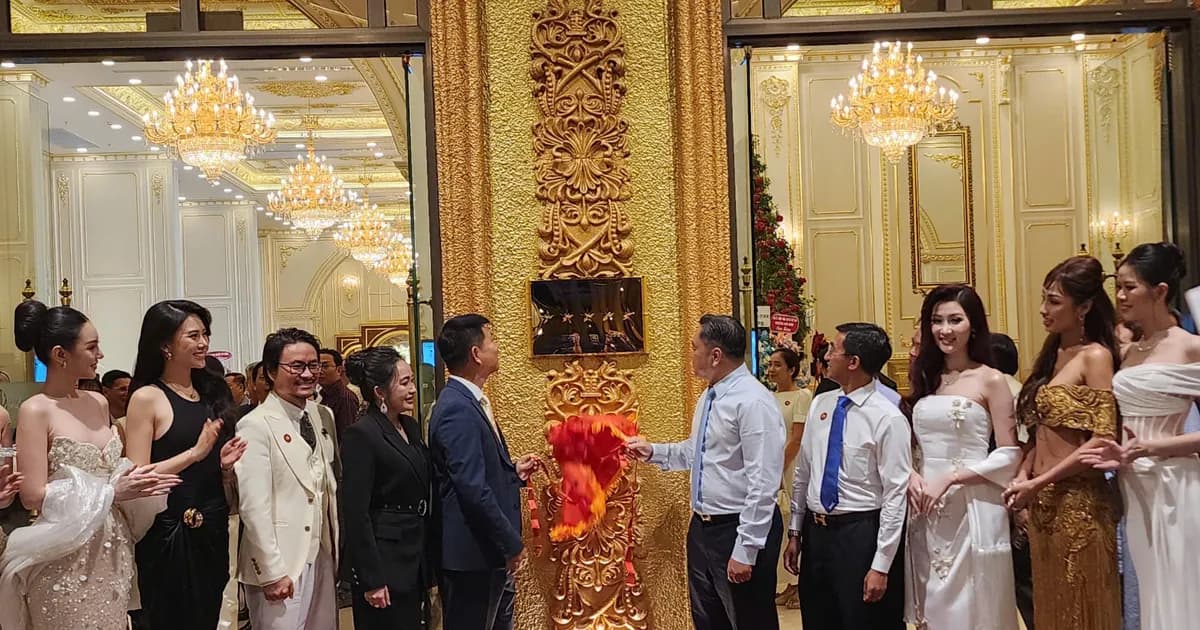
The postage stamp issuance ceremony commemorating the 150th anniversary of the birth of Mr. Huynh Thuc Khang took place in Da Nang on September 30, 2026. Source: Thanh Nien Newspaper
Those three lessons were clearly demonstrated in the two parliamentary sessions under Mr. Huynh. In the House of Representatives, he had his own opinions and dared to speak out, even though the opposing side was the colonial government headed by the Resident Commissioner of Central Vietnam. In the First National Assembly, he dared to acknowledge what he had not yet accomplished, even though he had just been recognized by President Ho Chi Minh. In both places, his measure was the interests of the people, not the position he held.
At the ceremony commemorating the 150th anniversary of the birth of Mr. Huynh Thuc Khang on the morning of October 1, 2026, in Da Nang, National Assembly Chairman Tran Thanh Man recalled President Ho Chi Minh's words about him: " Mr. Huynh was a man of vast learning, unwavering determination, and high moral character... Throughout his life, Mr. Huynh only strived for the people's freedom and the nation's independence." The National Assembly Chairman suggested "transforming tradition into motivation, aspirations into action, and potential into resources."
In today's National Assembly, that tradition has a specific purpose. At each session, members of the Government stand before the assembly to answer questions from delegates. The best answer remains the one in the style of Mr. Huynh: frankly stating what has not been done, acknowledging their responsibility, and then suggesting ways to rectify the situation.
Fifty years after the birth of Mr. Huynh Thuc Khang, eighty years after the first interpellation session, his statement, "There are unpleasant things happening in the country, that is my responsibility," remains a guiding principle for all those entrusted with power by the people. He yielded credit to the collective, but took responsibility upon himself. That is the demeanor of a great intellectual who dedicated his life to the nation and its people.
Source: https://congthuong.vn/cu-huynh-thuc-khang-tam-guong-sang-ve-nguoi-dung-dau-bai-1-bai-hoc-trach-nhiem-truoc-quoc-hoi-475518.html