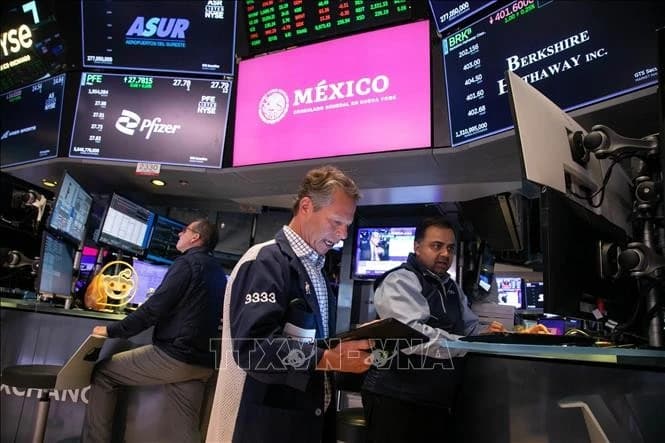
The US stock market surged on November 23rd, recovering from last week's sharp sell-off, as Nvidia's board of directors decided to reinstate Jensen Huang as CEO, fueling a wave of buying into technology and artificial intelligence ( AI ) stocks.
According to the VNA correspondent in the US, at the close of trading, the S&P 500 index rose 5%, the Nasdaq Composite rose 7%, while the Dow Jones Industrial Average increased by 1,344 points, or 2.8%.
The recovery followed a volatile trading week, when concerns about valuations and investment prospects in the AI industry fueled widespread selling pressure across the market.
Nvidia shares surged 31% after the company's board of directors announced the reinstatement of CEO Jensen Huang, effective immediately. This decision contributed to improved investor sentiment toward Nvidia and other AI companies.
US President Donald Trump publicly welcomed the decision. In a message posted on the social media platform Truth Social, he stated that it was the right choice and that Huang's leadership ensured success and prosperity for Nvidia, as well as contributing to the growth of the American economy.
President Trump also asserted that the government had no reason to believe that Huang's return to running the company posed a risk to national security.
Nvidia's rally spilled over into many other technology companies. Micron Technology shares rose 14%, CoreWeave increased 29%, and Advanced Micro Devices (AMD) gained 9%.
Last week, the US stock market came under significant pressure from concerns about valuations and investment prospects in the AI industry. Even Anthropic's initial public offering (IPO) on November 19th, considered a record-breaking event, couldn't prevent the sell-off.
The Nasdaq Composite and Dow Jones recorded their sharpest weekly declines in over six years, while the S&P 500 experienced its worst trading week since April 2025.
By the end of trading on November 20th, all three major indices had fallen at least 10% from their all-time highs, officially entering correction territory. The Nasdaq Composite also moved into its first decline since the beginning of 2026.
During the trading session, the Nasdaq-100 briefly fell 20% from its recent peak, reaching bear market status, although the decline in closing prices did not quite reach that level.
Drew Pettit, investment strategist at Roundhill, commented on CNBC's Closing Bell: Overtime program on November 20th that the widespread sell-off could indicate the market is nearing the end of a downturn.
However, he argued that to solidify the recovery trend, businesses still need to demonstrate that their long-term profit prospects have not weakened, and the market needs more positive factors to support investor sentiment.
In Europe, stock markets also rose in the morning session of November 23. The Stoxx 600 index increased 0.9%; Germany's DAX rose 1%, France's CAC 40 increased 0.8%, and the UK's FTSE 100 increased 0.6%.
Conversely, most Asian stock markets declined. South Korea 's Kospi index fell 3.31% to 4,708.54 points; Australia's S&P/ASX 200 dropped 0.26% to 8,570.6 points, marking its eighth consecutive day of losses.
In Hong Kong, the Hang Seng index fell 0.15%, while China's CSI 300 index remained almost unchanged at 3,958.29 points. The Japanese stock market was closed for a holiday.
The US trading week will be shortened due to the Thanksgiving holiday. The market will close on November 26th, and trading on November 27th will end early at 1 PM (Eastern Time).