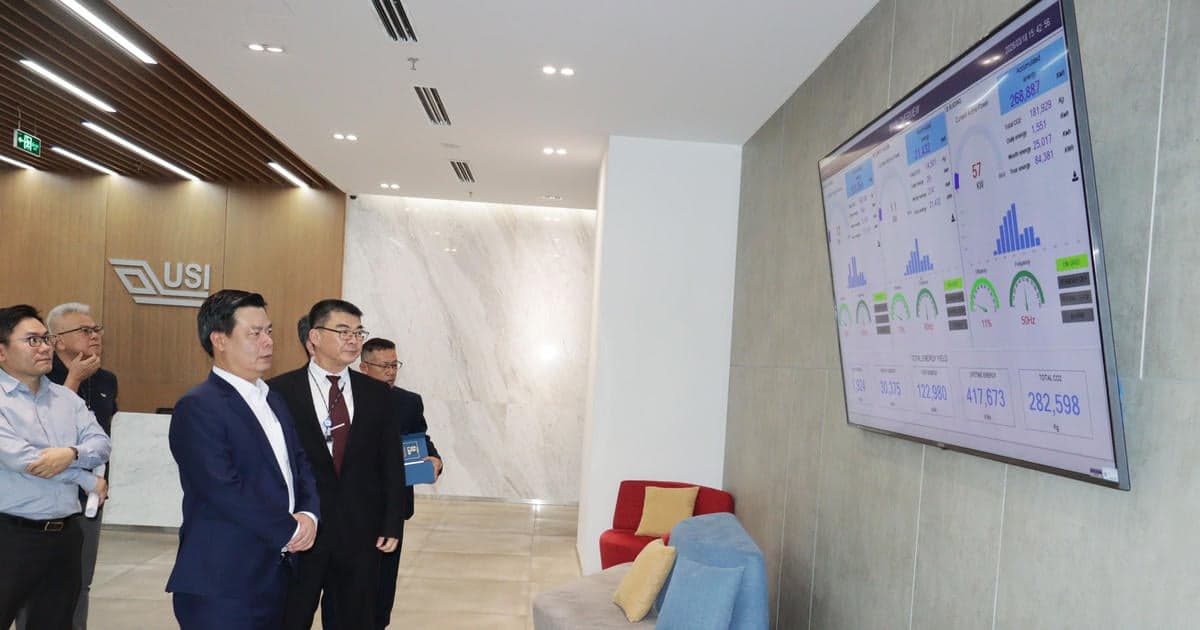
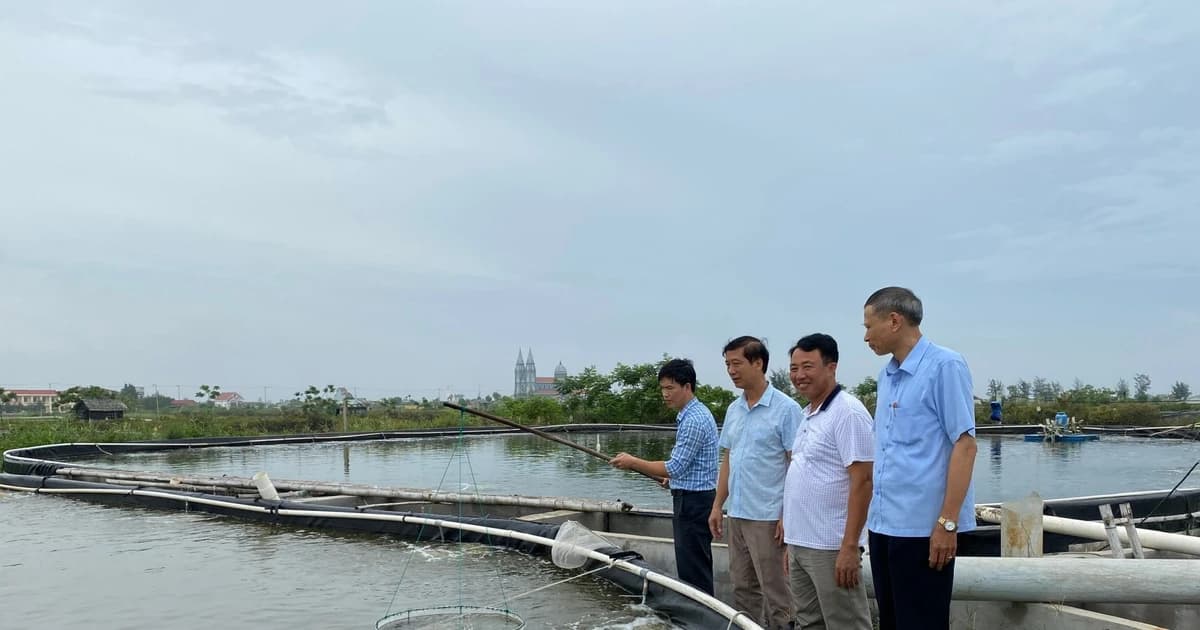
This is part of the project "Building a model of integrated mechanization combined with the use of biological products in low-emission rice production in Vietnam," which recently won first prize at the Vietnam Science and Technology Innovation Award (Vifotec) 2025.
According to experts, Vietnam has approximately 7 million hectares of rice paddy land, which plays a crucial role in ensuring food security and generating export revenue.
However, rice production still faces many limitations such as small-scale production, reliance on manual labor, use of chemical fertilizers and pesticides, and inefficient utilization of post-harvest by-products.
These shortcomings not only increase production costs but also put pressure on the environment, especially through greenhouse gas emissions, air pollution, and soil degradation.
In this context, the Institute of Biotechnology and Environment conducted research and applied the "Model of Synchronized Mechanization Combined with the Use of Biological Products in Low-Emission Rice Production in Vietnam" with an integrated approach of multiple solutions, instead of applying each measure individually, and it has been implemented in many localities.

The goal is to develop an advanced, environmentally friendly rice production model that is scalable and simultaneously improves economic efficiency.
In terms of mechanization, the project has developed a model for applying new technologies such as drones, water level sensors, automatic water control (AWD) systems, and emission monitoring devices in field management, as well as using a variety of biological products at each stage of rice plant growth accurately and effectively.
In addition, the model has utilized agricultural by-products and readily available organic resources such as straw and manure – which are typically discarded by-products after harvesting – to process into organic compost for the production of seedling tray substrates.
To transform agricultural by-products into organic humus, scientists have successfully researched and produced the Fito-Biomix RR biological preparation, applying microbial strains to convert straw into organic fertilizer. Simultaneously, it utilizes nitrogen-fixing and phosphorus-decomposing microorganisms to enhance nutrient absorption by the root system, inhibit fungal and bacterial diseases causing root rot and stem rot.
In particular, the product also supplements trace elements and rare earth elements, effectively increasing the resilience of rice plants under changing climate conditions.
In addition, for the first time, scientists at the Institute of Biotechnology and Environment have produced a multi-purpose bio-product for spraying rice, derived entirely from the wild sunflower plant. This product not only meets the usual standards for nutrition and adhesion but also has the ability to resist diseases in rice.
This product contains a source of naturally occurring amino acids in an easily digestible form, high levels of humic acid and fulvic acid, and high levels of plant growth regulators, providing balanced nutrition for rice plants.
The product also supplements nitrogen from biological sources, allowing plants to absorb and metabolize it quickly, promoting healthy growth and good resistance to unfavorable environmental conditions.
On the other hand, the product does not use chemical preservatives and commonly used solvents such as ethanol, methanol, acetone, etc., but instead uses water and wood vinegar to reduce costs and create a product that is safe for humans and does not pollute the environment.


The Vifotec 2025 Award Council assessed that the synchronized application of mechanization and biological products in rice production has brought many benefits to farmers, from being able to proactively manage production, reducing labor costs, and improving rice yield and quality, with an estimated economic benefit of 25-30 million VND/hectare compared to conventional production.
Specifically, the application of tray seedling technology for machine transplanting in rice production helps reduce seed costs by 20-30% and labor costs by 50%. Rice fields transplanted using tray seedlings grow well, are less susceptible to pests and diseases, and yield a 10-15% increase, contributing to an improvement in economic efficiency for rice farmers of 4-6 million VND/ha.
Calculations show that the model applying synchronized mechanization and biological products is expected to bring many benefits such as reducing labor (from 68-82%), reducing production costs (from 27-32%), increasing rice yield by 15-20%, and improving economic efficiency for farmers compared to traditional rice production models.
The profit earned from the integrated mechanization model combined with the use of biological products is more than 1 billion VND/100ha higher than traditional rice production.
Besides economic benefits, the product also offers environmental advantages, as the Bio-multipurpose bio-product, Fito-rice, helps reduce the amount of chemical fertilizers, limiting the emission of N2O and CH4 - the main greenhouse gases in rice production, with an estimated emission reduction of up to 30%.
Managing rice straw using the Fito-Biomix RR biological product instead of burning it directly reduces CO2 emissions, PM2.5 fine dust, CO, and NOx, which cause air pollution, especially in densely populated areas near residential areas such as Hanoi or areas near airports. The total emission reduction is estimated to be up to 40% compared to untreated straw.
The AWD irrigation model maintains a continuously non-flooded water level, facilitating soil oxygenation, reducing anaerobic microbial activity that produces methane (CH4), and decreasing CH4 emissions by 35% compared to continuous flooding irrigation. This meets the emission reduction requirements of the EU, US, and Japanese rice export markets.
The combined emission reduction measures in rice cultivation implemented in this project are estimated to reduce total emissions by 40%, equivalent to 750 tons of CO2-eq/300ha of rice.

According to experts, this is particularly important given that agriculture contributes a large portion to Vietnam's total greenhouse gas emissions (89,751.8 thousand tons of CO2 equivalent/year, accounting for 27.92%).
Rice cultivation emits 43.79 million tons of CO2 equivalent per year, accounting for 49.35% of the total emissions of the agricultural sector and 15.42% of the total greenhouse gas emissions of the whole country ( Ministry of Natural Resources and Environment , 2018). Although it is a major emitter, agriculture is also considered to have high potential for emission reduction, including rice production.
According to Dr. Le Van Tri, the project leader, the model, when applied locally, has been supported and accepted by local leaders and residents, and has high potential for replication. Therefore, the possibility of replicating the model is very feasible.
However, Dr. Tri believes that the model needs to be implemented synchronously, regionally, along the value chain, and with clear policy support. It is necessary to continue land planning, especially in agricultural areas currently left fallow, while focusing on investing in the production of high-quality rice varieties combined with the synchronized application of mechanization using high-tech machinery and equipment and the application of biological products in cultivation to create a sufficiently large raw material area to serve the production needs of large-capacity rice processing plants.
On the other hand, it is necessary to strengthen coordination with scientific research units nationwide such as the Institute of Agricultural Genetics, the Plant Breeding Research Center, enterprises operating in the field of agricultural science and technology, and enterprises providing high-tech machinery and equipment... to search for and apply new scientific and technical advancements to improve the efficiency of rice production.
According to a World Bank report, agriculture is the second largest emitter of greenhouse gases in Vietnam, accounting for approximately 19% of total emissions in 2020. Rice production and livestock farming contribute the majority of these emissions, with 48% from rice and 15.3% from livestock.